
K-State Q&A: Another way the Wildcats can honor their first Black student-athletes
University president Richard Myers and the Kansas State athletic department have spent lots of time over the past few days unveiling plans that should help combat racism and create a more diverse and inclusive campus in Manhattan.
Those plans were received well enough by K-State football players for them to end their boycott of team activities and resume summer workouts when they start up again on July 13. Things are heading in the right direction. Still, here’s another idea worth considering: Why not honor some of the best and most influential Black athletes in school history by naming athletic buildings after them?
Earl Woods, the famous father of Tiger Woods, was born in Manhattan and played baseball for the Wildcats. He is credited for breaking the color barrier in the old Big Seven conference in the early 1950s. This should be more widely known.
It would be cool to see his name featured somewhere prominently at the K-State baseball stadium. Maybe Tiger Woods would attend the ceremony.
Harold Robinson was the first Black student-athlete at Kansas State University and the first Black student-athlete in the Big Seven to be awarded an athletic scholarship in 1950. He played center for the Wildcats on the gridiron.
There are several unnamed and undedicated areas at Bill Snyder Family Stadium, including the West Stadium Center and the South End Zone Project. Maybe it’s time to name one of those after Robinson.
Veryl Switzer was the first Black student-athlete to graduate from K-State and helped the Wildcats go 6-3-1 long before they were any good at football. Then he went on to star in the NFL. Gene Wilson was the school’s first Black scholarship basketball player.
I could go on and on.
K-State has a rich history of Black athletes and has hired a few Black head coaches. Many of them have been inducted into the school’s Ring of Honor and athletic Hall of Fame. Others have watched their Why not celebrate them even more by placing their names somewhere on campus along with the generous donors that helped pay for the buildings.
Full transparency: this is not an original idea. I have seen it suggested at other schools in the past and am merely mentioning it again here piggy-back style. Credit goes to Bring on the Cats and a few message-board posters for already suggesting K-State consider doing the same this week.
A reader sent me an e-mail wondering if I also thought it was a good idea. Indeed, I do.
I was surprised to learn last month that Jack Trice Stadium at Iowa State is the only major-college football stadium named for a Black man. Sadly, I had no idea who Jack Trice was until I read about him this year in the Ames Tribune.
Now I do. I’m glad I learned about him and Iowa State’s decision to name its stadium after him.
It’s probably time for more schools (not just K-State) to honor some of their former Black players in similar fashion.
With that, let’s dive into your questions. Thanks, as always, for providing them.
Well, there isn’t a single college football team anywhere that is practicing right now.
The only thing permitted at this very moment is “voluntary” workouts with strength coaches. In normal circumstances, players could organize their own seven-on-seven competitions and use those as a form of summer practice. But with the coronavirus pandemic hitting us stronger than ever, that type of group gathering has been discouraged. So the best any team can do right now is run and lift.
K-State is one of the few teams that isn’t doing that in early July. But there are a few others.
Arizona, Houston and Boise State all had to suspend their “voluntary” workouts because of COVID-19 outbreaks within their teams and Oklahoma players didn’t arrive on campus until this week.
There are probably smaller conferences out there that haven’t let their football players report for “voluntary” workouts, either. The Patriot League, which has placed strict restrictions on its teams and essentially canceled some of its nonconference games, comes to mind. The Ivy League is supposed to announce next week whether any of its teams will compete in the fall.
Most power-conference teams are working out together in some form, but K-State is far from the only team that isn’t.
I watched highlights of a Russian soccer game where they had fans spread out because of social-distancing rules ... and, let me tell you, it was weird.
The reduced crowd still generated a decent amount of noise. It was better than no fans like we’ve seen in Germany or cut-out fans like we’ve seen in Korea. But it was definitely weird.
I still think fans will want to go if there are games and they are permitted to attend. But the demand won’t be nearly what it has been under normal circumstances, especially if tailgating is canceled and everyone has to wear a mask.
The bigger issue I see isn’t that fans won’t want to, because there won’t be a packed house. I think they will want to stay home, because of coronavirus fears.
Will there be college football in 2020: I’m starting to have my doubts. If the COVID-19 numbers don’t start trending the right way soon, we may not have any college sports next season.
Even if we we do, teams say they are going to test every single week. I foresee a boatload of positive tests. Unlike pro basketball and baseball, where teams can theoretically contain their players in a coronavirus-free bubble, that’s not going to happen on college campuses.
Hope I’m wrong, but my optimism has turned into pessimism over the past few weeks.
Also: alligators seem to be more of a threat in Manhattan than Murder Hornets.
Has K-State done enough to satisfy the football team’s demands when it comes to racism issues: Yes.
The school is not going to expel Jaden McNeil or create a policy that will give it the power to punish other students for posting racist messages on social media. But those were never practical options, because they violate first-amendment laws.
It seems to me that the university has come up with many other solutions that will ultimately make Manhattan a better campus and reduce incidents of racism.
Everyone in K-State’s athletic department and many academic leaders supported the team’s boycott and worked to create change. Both sides reached a fair compromise and the football team won’t miss a single workout. I would call that a happy ending.
Is it time to honor some of the school’s best and most influential Black athletes: Read my intro again.
The way it was explained to me, K-State football players were given special dri-fit masks to wear during summer workouts when they briefly returned to the weight room last month.
I assume they will continue to wear them now that the Governor has issued a statewide order to wear masks.
I have always been partial to the old Cat Scratch Fever uniforms that were popularized by Bob Huggins, Bill Walker and Michael Beasley.
There is something about the huge shorts (or shants, to be more accurate) and the baggy nature of those bad boys that have always made them stand out in my mind.
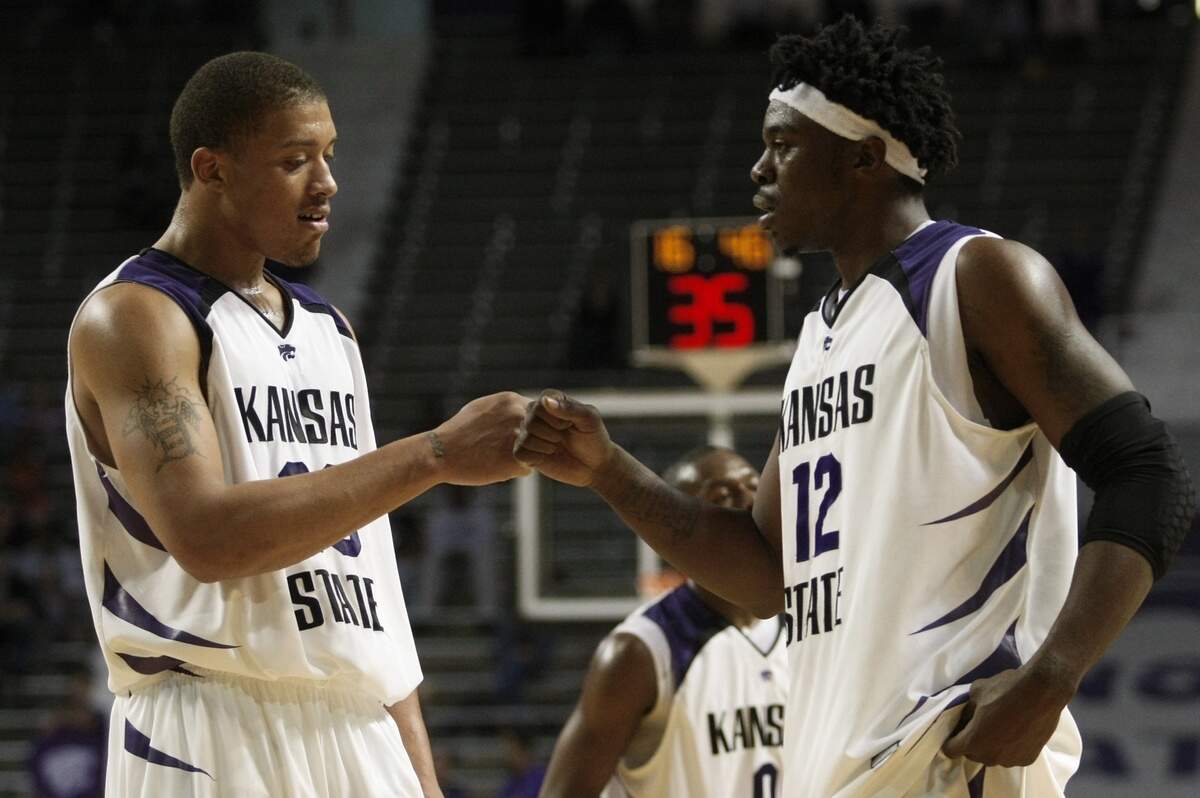
Just look at those beauties!
I wonder how they would look today in a slimmer fit.
Some other good ones: The throwback lavender two-tones, the original road blacks and the old home whites that featured “Wildcats” written in script.
Some of my least favorite are the karate-belt uniforms that Weber’s teams wore a few years ago and the all-lavenders that were unveiled last season. As much as I liked the idea of those, they just don’t very cool on the court.
For basketball: Duke.
For football: The entire Big Ten.
For being super hard to reach: Northern Arizona.
For an annoying fight song: Oklahoma.
For nonsesical traditions: Texas A&M.
For bad press seating: Mississippi State.
For lacking entertainment options: BYU.
Michael Beasley for basketball, because the Wildcats are going to need scoring and rebounding next season and he would provide a lot of both. He also led K-State to the NCAA Tournament with a very young roster, which next year’s team will have.
Jordy Nelson for football, because Skylar Thompson could use a star receiver to target as he finishes up his K-State career.
Nicole Ohlde for women’s hoops. It’s always nice to have a two-time Big 12 player of the year on your roster.
I pulled all 10 Big coaches’ names out of a hat and have decided that, for the purpose of this exercise, each one will be in charge of the following team next season.
Oklahoma - Chris Klieman
Baylor - Neal Brown
Texas - Matt Campbell
Kansas State - Mike Gundy
Iowa State - Lincoln Riley
Oklahoma State - Dave Aranda
West Virginia - Les Miles
TCU - Matt Wells
Texas Tech - Gary Patterson
Kansas - Tom Herman
Oh boy, does that look weird. Out of all those new marriages, I guess I like Matt Campbell and Texas the best. Campbell would benefit from a talent upgrade in Austin and the Longhorns run a similar system to what is already in place at Iowa State.
It’s tempting to pick Oklahoma and Chris Klieman, though. We all saw what Klieman was capable of with a new team last season. He has also has a long history of winning. I’m just not sure the Sooners, built for high-flying offense, would match up with his preference to ground-and-pound.
I would be interested to see what Gary Patterson and his defensive background could do at Texas Tech.
Poor Tom Herman would have his hands full in Lawrence.
This story was originally published July 3, 2020 at 5:00 AM with the headline "K-State Q&A: Another way the Wildcats can honor their first Black student-athletes."