
Erratic play of Marcus Foster at heart of Kansas State’s disappointing basketball season
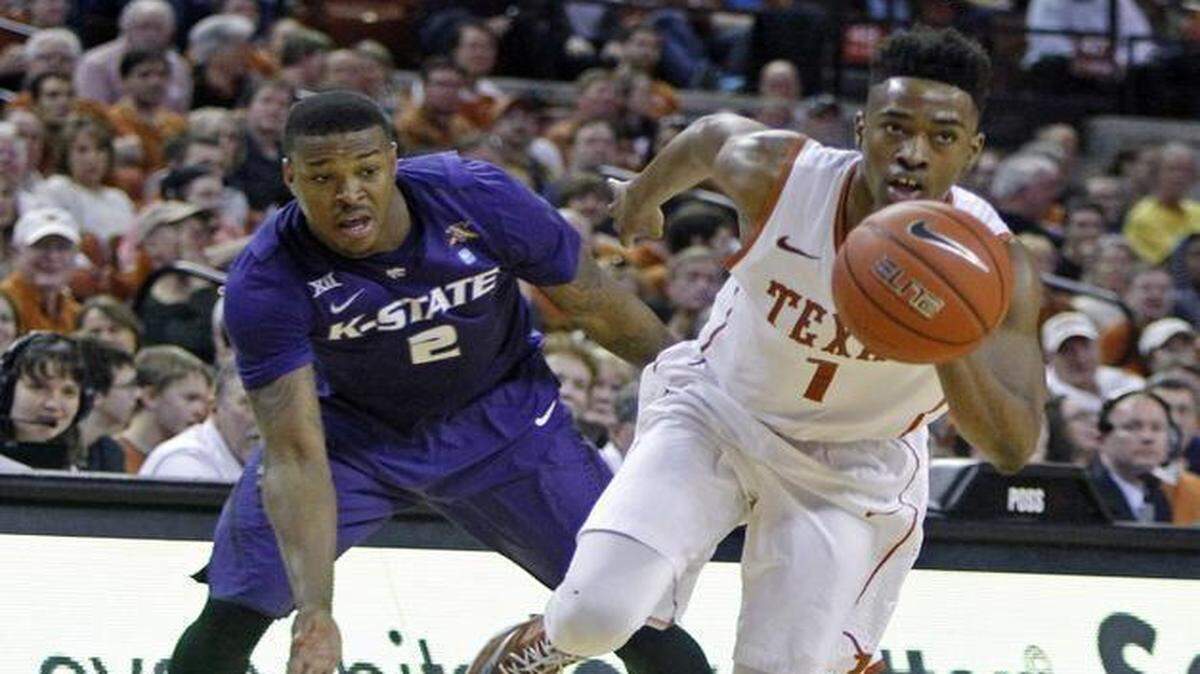
This story begins with Marcus Foster. It has to.
Any analysis of K-State’s tumultuous basketball season, which began with expectations in the clouds and ended with results in the dirt, must center on the team’s most erratic player.
There was abundant blame when K-State finished 15-17, the team’s first losing season since 2003, and Foster endured much of it. So much so, he blamed himself for ending the Wildcats’ run of eight straight 20-win seasons and five straight NCAA Tournaments.
“I just didn’t go hard every day like I should have,” Foster said. “I tried to go hard late in the season, but it was too late.”
The lack of effort was noticeable.
As a freshman last season, Foster was constantly in the gym. He said his goal was to average five points, but he worked tirelessly to do more. He excelled, averaging 15.5 points, 3.2 rebounds and 2.5 assists for a team that won 20 games and reached the NCAA Tournament.
As a sophomore, his practice habits changed. He said he wanted to score more points, win the Big 12 and reach the Final Four. Yet, he did not work to reach those goals. He regressed in nearly every way, averaging 12.5 points, 2.3 rebounds and 1.9 assists. He also started less, played less, defended worse and earned a three-game suspension.
He morphed into a three-point specialist, losing the all-around skills that once set him apart. Somewhere along the way, he lost his drive.
“When you think that way you have got to be hungry with it,” Foster said. “You can say, ‘I am going to average 15 points,’ but then you have to make sure it happens. I didn’t stay hungry enough to make things happen like I should have.”
K-State coach Bruce Weber could see Foster’s struggles brewing. The chasm between Foster’s talk and his work grew so large that Weber chose not to bring Foster to Big 12 Media Day, violating an unwritten rule that every preseason all-conference selection, which Foster was, attend the event. Weber went on to limit Foster’s media opportunities throughout the year, banning him from all interviews in February.
Weber tried to temper expectations for the entire team, asking Foster and others to emphasize short-term work instead of long-term goals.
“It’s just a shame,” Weber said, “because we had enough tools to be better.”
Still, K-State was good enough to beat five ranked opponents and surge to the top of the Big 12 standings after one month of league play. Consistency was simply unattainable. K-State lost games it was expected to win and went 3-13 away from Bramlage Coliseum.
Many underperformed.
Justin Edwards averaged 6.3 points after leading the America East in scoring before transferring from Maine. Sophomore wing Wesley Iwundu regressed, Jevon Thomas and Nigel Johnson were inconsistent point guards and Stephen Hurt did little.
Freshman Malek Harris earned a three-game suspension, while D.J. Johnson missed the entire year with an injury and Brandon Bolden was unavailable late with a broken wrist.
Senior forward Thomas Gipson was reliable inside, but he failed to show the same leadership that buoyed the team a year ago. The only player to take a significant step forward was Nino Williams. Williams, a former role player, averaged 11.4 points and 5.3 rebounds and twice was named Big 12 Player of the Week.
But Weber expected improvement from the whole team.
“I’m definitely looking forward to a fresh start,” Edwards said. “There’s a lot of motivation after a year like this. You want to come back and prove people wrong. We have been saying all year we want to prove people wrong, but that’s not good enough. We have to actually do it next year.”
K-State players lost faith in each other as the season went on. At the team’s final media session, Gipson and Williams were extremely critical of their younger teammates.
Weber did not help the situation by altering the team’s offensive strategy. He built this roster to run and score with athletic plays. But he lost his stomach for it after 11 games, despite a 7-4 start while averaging 71.4 points. Weber switched to a slower-paced style that yielded an 8-13 finish while averaging 58.5 points.
Constant lineup shuffling was also an issue.
“We really couldn’t ever mesh and get a connection,” Iwundu said. “We had 11 different starting lineups. No one ever really knew what to expect. It messed up chemistry.”
K-State has three signed recruits coming in — St. John, (Kan.) forward Dean Wade, Florida guard Barry Brown, and Texas center Dante Williams — as well as one commitment, Baltimore point guard Kamau Stokes.
The Wildcats are expected to lose at least one transfer in order to create roster room for Stokes.
Pressure will be on Weber next season to prove this disappointing campaign was a hiccup and not the start of a downward trend.
“We have got to get some things corrected,” Weber said. “We feel good about our nucleus coming in, a little more skill, some guys that can maybe make some shots and help us, but we will miss Nino and Thomas. The other guys have to take a step in the weight room, in their workouts, their intensity, and we’ll be fine.”
A focused Foster would help even more.
He wants next season to end differently.
“I definitely want to go hard from the beginning,” Foster said. “Somebody I am going to use as motivation is Rodney McGruder. He went hard every game and made his teammates better. That’s what I want to do.”
To reach Kellis Robinett, send email to krobinett@kcstar.com. Follow him on Twitter @KellisRobinett.
This story was originally published March 14, 2015 at 6:10 PM.