
Should Big 12 football bring back divisions? Conference leaders still mulling options
The days of “everybody plays everybody” are coming to an end for Big 12 football.
By this time next year, four new schools are expected to join the conference and a round-robin schedule will no longer be an option as the league grows to 14 members with the additions of BYU, Cincinnati, Houston and UCF.
What scheduling model will the conference pivot to in 2023 and beyond? Good question. For now, there is no consensus.
Leaders from across the Big 12 discussed divisional formats when they met in Kansas City for the conference’s basketball tournaments in March and they were unable to pick a favorite. They met again last week in the Phoenix area for spring meetings and considered other scheduling options that didn’t feature divisions. Once again, no front-runner emerged. You could say the conference is still mulling its options.
“We are waiting to see what happens,” K-State athletics director Gene Taylor said in an interview this week. “We wanted to see what other conferences might be doing before we finalize which direction we were going to go from a scheduling perspective for football.”
Taylor said Big 12 ADs are expected to meet again later this month. At that time, he hopes the conference will have more clarity on the issue.
“That’s when we will really start honing in on which direction we want to go,” Taylor said.
Big 12 leaders are probably wise for considering all their options. There have never been more scheduling formats available for conferences to choose from.
Until just recently, the NCAA required any conference with more than 10 members to split into divisions in order to hold a championship game. The Big 12 used that system for many years with its old North/South split until Colorado and Nebraska left the league a decade ago.
Then the Big 12 crowned its champion based on regular-season results and later brought back its championship game with the top two teams in the final standings playing for a trophy instead of divisional champs.
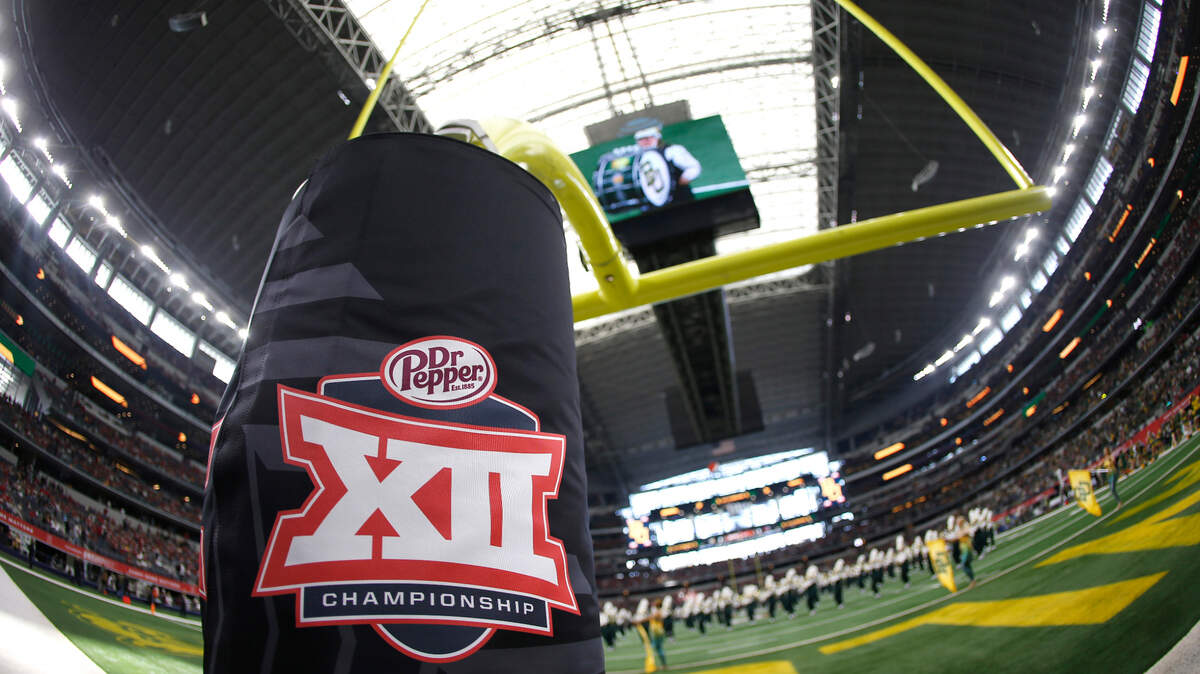
The NCAA is soon expected to eliminate division requirements for football conference title games, which paves the way for the Big 12 to continue pitting its two best teams against each other every December at AT&T Stadium.
But is that what the conference prefers?
“There are pros and cons to both,” Taylor said. “With divisional play, you’re not going to have big gaps where you go five-plus years without playing a team in your conference, but then you run into times where one division is much stronger than the other and you don’t typically have your two best teams in the championship game.
“If you don’t do divisional play, we would need to make sure we rotate through enough that you see every team on a pretty regular basis. I’d be okay with that, because I think the goal is to have your best teams in that game. But how do you determine your two best teams when everybody doesn’t play everybody? That’s another subject.”
The ACC may eliminate its Atlantic and Coastal divisions in 2023 in favor of a 3-5-5 scheduling model in which every team in the league would play three regional rivals every season and rotate playing the other 10 teams in the conference every two years.
Similiar options are being considered by the Big Ten, Pac-12 and SEC.
The Big 12 could follow suit for two years, before Oklahoma and Texas are scheduled to join the SEC in 2025. But the conference would need to adjust to a 3-4-4 model afterward.
One problem: The Big 12 currently plays nine conference games. The ACC scheduling model is for eight conference games. Some math would need to be adjusted, or the league would need to play one fewer game. Questions remain.
“We all want to see what a Big 12 schedule would look like without divisions,” Taylor said.
Big 12 Divisions could split teams up based on geography (East/West, North/South) or traditions (founders/newcomers). But Oklahoma and Texas create problems there, too. Would they be placed in opposite divisions for simplicity? Or would the Big 12 move teams around after just two years?
And who gets to play the Longhorns and Sooners before they switch conferences?
There is still much for Big 12 leaders to consider.
This story was originally published May 12, 2022 at 3:14 PM with the headline "Should Big 12 football bring back divisions? Conference leaders still mulling options."