College (flag) football’s No. 1 dynasty currently resides in Kansas
AI-generated summary reviewed by our newsroom.
- Ottawa University women’s flag football has won five straight NAIA national titles.
- The Braves have lost nine games while winning over 100 in program history.
- Coaches Liz and Katie Sowers helped build the program’s culture and success.
One of the greatest running dynasties in American sports sits 53 miles southwest of Kansas City.
No, the Chiefs don’t stretch out that far. And one of the few programs to do what this team has done was the North Dakota State Bison back in the 2010s.
But this dynasty is from the Ottawa University women’s flag football team.
The NAIA, in partnership with the NFL, made women’s flag football a varsity sport beginning with about 15 teams in 2021. This year, the sport has 35 programs.
It has only known one national champion in its young history: Ottawa University.
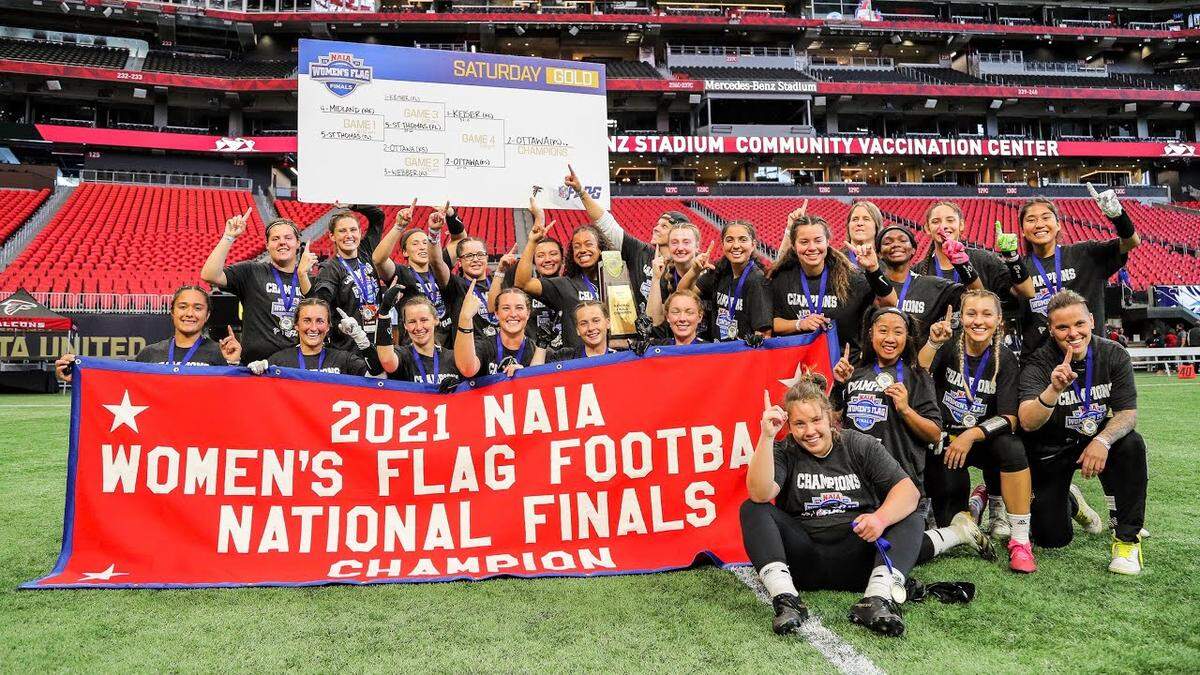
The Braves have won five straight NAIA women’s flag football titles. They’ve only lost nine games in program history, while winning more than 100 games and six consecutive Kansas Collegiate Athletic Conference (KCAC) championships.
The coaches and players lend their success to the positive, professional culture cultivated by everyone involved.
And the leaders of this program are trailblazing coaches and twin sisters Liz and Katie Sowers, both accomplished athletes and tackle football players who have made names for themselves in the coaching sphere.
Football fans may be familiar with Katie Sowers, the first female and openly gay coach in a Super Bowl with the San Francisco 49ers — when they faced the Kansas City Chiefs in Super Bowl LIV.
She was with them from 2017-20, she joined the Chiefs the next season as an assistant before being appointed as the director of athletic strategic initiatives at Ottawa and helping her head coach sister with the flag football team as defensive coordinator.
Head coach Liz has worked in administration for several sports organizations and teams. She was a graduate assistant for the University of Missouri-Kansas City women’s basketball team from 2011 to 2013 and player liaison/social media coordinator for women’s soccer club FC Kansas City, while playing tackle and flag football and making a brief stint with the USA Rugby Sevens team. She also played on USA’s Women’s Flag Football team.
Both Sowers women, Hesston, Kansas natives, played tackle football in Kansas City and won gold medals representing the country’s women’s tackle football team at world championships. They’ve also both coached and consulted with several international flag football teams.
Their father, Floyd Sowers, is a women’s basketball coaching legend at KCAC school Bethel College, owning the second-most wins in program history.
In 2020, then-athletic director Arabie Conner reached out to Katie Sowers, asking for coaching recommendations for the burgeoning program. Sowers had contacted Conner about four years prior about a coaching position on the men’s tackle football team, but got no answer.
Katie recommended her sister, who was caring for their father after he suffered a major stroke in 2018. There weren’t too many barriers before Liz Sowers was named head coach. After finishing her stint with the Niners, Katie Sowers watched one practice before the program became a family enterprise.
“Being around here, being on the national team, it was just kind of like it was supposed to happen,” Liz Sowers told The Star. “If there was an interview process, I don’t remember it.”
Building from the ground up
A 2021 inaugural flag football season meant recruiting players during the COVID-19 pandemic.
Kansas hadn’t made its way into girls flag football yet, so the initial squad was mostly from Las Vegas, with student-athletes from Georgia, Florida and the local area sprinkled in.
It took some time to get adjusted. Head coach Sowers was used to 5-on-5 flag football, NAIA was 7-on-7.
They didn’t have uniforms for the first few practices, and didn’t have a locker room in the first year, things the team hardly noticed. The coaches’ office is no bigger than a janitor’s closet, but the yellow brick walls are lined with championship pictures, motivational quotes, magazine covers of female athletes, soccer star Hope Solo, and accomplishments of each coach.
But in that first season, it helped to have a core group of players from the same area. It also helped to have offensive mastermind Kyle Shanahan’s playbook from the Niners’ Super Bowl run. The sisters credit their experiences in other sports for helping them understand how to properly space their players when designing plays.
They soon realized their competition wasn’t doing nearly the same amount of preparation.
“I knew that we were gonna be good,” Katie Sowers told The Star. “I could feel (it), but ... it almost felt like we were trying harder than everyone else, in a sense.”
“Still are,” assistant coach Abby Brown chimed in.
Brown is set to take over the program once the Sowers sisters leave after the season to build the University of Nebraska’s women’s varsity flag football program. The NCAA has tabbed the sport for the Emerging Sports for Women program, which creates a pathway for it to become a championship sport.
The Huskers are expected to have their inaugural season in spring 2028 with informal competitions next year.
Inside the sport of flag football
Some opposing coaches rarely change their tactics, the coaches said. And taking tackle football concepts and throwing them in flag football is not as easy it seems.
The game is played at a much higher speed on a much tighter space — a 40-by-80-yard field.
Tackle football has plenty of resources to learn from. Flag football, not so much.
“There’s a lot of things that you can’t just go search online and find,” Katie Sowers said.
For example, playing standard defensive coverages, like Cover 2, won’t work if not adjusted for the flag game, she said. It’s one of the biggest adjustments to make.
“Nothing can be outside leverage in this game. This game is too fast,” she said. “Little things that need to be adjusted. For all those tackle guys that don’t think about why they do the things they do, they keep it the same.”
While they outpace their opponents on the whiteboard, they also recruit quality talent, sending three players to the USA Football national team and several players to other national teams in the Sowers era.
But recruiting talent has gotten “exponentially more difficult” for the self-proclaimed “UConn of flag football,” Brown said. As the sport grows to the Division I level, larger schools are investing more money into scholarships for players and facilities.
Brown, who was a linebacker in the program from 2021 to 2024 before transitioning to coaching, has worked with the Chiefs to help start flag football programs at high schools in Kansas and Missouri.
There are 29 active programs in Kansas and 54 in Missouri. The Kansas State High School Activities Association recently voted to sanction the sport, beginning next year.
Those changes will help build the local pipeline and grow the game, but competition is getting congested.
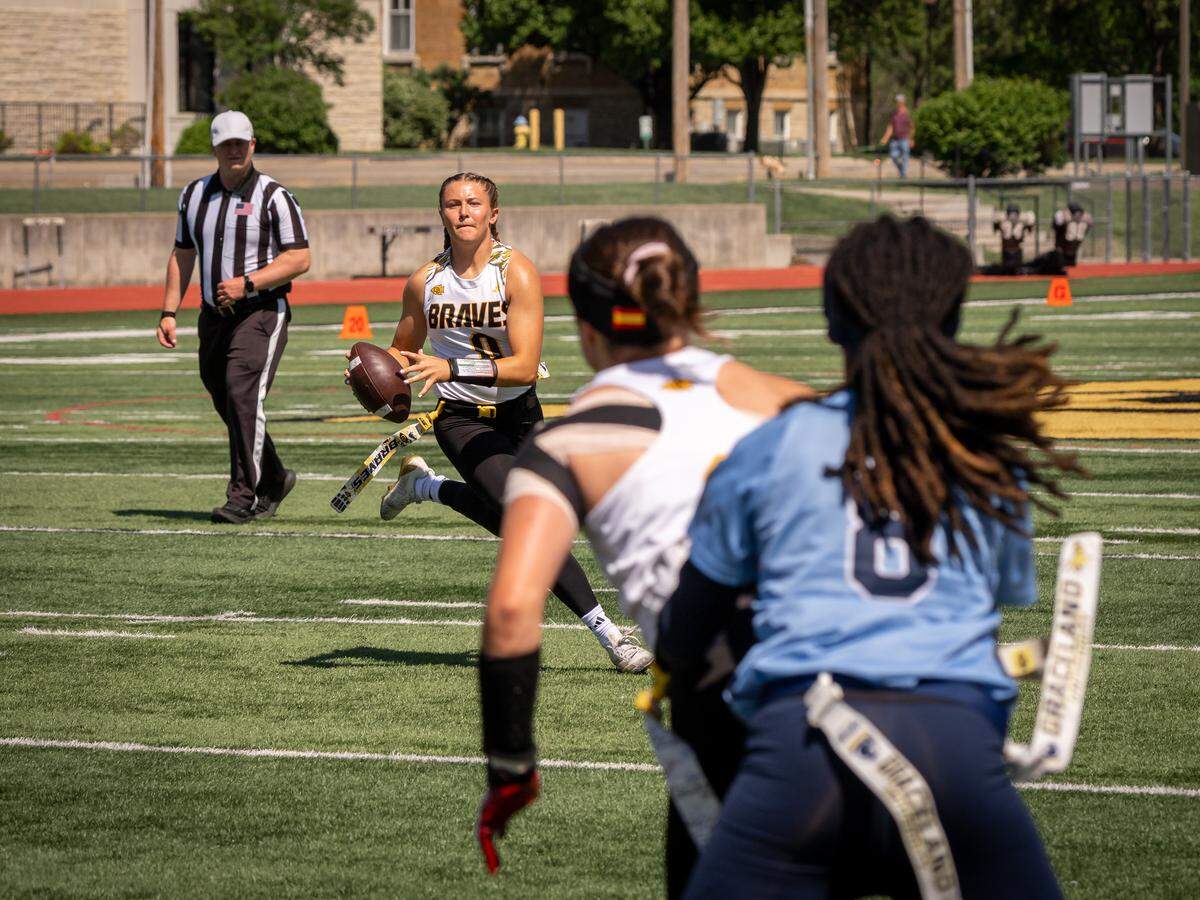
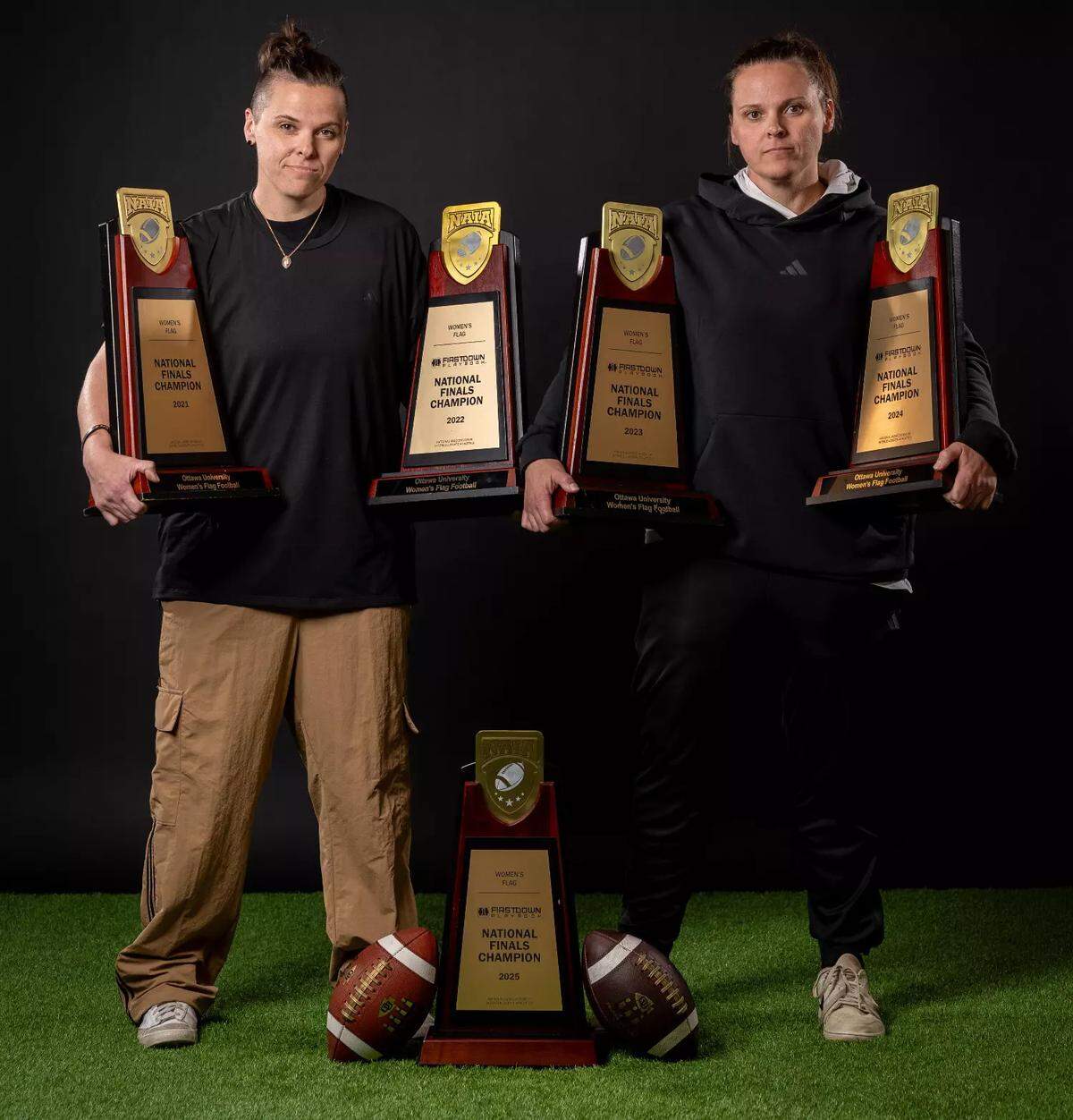
“Somebody asked me on Instagram, ‘Why should I come to Ottawa from far away?’ And I jokingly just put a picture of me with every single trophy from every single year,” Brown said.
She added that she followed up with their proper recruiting pitch: The small school setting provides a quality support system from faculty and staff. Ottawa has a storied track record in other sports and has made a commitment to investing in the women’s program.
For Brown, the program sells itself, even against new programs with bigger budgets.
“We were supporting this sport and believing in it before there was ever any evidence of success, before we were winning anything,” Brown said.
Brown played tackle football in high school at Central Heights in Richmond, Kansas, about 15 miles from Ottawa, before becoming a record-setting linebacker for the program.
“This school was behind it,” Brown said. “So I think that’s really special.”
Game day at Ottawa
A Wednesday evening flag football game provides a stark contrast from a typical college tackle football game, even at a smaller school level.
In front of about 40-ish people in the crowd on Senior Night on April 1, the Braves routed Hesston College (where the Sowers twins attended college) 27-7. The game was called early because of storms.
But in one half, the Braves made it clear why they are so successful.
Freshman quarterback and Park Hill High alumna Anna Anderson is the conference player of the year, throwing for 3,278 yards and 46 touchdowns on a 76% completion clip. She has smooth mechanics and throws a tight and accurate spiral.
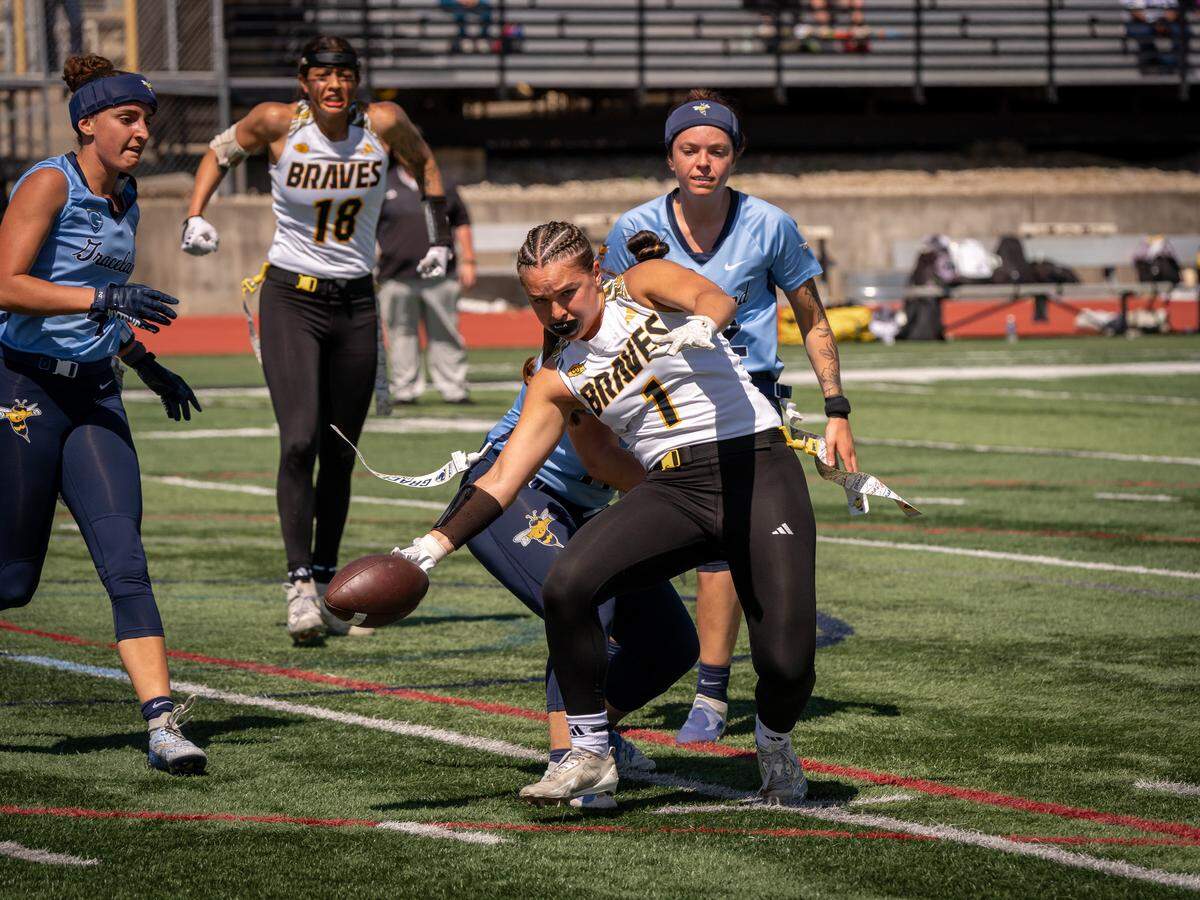
The Braves are methodical offensively, utilizing their downs to get to certain parts of the field and running different concepts to open spaces. They often employ multiple quarterbacks, and laterals are always on the table when the ball is in play.
Defensively, they are fast, athletic and rarely miss when pulling flags. KCAC Defensive Player of the Year Jukanie Washington is the eye in the sky, boasting 26 interceptions and four pick-sixes over her career. The Decatur, Georgia native is their senior captain, a vibrant personality and spirited leader on and off the field.
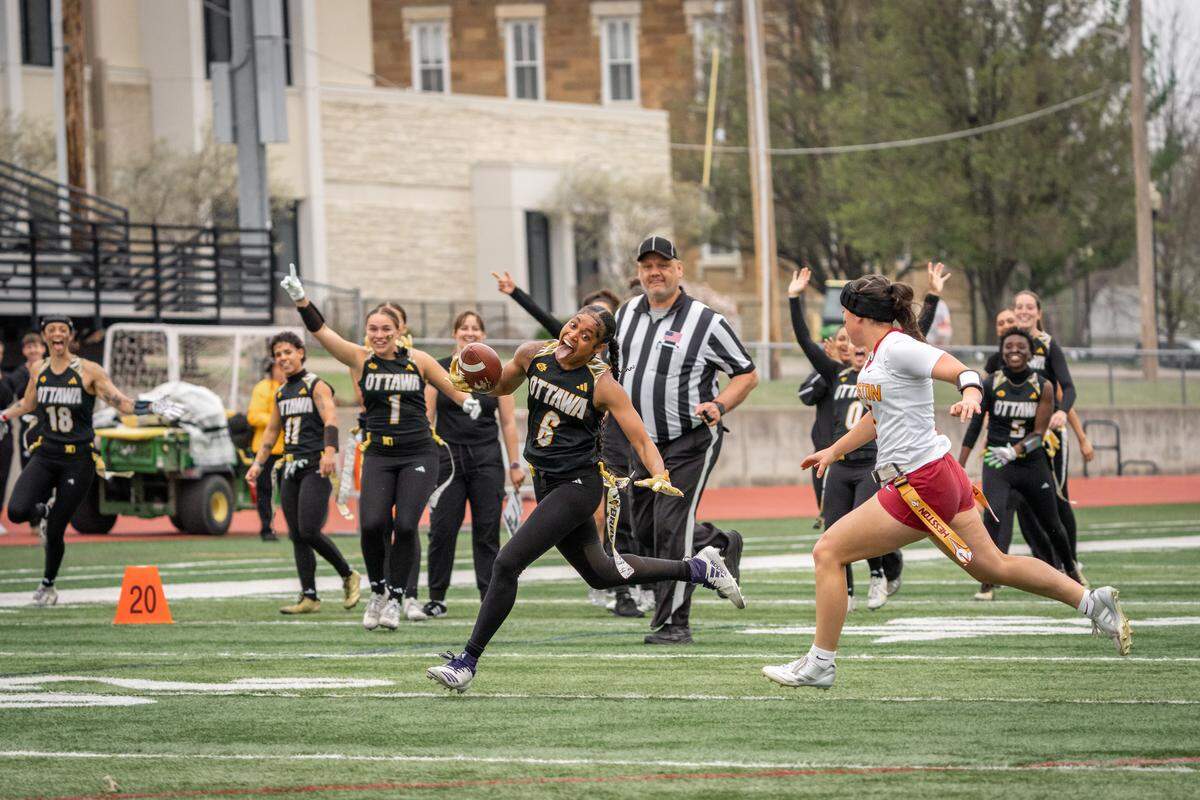
The Sowers duo didn’t have to do much to establish a culture. Come in willing to work and learn, do your job and be a good teammate. Players did that from the first day, seamlessly providing a professional, healthy environment where everyone was encouraged to bring their best selves.
“It was already a bond built. So I came into the energy and I fed off them,” Washington said. “The personalities that each player brings to the team are super important. And I think a culture is built around every single person, no matter if you play or not.”
The sideline during games is a balance of whimsical and serious, countering jokes and laughs with talks of how to limit opponents. The only yells or loud voices are chants of encouragement. Even tackle football players attend games, shouting out the leverages and coverages of opponents from the bleachers.
On May 7, Ottawa will begin its inaugural Women’s Flag Football Invitational journey as a 2-seed against 7-seed St. Thomas. The Braves won an automatic bid as the KCAC champion for the sixth straight year.
Before the Sowers duo continues leading the women’s flag football charge at Nebraska, they have one more go-round to make the Braves winners of six straight NAIA flag football titles. Then they know the program will be left in good hands with a well-established foundation and Brown to take it to the next generation.
“I was a captain all four years, so I was already very comfortable in a leadership role,” Brown said. “So it’s been a pretty easy transition, and I knew I wanted to coach for years.”
Katie Sowers’ view?
“It was important for us ... (that) the program was going to be taken over by someone who cared about it and wanted to make sure it continued to grow,” she said, “and wasn’t just left to some random tackle dude that wants to come get a flag job.”