
From Fulton to Berlin: Why Missouri still matters in the story of freedom | Opinion
Starting May 29, visitors to Kansas City’s Union Station will encounter one of the most powerful symbols of the twentieth century: the Berlin Wall. The exhibition “The Berlin Wall: A World Divided” examines the concrete barrier that divided Europe for nearly three decades and became the defining physical manifestation of the Cold War.
Yet few Americans realize that the story of the Berlin Wall did not begin in Berlin.
In many respects, it began in Missouri.
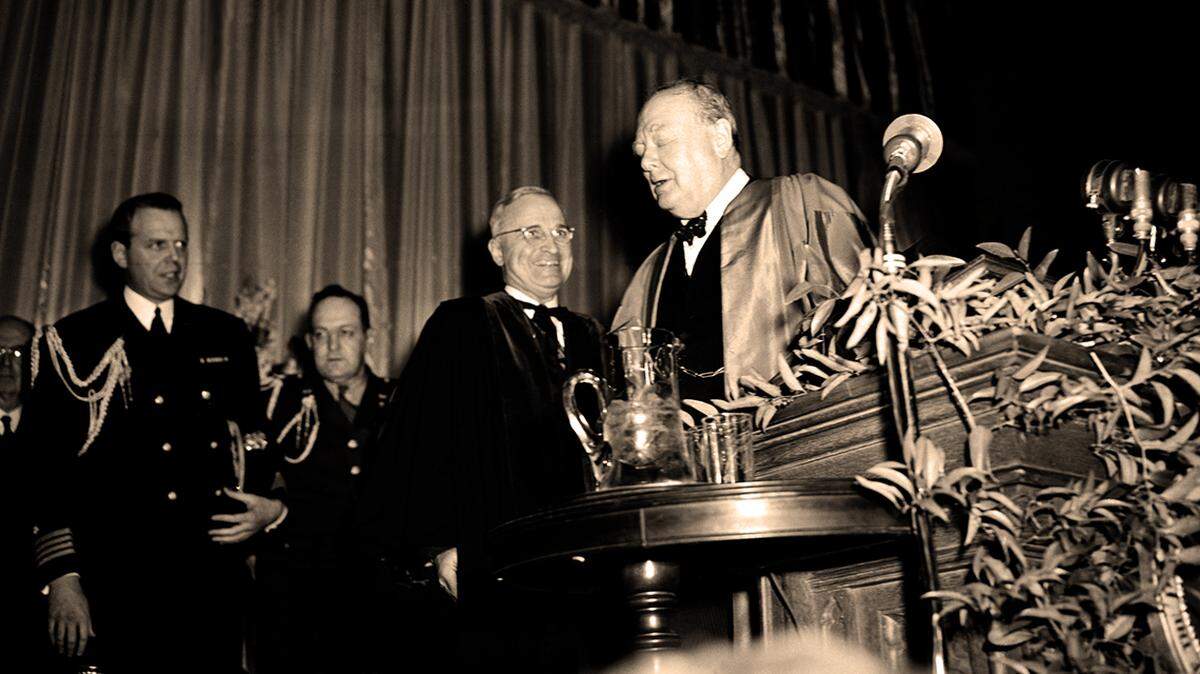
On March 5, 1946, at Westminster College in Fulton, former British Prime Minister Winston Churchill, with President Harry Truman at his side, delivered his historic “The Sinews of Peace” address. Churchill famously declared: “From Stettin in the Baltic to Trieste in the Adriatic, an Iron Curtain has descended across the continent.”
Those words defined an era. Churchill’s warning gave language to the growing divide between the democratic West and the Soviet sphere of influence. Within a generation, the Berlin Wall would become the starkest embodiment of that Iron Curtain.
Today, 80 years later, Westminster College and America’s National Churchill Museum remain uniquely connected to the origins, course and conclusion of the Cold War.
The original lectern from which Churchill delivered his speech is preserved at America’s National Churchill Museum. Remarkably, it was used again in 1992 by former Soviet leader Mikhail Gorbachev, who returned to Westminster College shortly after the collapse of the Soviet Union to declare that the Cold War had ended. Few objects in American history can claim such extraordinary symbolism: one lectern used first to warn of a divided world, and later to celebrate the possibility of reconciliation.
Today that lectern is in Kansas City at the entrance to the exhibition at Union Station.
The connection extends beyond speeches and statesmen. Westminster College also became home to one of the Cold War’s most powerful artistic statements: Breakthrough, the monumental sculpture by Edwina Sandys, granddaughter of Winston Churchill. Created from eight sections of the Berlin Wall itself, the sculpture transforms a symbol of oppression into one of hope and human freedom.
Dedicated by President Ronald Reagan on the Westminster campus on the first anniversary of the fall of the wall— Nov. 9, 1990 — Breakthrough was among the earliest monuments in the world created from actual remnants of the Wall. The sections of the towering wall are pierced by the silhouettes of a man and woman. From those openings, visitors can step though to liberty. The sculpture reminds viewers that barriers — political, ideological and physical — can indeed fall.
As Kansas City visitors experience fragments of the Berlin Wall at Union Station, they should also remember Missouri’s profound connection to this global story. The Cold War was not only waged in Berlin, Moscow, Washington or London. Some of its most important ideas were articulated in the American heartland.
At a moment when democratic values again face mounting pressures around the world, the lessons of Fulton and Berlin remain urgently relevant. Churchill understood that freedom required vigilance, moral courage and strong alliances. The collapse of the Berlin Wall demonstrated that even the most entrenched systems of division can ultimately yield to the human desire for liberty.
The story of the Cold War is more than an iron curtain descending. It is also about walls broken through.
And in that story, Westminster College occupies a singular and enduring place.
Timothy Riley is the Sandra L. and Monroe E. Trout Director and Chief Curator of America’s National Churchill Museum and Churchill Fellow of Westminster College in Fulton, Missouri.