
World Cup fans will still come to Arrowhead — nervous they’re not welcome | Opinion
This month, athletes from around the globe competed at the 25th Winter Olympics — at least athletes from nations that have snow and ice. Among them was bobsledder Caleb Furnell, who grew up in the Kansas City area, representing Lee Summit West as a high school sprinter.
However, our attention will soon swing to a bigger, more-inclusive sporting event: the 23rd World Cup, which will feature qualifying teams from a whopping 206 competing nations. Six of the tournament games will be played at Arrowhead Stadium starting June 16, and four top-flight national teams will be hosted in or near Kansas City, including the most recent Cup champion Argentina, the major contender England, plus the Netherlands and Algeria.
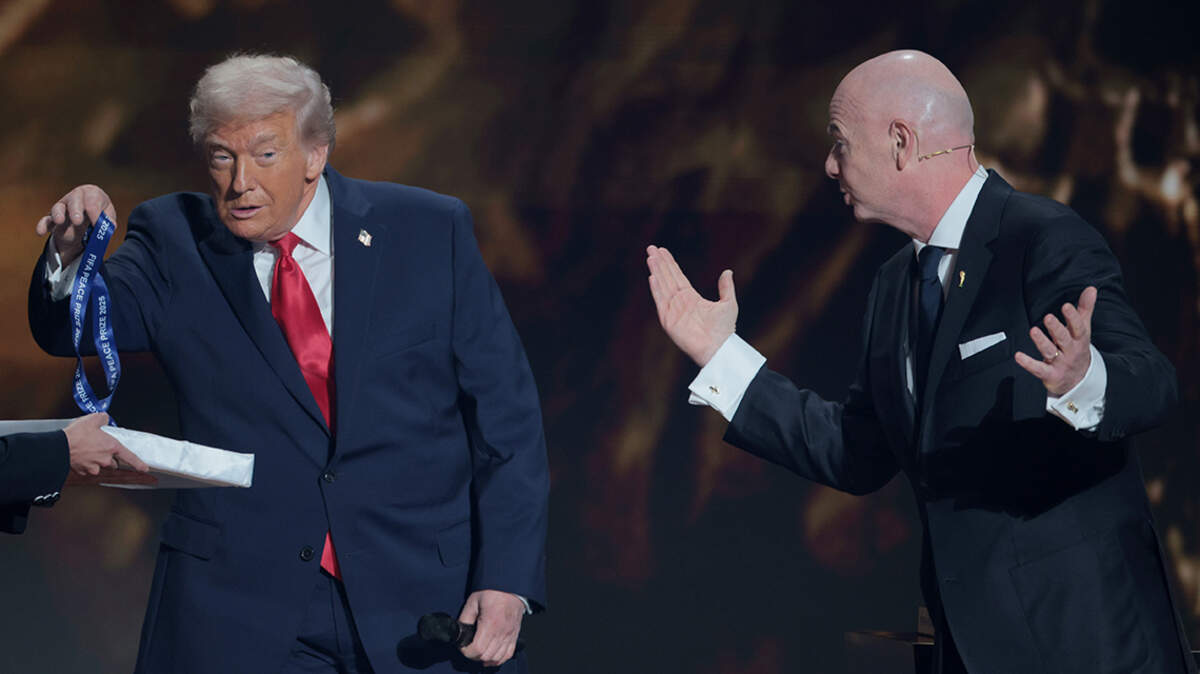
I love soccer because of how it brings so many people together. When rivals meet, there may be fierce competition, but there is the hope of fresh understanding and respect simply because players and fans cross over the usual cultural divides. The World Cup is a perfect symbol of that coming together, so it makes sense that the Fédération Internationale de Football Association might initiate a FIFA Peace Prize, doing it in conjunction with the World Cup and its Football Unites the World initiative. However, the person FIFA has selected as its first honoree is raising furor, and for good reason.
‘Extraordinary actions for peace?’
FIFA supposedly intends “to reward individuals who have taken exceptional and extraordinary actions for peace and by doing so have united people across the world.” Nothing could be further from the truth about President Donald Trump. Since the medal was hung around his neck in November, he has sent troops into Venezuela to capture that nation’s ruler. He has authorized sudden missile strikes in Nigeria and Syria. He has used an army of poorly trained, masked agents to intimidate U.S. states that he considers disobedient. He has even threatened to take Greenland by force, stealing it from its longtime European overseer, Denmark. And when defied by traditional allies in NATO, he has whined that, since he was not given the Nobel Peace Prize, he no longer feels “an obligation to think purely of peace.”
This past month, we may have been celebrating the performances of graceful figure skaters or rocket-fast sledders like Furnell, but Trump’s egocentric, bullying behavior is having its effect as international soccer leaders take stock of the impending World Cup. Oke Goettlich, vice president of the German Football Federation, already declared at the end of January: “It is clearly time to at least discuss a boycott. Germany’s Foreign Office has issued travel advisories for parts of the United States. We are seeing people die on the streets as a result of actions by immigration enforcement. We do not know what will happen with Greenland. Against that backdrop, it’s responsible and necessary to openly discuss which scenarios are on the table.”
So far, the German federation has decided not to boycott the World Cup. However, other nations such as Denmark and France have had their own conflicted conversations, and a former head of FIFA, Sepp Blatter, has advised fans to skip the whole tournament.
JD Vance joked about deporting foreign fans
Who would have guessed that when the U.S. was approved as a host eight years ago, we would be in this position? But from the start, the Trump administration has bungled the welcome for this largest of sporting events, predicted to draw 5 billion viewers worldwide. At an initial press conference, Vice President JD Vance said with regard to foreign fans who travel to the U.S., “We want them to come, we want them to celebrate, we want them to watch the games.” Then he pivoted to the Department of Homeland Security Sec. Kristi Noem, who is in charge of all the armed and masked deportation agents, and blithely joked, “But when the time is up, we want them to go home, otherwise they will have to talk to Sec. Noem.”
The response to that sinister bit of humor was instant outrage, both domestically and abroad. Nikos Unity, an American reggae singer, put it well: “He turned a World Cup welcome into a fearmongering deportation line. Zero applause. Zero charisma. Zero clue.”
Although my sons and I have eagerly anticipated the 2026 World Cup, I am conflicted about this year’s tournament. In the end, I doubt it will face any meaningful boycotts, since so many players live for this rare opportunity, and since this year’s games will be co-hosted by Mexico and Canada. Despite the way Trump has harassed both neighboring nations — demanding that the Gulf of Mexico be named the Gulf of America and that all of Canada be turned into America’s 51st state — both nations will probably stick to their initial commitment, not wanting to be penalized by FIFA or by the U.S. itself.
Backing out of tickets, going only to Mexico or Canada
Fans will come, even traveling from qualifying nations such as Haiti or South Africa that have been demeaned by the Trump administration. However, I’ll bet attendance will be down. There is speculation that some travelers might be planning on backing out of buying tickets or reselling them. Others have decided to attend games only in Mexico or Canada. As for the rest, when they pass through security at Arrowhead or another of the host stadiums here, I suspect they will do it nervously, worrying about being foreigners in a nation that is not so at peace with itself.
They won’t say it out loud, of course, but they will wonder how the president of FIFA, Gianni Infantino, could stoop so low as to select Donald Trump for the first-ever FIFA Peace Prize. Even if Infantino was pressured into it, what hypocrisy. Such an honor should be honestly earned.
Author Tim Bascom’s newest book, “The Boundless Game: Soccer Stories from Across the Street to Around the World” from the University Press of Kansas, celebrates ways that soccer transcends cultural and national borders. He received his MFA from the University of Iowa.
This story was originally published February 27, 2026 at 5:04 AM.