
Democracy decays when we think outrage is easier than truth. KC, let’s talk | Opinion
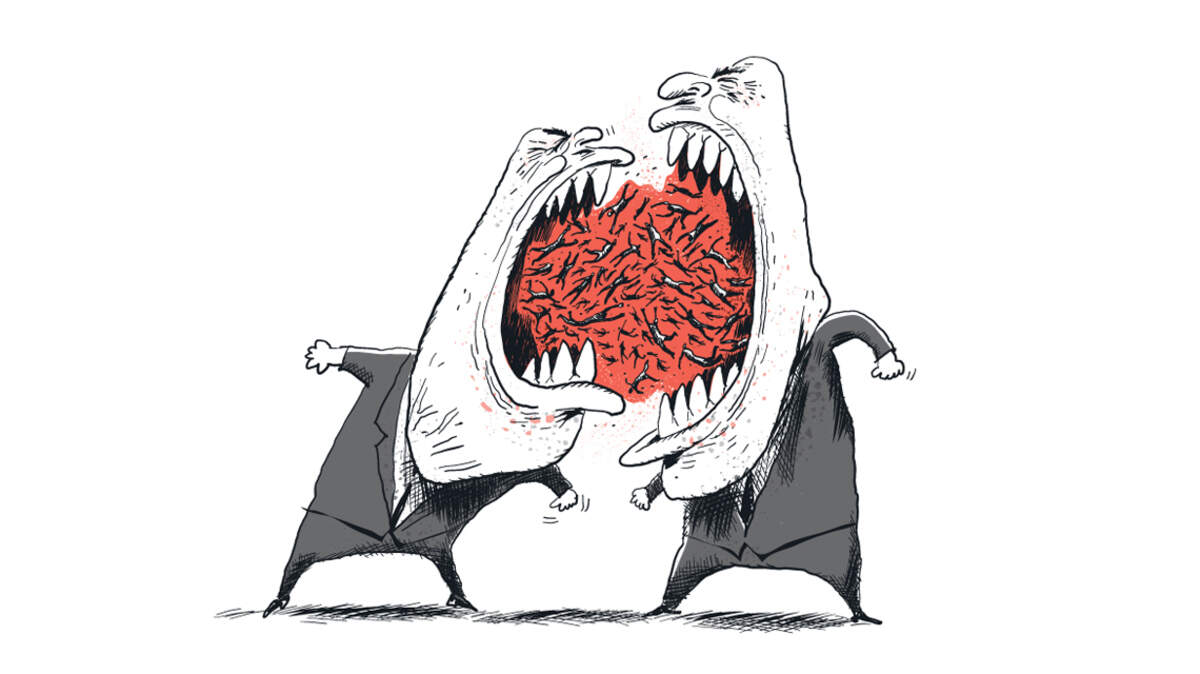
In Kansas City’s diverse metropolitan area, our political differences often live side by side. Most of us know flag-flying conservative relatives in Lee’s Summit and friends in Lenexa with “In this house we believe …” yard signs, all of us trying to grapple with the national fever. In my own Volker neighborhood, a Donald Trump-JD Vance sign sits blocks from a torn American flag, hung in protest.
I personally keep flags off my own house. I hesitate to post on social media, seeing how it flattens nuance and inflames rather than clarifies. My personal antidote to the daily horror of the news has been reading biographies of great resisters. My recent inspiration: Czech playwright, dissident and later president Vaclav Havel.
In 1978, Havel wrote an essay that still feels unnervingly contemporary. “The Power of the Powerless” was not a manifesto about revolution — it was an anatomy of quiet complicity. Havel described a greengrocer in communist Czechoslovakia who placed a communist slogan in his window not because he believed it, but because not doing so would invite trouble. The system endured, Havel argued, not merely through repression, but through millions of small, daily performances of agreement. The lie survived because people kept acting as if it were true.
Havel’s phrase for this condition — “living within a lie” — has become shorthand for authoritarian systems. But its deeper warning is how societies decay not only when leaders distort reality, but when citizens decide that accuracy is inconvenient, that slogans tell the whole story, or that outrage is easier than deep understanding.
Canadian prime minister at Davos: honesty
At this year’s Davos World Economic Forum, Canadian Prime Minister Mark Carney invoked Havel in a speech reflecting on geopolitics and the erosion of the so-called rules-based international order. Quoting Havel’s greengrocer, Carney argued that global systems, like domestic ones, are sustained by rituals we privately know are incomplete or misleading. For decades, many countries benefited from an international framework that promised fairness while often delivering asymmetry. The fiction was tolerable when it produced stability. “The power of the less powerful starts with honesty,” Carney said.
The same is true here at home. Our era is saturated with claims of “truth” and yet strangely allergic to the discipline required to digest its complexity. Political actors — especially leading figures in the current administration — have witnessed that bending reality, flooding public discourse with contradictions and attacking critical institutions can be more effective than persuading on the merits or grappling honestly with nuance. If every account is branded partisan, if every inconvenient fact is dismissed as a plot, then power no longer needs to defeat the truth. It needs only to exhaust people into being divided.
Democracy does not require us to pretend that truth is simple. Treating complexity as weakness is how propaganda thrives. Authoritarian movements flourish when they convince citizens that nuance is elitism, research is manipulation and every uncomfortable fact must be part of an enemy’s scheme. Honesty also requires acknowledging where governing coalitions lose public trust: when voters perceive disorder, dismissal of their concerns or rhetorical certainty in place of workable policy that listens to their expertise.
The answer to our fractured information ecosystem is not to punishing truth-telling, but to cultivate better habits of discernment. It might mean practicing lateral reading: stepping outside a single source, checking who is behind a claim, comparing coverage across ideological lines. It definitely means reading. It also means pairing critique with construction. For every injustice identified, solutions must be proposed. Constant alarmism blows out our palate for necessary critique.
Civility is not weakness
Democracies rot when politics becomes a permanent audition for indignation rather than a contest of workable ideas. In a time of upheaval, people can understandably see civility as weakness or a refusal to meaningfully engage. Civility done right should do the opposite: giving space for us to say sometimes uncomfortable truths, pausing our own certainty long enough to hear alternative perspectives and rigorously checking claims against the facts. Acknowledging that someone has a point increases the likelihood that person may do the same, and we might find then that we are more on the same page than we are led to believe. Our media environment is designed to keep us partitioned into echo chambers. These conversations in search of nuance are the hard, necessary work democracy requires.
Kansas City doesn’t have to solve this alone at home on a couch with a doomscroll. We can exercise the muscle of disciplined honesty in public by listening, checking claims and staying in conversation with those we seem to disagree with when it would be easier to retreat. American Public Square has been making it easy for people across the metropolitan area to engage in civil discourse, convening people across ideological difference for free programming to argue with evidence rather than slogans.
In American life we are trained to soften, delay or outsource difficult truths to protect ourselves, whether within corporate jobs, political parties or even families. But Havel writes that societies change when we challenge institutional falsehoods: “If the main pillar of the system is living a lie, then it is not surprising that the fundamental threat to it is living the truth.” If you’re tired of being told that saying hard things makes us fragile, or that minds never change, visit americanpublicsquare.org and come test that assumption in public.
Ryan Bernsten is a playwright and the author of “50 States of Mind: A Journey to Rediscover American Democracy.” He is also director of brand and partnerships at the 501(c)(3) nonprofit American Public Square. APS is hosting a conversation with Church of the Resurrection, “I Love You But I Hate Your Politics,” about staying in relationship across political difference, before launching a season on issues that affect us all: affordability, immigration enforcement, free speech and the state of our democracy. Learn more and register at americanpublicsquare.org