
Frank Gehry’s genius found its expression via Kansas City’s A. Zahner | Opinion
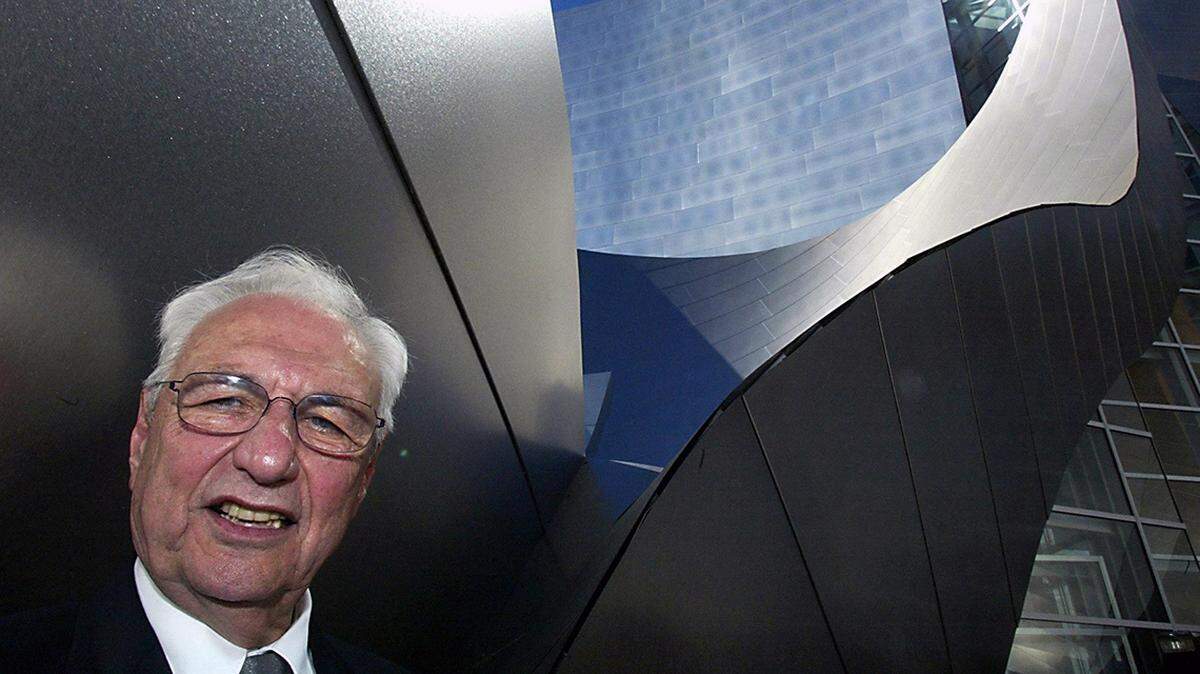
For many years now, Bill Zahner has given support, energy, backbone and technical assistance in realizing many of my works. His firm provides exemplary craftsmanship in everything they undertake, and are seriously and extremely committed to Architecture, with a capital A.
- Frank O. Gehry
Frank Gehry — “one of the most formidable and original talents in the history of American architecture,” in the words of The New York Times — died at the age of 96 on Dec. 5 at his home in Santa Monica, California, leaving a vast legacy of work that forever transformed cities throughout the world.
Born Ephraim Owen Goldberg, he reluctantly changed his name to Frank Gehry in 1954, long before he shifted the world of architecture through his cutting edge, iconic designs. Gehry taught us a new way of seeing, of looking, undoubtedly inspired in part by his close friendship with a host of Los Angeles artists and his enduring embrace of a variety of metals — galvanized steel, copper, aluminum, zinc and titanium — for his projects that created sculptural, free-form surfaces never before seen in architectural design.
Most significant, Gehry’s exploration into a variety of metals resulted from his enduring collaboration with A. Zahner Company of Kansas City, a sheet metal concern established in 1897.
William Zahner, retired CEO, recently reminisced about Gehry, whom he considered his mentor and friend: “My firm’s expertise was in sheet metal but with Frank, those materials took on an entirely new life. Together, we explored thin cladding in ways no one had before. How light could reflect from surfaces and edges, how color would shift through interference-colored stainless steel, how titanium could bend, shimmer and transform a building into sculpture.”
A. Zahner Company worked with Gehry and his firm on more than 30 projects throughout the United States, beginning in 1988 with the temporary exhibit “Sheet Metal Workers International Association,” placed inside the National Building Museum in Washington, D.C. The 65-foot display, which celebrated the SMWIA’s centennial, ultimately showcased the endless capabilities of what sheet metal surfaces could produce. It was from this initial venture that Gehry and Zahner formed a longstanding professional relationship.
Another collaboration with Gehry, that of Seattle’s Experience Music Project (now the Museum of Pop Culture), funded by Microsoft co-founder Paul Allen, is a landmark project for Zahner, completed in 2000. Here, Zahner’s team invented ZEPPS, the Zahner Engineered Profile Panel System, which revolutionized how complex metal surfaces could be customized and fabricated, resulting in an unbroken surface that reflects light in uninterrupted, immeasurable ways and where solids and voids manifest into an undulating Baroque-like display. Said Zahner: “We had to invent new ways to define and fabricate surfaces while working on one of the most complex projects ever conceived. Even today, when I walk by that building,” — which comprises 21,000 unique metal sheets for the building’s skin — “I still pause in disbelief that we actually pulled it off.”
Zahner also collaborated with Gehry on Chicago’s Jay Pritzker Pavilion, a dynamic outdoor amphitheater that boasts a 100-foot proscenium featuring the company’s patented Angel Hair finish on high performance stainless steel. Commissioned by the family who bestowed the international Pritzker Architecture Prize to Frank in 1989, the Jay Pritzker Pavilion stands as the centerpiece of Millennium Park. In working with Frank on the project, Cindy Pritzker remarked that “Chicago could benefit from having a Frank Gehry,” and not the other way around.
Of the scores of other projects where Zahner and Gehry worked side by side — the Weisman Art Museum in Minneapolis, the Ohr-O’Keefe Museum of Art in Biloxi Mississippi and the Fisher Center at Bard, Annandale-on-Hudson, New York to name a few — Zahner was also a consultant for the Walt Disney Concert Hall in Los Angeles and the Guggenheim Bilbao Museum, the latter of which forever changed the cultural, architectural and economic landscape of this northern Basque city, resulting in what is known as the Bilbao effect.
Given the distinguished relationship between Gehry and Zahner, it is perplexing why Kansas City never landed a Gehry building of its own. Yet, recalling the aggressive politics of the 2004 downtown arena competition, Gehry — teaming with Kansas City’s Crawford Architects — retreated, and Zahner and the rest of us lost the chance to get our own Bilbao in the heart of our city.
Cydney E. Millstein, Hon. AIA, is the founder and principal of Architectural & Historical Research LLC. She lives in Kansas City.
This story was originally published December 23, 2025 at 5:01 AM.