
Ty Masterson doubles down on Kansas’ shameful anti-immigrant history | Opinion
An unfortunate truth: Kansas isn’t always friendly to those we deem to be outsiders.
We can even be jerks.
During World War II, then-Gov. Payne Ratner joined in the slurring of Japanese Americans who had nothing to do with Pearl Harbor. “Japs are not wanted and not welcome in Kansas,” he said in 1942.
That ugly quote is the only reason anybody remembers him today.
A decade ago, then-Gov. Sam Brownback followed Payne’s example and declared that Syrian refugees — people fleeing a deadly civil war in their own country — were unwelcome here. Those folks posed an “unacceptable risk to the safety and security” of Sunflower State residents, he said in an executive order.
It was alarmist nonsense.
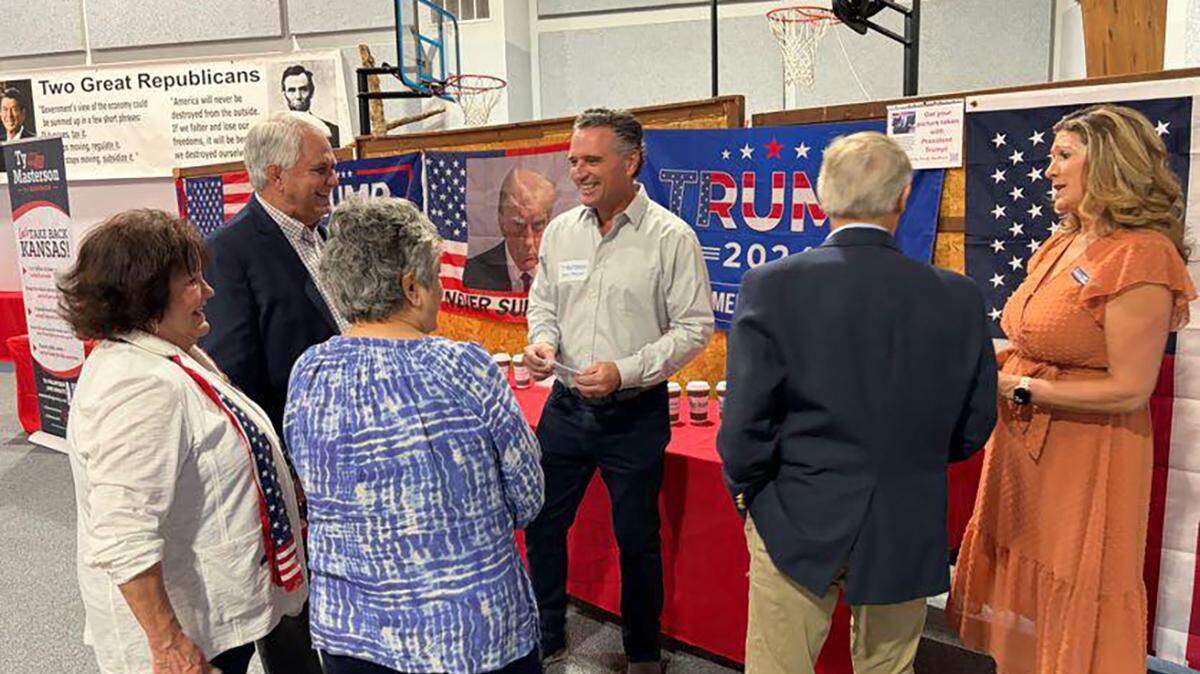
Now Ty Masterson is poised to add to that shameful history.
The GOP candidate for governor last week warned that Afghan refugees in Kansas are potentially “terrorists and terrorist sympathizers,” and promised to ally himself with Donald Trump’s crackdown following last month’s Washington, D.C., shooting that killed one member of the National Guard and badly injured another.
“As governor, I will work alongside the Trump Administration to uphold immigration law and ensure that migrants are properly vetted to keep Kansans safe from terrorists,” Masterson, currently the president of the Kansas Senate, wrote in an email to supporters.
If you’re an Afghan native now living in the Sunflower State, it is probably difficult to see that pledge as anything but a threat.
Manhattan Area Resettlement Team’s fragile success
Some background: After Kabul fell to the Taliban in 2021, a number of Afghans — mostly folks who worked with American forces during our two-decade war in their country — came to the United States, many of them with the assistance of U.S. veterans with whom they had personal relationships.
A few hundred landed near Fort Riley, the Army base in northeast Kansas, in the university town of Manhattan. A group of community members got together and formed MART, the Manhattan Area Resettlement Team, which helped the new arrivals find housing, work, schooling and more as they adjusted to new lives in a new country.
For the most part, the effort has been seen as a success story.
“I’ve had veterans standing on my porch handing me a check for several thousand dollars from their church, saying ‘We need to help people, we need to help these people,’” Susan Adamchak, MART’s president, told me on Tuesday. “And so you know, I think Manhattan really did step up when it was necessary.”
But the bulk of those efforts came as Trump (always disdainful of immigration and immigrants, especially from non-white countries) prepared to return to the White House. And the shooting in Washington — allegedly by a mentally unstable Afghan refugee who worked with the CIA during the American war — has raised fears in the migrant community. The president vowed to “reexamine every single alien” who came from Afghanistan, and to expel those who do not “add benefit to our country.”
“If they can’t love our country,” Trump said, “we don’t want them.”
Suddenly, Manhattan’s success story seems fragile. Adamchak told me Tuesday she had just received a report of Afghan high school students in Manhattan suddenly being “shunned” by classmates who had previously been friendly.
“The rhetoric is not helpful,” she said. “Our community is very much on edge, worried about if ICE is going to be coming.”
Fled from Taliban to Kansas
Adamchak put me in touch with one of the first Afghan refugees to arrive in Manhattan, a man who worked alongside Americans in his home country during the war. “We were shoulder to shoulder with them the last 20 years,” he told me. “It was not easy.”
The Taliban’s victory forced him to flee. “It was very harsh for me when the government collapsed” in 2021, he said. “That was kind of a worry for me.” The people in Manhattan offered him safety and a “very warm welcome.”
The Afghan, who has since moved away from Kansas, was leery about speaking publicly at this moment in time — he asked me not to use his name — but talked for two reasons: To praise the people of Manhattan (“The community was very much supportive. It was beyond my imagination.”) and to emphatically condemn the attack on the National Guard members.
“It’s not acceptable,” he said of the violence. “A sound-minded person cannot do this. … We do not support this at any level.”
It is, of course, wildly unfair — an act of bigotry, honestly — to hold an entire community responsible for the evil act of one apparently sick individual. Once upon a time, we might have even considered it un-American.
Now? Folks have to scramble to prove themselves innocent of a crime they did not commit.
The National Guard attack “does not define thousands of other Afghans who are here,” Adamchak told me. “You know the Afghans want the same thing you want: They want their kids to be healthy. They want them to be educated.”
History has not been kind to Ratner, a Kansas governor who embraced and trumpeted the xenophobia of his age. I am guessing it won’t look well on Brownback’s anti-Syrian, anti-Muslim crusade either. Masterson’s pledge to stand alongside Trump’s anti-Afghan fervor feels like a bad story repeating itself — and surely clarifies the stakes of next year’s governor’s race.