
Portal in a pasture: Farm pond is a lens into Missouri’s prehistoric past | Opinion
From a remote, frostbitten pasture southeast of Warrensburg, the crew labored over a pond excavation for two days as the first winter storm of 2005 advanced. Snow flurries whirled and the chill deepened while three men dug through soil and clay, then hacked at brittle layers of shale, coal and fractured rock. Eight feet down, the excavator’s bucket struck solid bedrock with a sharp ring, signaling to the foreman that the site might be a lost cause.
Scraping off the rock’s exposed surface, they confirmed a massive layer of limestone more than 2 feet thick, level and stretching indefinitely beneath the pasture. The ledge capped the future pond’s depth at a shallow 8 feet and, worse yet, a hairline fissure ran the length of the limestone slab, thwarting the site’s prospects to hold water reliably.
Had the crew members swept away the snow, clay and loosened earth with trowels and brushes, they would have uncovered hundreds of shells and cylinder-shaped fossil fragments embedded across the top of the limestone. But they weren’t paleontologists and back then, in December of 2005, I as the landowner cared about one thing: finding a site on my Missouri acreage for a pond deep enough to accommodate catfish and bass through the seasons, especially winter. In the words of the great rural writer Gene Logsdon, I “craved a fishing pond like some people crave a seaside resort,” and I was willing to dig more holes to get it.
The crew went home. The site’s fate — and a vast record of untold prehistory — hung in the balance with a backfill as the likely conclusion.
Peering into the pit
That night, after hearing of the costly setback, I trudged from my new cabin across the frigid field, past the machines and then down into the pit to see the ledge for myself. Eight feet below, the sky shrank and the air stilled. The ruins of a century-old silo loomed from a hill above, but my descent had left it blocked from view. Here, closer to ancient rock than to sky, the world changed.
Every sound resonated: my breath, heartbeat, boots. The smell was uncanny — chalky with a sulfurous edge. Scourged by geologic forces, the ledge’s surface challenged my footing. Then the pit’s cold turned its knife, a twist felt in my bones and nerves. Time on that subterranean ledge unnerved me like nothing else on my land had in two years, including nights camping in its old timber.
In the pit and its eeriness, my isolation of the past week and its brew of Thoreauvian solitude and Hank Williams lonesomeness was displaced by a Lead Belly dread. Beneath and around me lay rock undisturbed for hundreds of millions of years with verities of deep time at work that beggared belief. We had just exposed it, something as unearthly as it was earthly.
Remaining until numbness and alienation crept in, I finally climbed out, walked back to the cabin, and poured a whiskey to warm up. I was spooked and enthralled, estranged and solaced. Mostly though, the thought of backfilling that eldritch ledge — beautiful in its strangeness — had become the furthest thing from my mind.
Hundreds of fossils unearthed
At sunrise, 10 years later, in the last week of September 2015, I pulled on waders and stepped a few feet back down into the waters of what had become Fossil Pond. That morning, I had many chores ahead — mowing, landscaping and securing the silo’s ruins for an event that weekend — but finishing a floating dock and its ramp came first.
To the shore I had tethered the dock and ramp separately. Now they were about to become one. I added decking over the exposed ribs of lumber and six repurposed plastic barrels, then screwed in large eye screws and clipped on heavy-duty carabiners to the ends of the dock and ramp. After guiding the dock out farther into the pond, I connected the dock and ramp and installed a couple of marine bumpers between to keep them from killing each other.
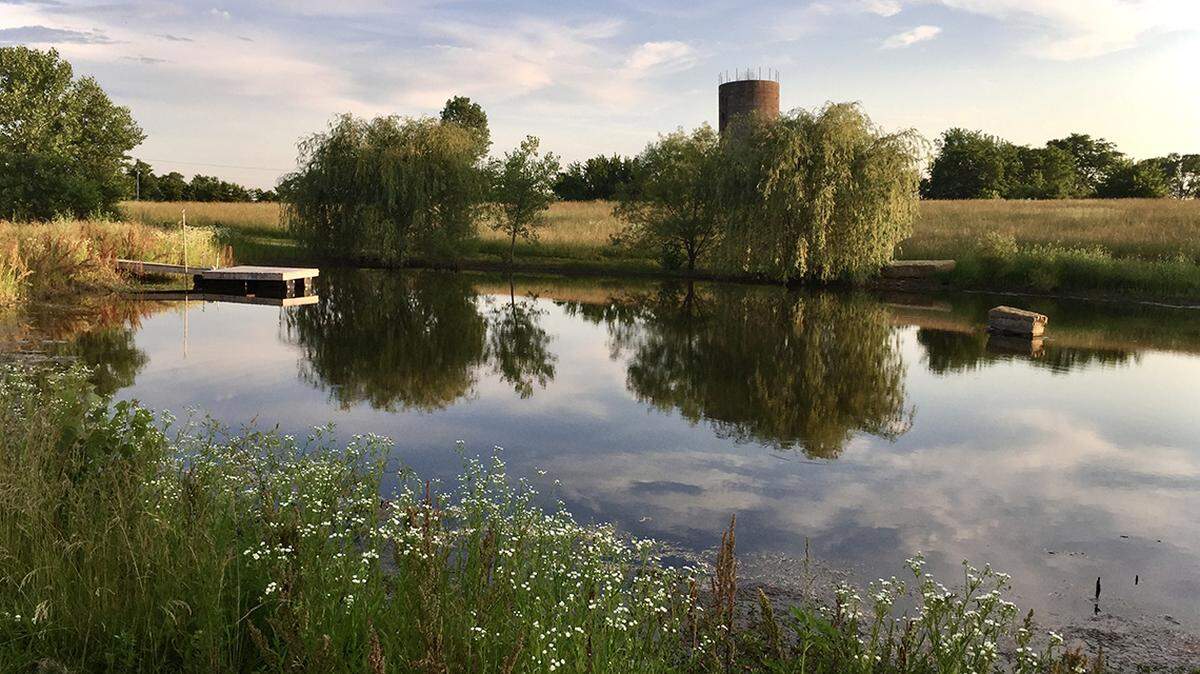
After two days’ work, with help from my brothers the day before, the dock reached 12 feet out into a quiet expanse of water and time. Even with more tasks ahead, standing on that new platform slowed time with the past floating up in relief. Reflections of sunrise, the old silo, willows and red-winged blackbirds shimmered across Fossil Pond’s glassy surface.
If I shifted my gaze — or my imagination — I could also see into the depths where not only catfish and bass now thrived but also where the excavation crew had first hit bedrock, where I’d walked alone one eerie winter’s night, and also where that same skeptical crew returned with my instructions to break up and pry out the ledge, one boulder at a time.
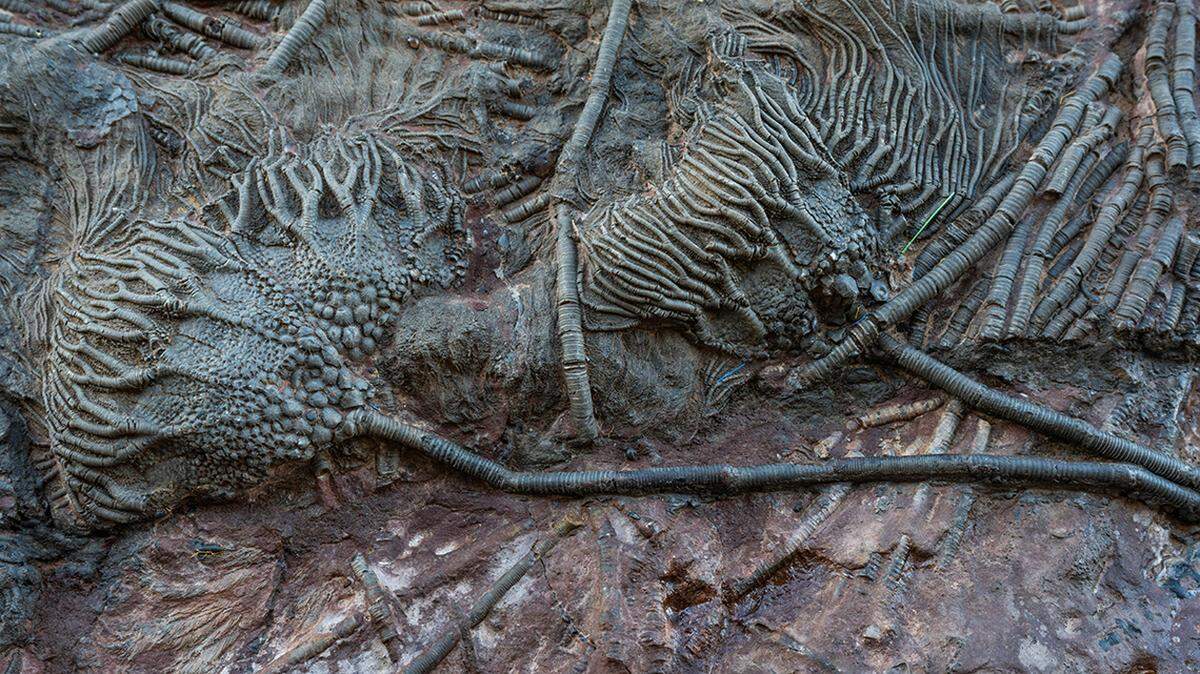
Massive piles of those stones ringed the shoreline, and a five-boulder-high island rose from near the pond’s center. The rocks brimmed with fossil fragments — bits of brachiopods, trilobites, corals — but most of all crinoids. My family, friends and I had found hundreds of crinoid fragments in the form of segmented cylinders. I had also discovered two crinoid fossil assemblages — plantlike marine creatures, long-stemmed and multi-armed, that anchored to this seafloor and reached up from the depths to the light.
A garden under a sea
I call it the seafloor because, incredibly, Paleozoic Era waters pooled here, but out far beyond Fossil Pond’s 100-foot diameter. The crinoids whose remains and traces have recently emerged from this limestone burial slab existed roughly 300 million years ago during the Pennsylvanian Period when Missouri lay beneath a warm, shallow sea by the equator.
The late Kansas City paleontologist and University of Missouri-Kansas City professor Richard J. Gentile, renowned for his work on Pennsylvanian strata and fossils, related that these conditions allowed crinoids, also known as “sea lilies,” to “grow in great profusion, probably resembling an undersea garden.” His book “Rocks and Fossils of the Central United States, with Special Emphasis on the Greater Kansas City Area” includes vivid illustrations by John Babcock that beautifully reimagine the seas here and the life and crinoids that teemed in them.
From my new dock, the notion of Gentile’s undersea garden undulating to the rhythms of an ancient sea was a mind-bender, along with other profound deep time differences. If transported on the dock to that time, I’d be swatting at dragonflies with two-foot wingspans. The sky would be pink from the fires across the planet, and — if I could handle the extra oxygen present then in Earth’s atmosphere that supported giant dragonflies — I might be able to travel up and down the newly formed supercontinent Pangea.
By night, the moon would look larger as it hung closer, and the stars would be reconfigured — no summer version of Perseus, for example, and so no need to make my annual Aug. 12 call to Mom to remind her to watch for her birthday meteors shower out of Perseus, because neither the constellation nor the Perseids could yet be seen.
More mind-bending, this was long before the dinosaurs — or any mammal — had evolved. Long before flowering plants or even coffee trees existed.
Before coffee existed. No wonder the raw excavation site had unnerved me in 2005. But it also sparked a decade of wonder about how it came to be. Upon that sunrise in 2015 dawned a new decade with the dock as a time-traveling raft, the pond its portal. I could see hundreds of the crinoids — a garden of sea lilies — in the water below me, a wide-open sea out to the horizon before me, and just beyond the corner of my raft and mind, a sun rising to warm that ancient world.
A Cold War relic revealed
Another excavation crew came to my land in 2015, this one chasing a miles-long geopolitical relic of the Cold War between the United States and the Soviet Union. They had dug a 6-foot trench across the neighbor’s field to pull out a large cable with copper wiring, and now wanted to slice through my land. Copper — highly conductive and in demand for electronic products — had surged in value, and the crew dangled $5,000 for my share of that cable.
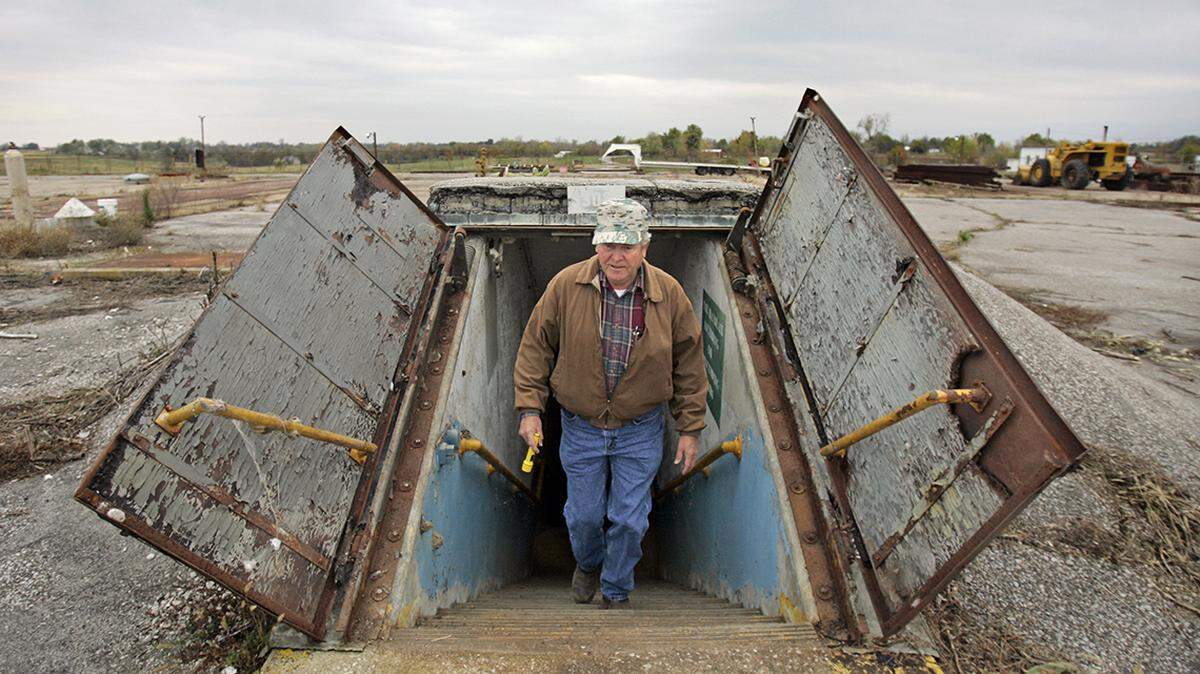
This wasn’t ordinary cable, but a communications and command control conduit laid by the U.S. government decades ago, in the late 1950s and ‘60s, as part of the infrastructure linking the Minuteman missile systems around nearby Whiteman Air Force Base. The system included 150 intercontinental ballistic missile silos and launch control centers punched separately, 80 feet into the bedrock of central Missouri. Regional geologists, while theorizing about how the conditions of our Paleozoic seabed had been advantageous for both crinoid life and then their later fossilization into limestone, also confirmed the bedrock’s geologic advantage for embedding the underground silos. Dr. Gentile was among the geologists who had advised the U.S. government.
Each missile could travel 7,000 miles and was tipped with a nuclear warhead. Moscow itself was 5,300 miles away. From 1963 until President George H. W. Bush decommissioned the system in 1991, launch signals through the cable could have wrought global annihilation and forever doomed the human race and most of life on the planet. Nikita Khrushchev notoriously warned a group of Western ambassadors, “We will bury you.” Chillingly literal: The military leadership of the United States and the Soviet Union mistrusted and despised one another, and for that hatred, what a shocking burial slab to be revealed at some dig another 300 million years hence. Or never.
As a young woman, geologist and author of “Trace: Memory, History, Race, and the American Landscape,” Lauret Savoy moved toward geology as sanctuary from the worst of human impulses. Savoy, who is Black, reminds us: “The landscape itself did not hate. It preceded hate.” She found “solace and refuge” in the land because it carried no judgment or malice aginst her.
As a longtime civil rights attorney who has been in many battles over housing discrimination, segregation and land use, I hear Savoy’s words ringing like an excavator’s bucket hitting bedrock. Malice ends at the rock. And the geology of my land — layered in time and space — offers perspective and sanctuary, allowing me to gather thought and strength. It fortifies my resolve to hold ground.
I had not read Savoy yet in 2015 but I’d like to think that she would have counseled me to let the land deal with the cable.
“No thanks,” I told the excavation crew.
Contemplating trees over a picnic
Today, another decade later, my wife Christina and I park our truck in the shade of the silo, on a slope of the hayfield overlooking Fossil Pond. With its water level down a foot and a half, and a few ragged, dying trees along its bleached shoreline, the pond looks like it’s been through a 20-year wringer. Half of one of the willow trees has cracked off and fallen uphill, its handlike branches reaching toward us like a corpse from its grave.
A couple of droughts have taken their toll, and we’ve let too many cottonwoods and willows grow up around it, siphoning thousands of gallons of water daily. Over our pickup picnic — sandwiches brought down from Kansas City — we resolve to cut down a third of the shoreline’s trees. We also resolve to stop giving them cool Native American names such as Sleeping Buffalo that only dissolve our resolve to fell them.
Time rushes by here like a stampeding buffalo. After our lunch, Christina and I walk down to the dock, itself bleached and crooked from the years and weather. From the dock, we can see in the surrounding fields dozens of fresh, round, 1500-pound bales from last week’s hay harvest. It’s my 21st year of overseeing the harvests, each one coming around faster than the last. And each year, we are still finding new fossils — including during a paleontologist’s visit in 2022 — along with shale and coal fragments, all geologic tells of a slower time with long sequences of alternating limestone (ancient sea), shale (swamp) and coal (swamp and forest) from the Pennsylvanian period. Fossil Pond’s layers run in the strata for miles, following us all the way home to Kansas City.
Just a couple months ago, I scrubbed black and green residue from limestone blocks that form an arch over our front door in Waldo. Revealed then in stone in the top right corner was a half-inch crinoid cylinder tilted in a 45-degree angle, perched there like a tiny prehistoric mezuzah.
Examining the other locally quarried stones and even those in our basement foundation, Christina and I have found many more fossilized fragments. We also see echoes of Fossil Pond in Kansas City’s bluffs, roadcuts, the limestone rocks of the Crown Center waterfall and in a stone fence along Wornall Road.
The dock creaks under our weight and ripples fan outward. The year 2025 itself already bears witness to a spectacle of hate, greed, corruption, deception, violence and warmongering, but Fossil Pond still shimmers as a portal to a world before such things existed. True, there were no flowers, love, music or even coffee. As always, solace with the estrangement.
Gary Rhoades is a civil rights attorney and author living in Kansas City. He and his wife Christina not only time-travel to the Paleozoic Age, but also split time between their home in Waldo and their fossil-rich hay farm near Warrensburg. Their adventures can be followed on Instagram: @thelonggravelroad
This story was originally published September 16, 2025 at 9:14 AM.