
Obama convinced Kansas about the American dream. Democrats, listen up | Opinion
Even Kansas’ own conservative Republican President Dwight Eisenhower recognized the political potency of the American dream. He bucked his party’s opposition to the New Deal-style big-government programs to build the interstate highway system, thus making that dream more accessible to millions of Americans.
It’s a lesson that Democrats today would do well to heed. It’s not any specific policy prescription, no appeal to identity or tactical change that will return them to the political promised land. Rather, they must reclaim the American dream.
From the 1930s through the early 1960s, Democrats dominated Congress and won six of eight presidential elections because they presented a community-focused variant of the American dream. Franklin D. Roosevelt and his heirs called for government to do for the people what no one, save for the very rich, could do for themselves. They depicted the rich as the enemy of progress and argued that ordinary people could prosper if they worked hard and the government invested in the whole nation. In this narrative, the identity that mattered was the American one, not any particular ethnic group. The community-oriented American dream also tapped into the idea of American exceptionalism: The extraordinary heroes of the founding had empowered ordinary Americans to prosper and serve their country.
The community-oriented variant of the American dream was undermined by failures of government in the Vietnam War and by the perception that government had become too big. Issues of race and identity also played a role. The community-oriented American dream had papered over the failures of the nation to provide opportunity for all. The heroic efforts of the justice movements for civil rights, women’s rights and others produced backlash among many who feared that their privileged role in society was thus threatened.
In this situation, Ronald Reagan played a crucial role in revitalizing the conservative movement and the Republican Party by presenting an individualistic variant of the American dream. In Reagan’s telling, ordinary people could prosper if the government would just get out of their way. In fact, Reagan’s attempts to cut the size of government were never very popular, and at the end of his two terms, many conservatives concluded that he had failed to radically reduce the size and scope of government. However, it was his eloquent retelling of the American dream that made him a commanding figure and produced three decades of conservative political dominance.
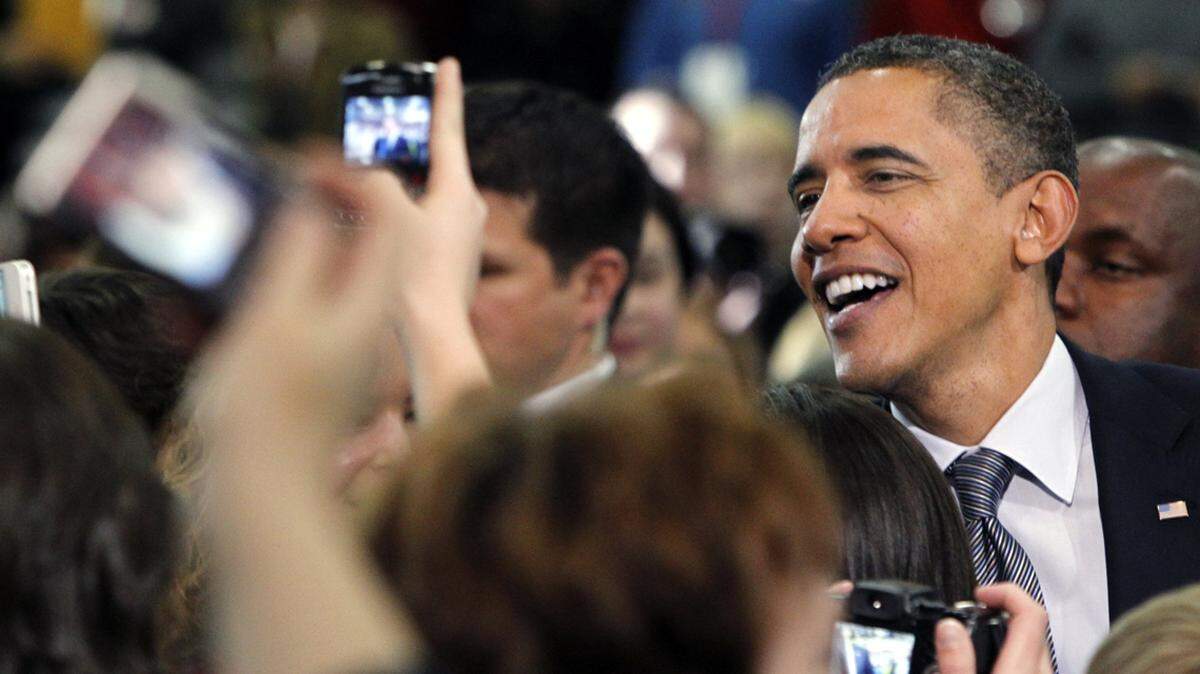
Just as perceived failures of liberalism created the preconditions for the Reagan revolution, the debacles of the Iraq War and Hurricane Katrina left an opening for a gifted narrator of the American dream — President Barack Obama — to revitalize the community-oriented narrative. He used it to rally support for the 2009 fiscal stimulus, the Affordable Care Act and other programs to make life better for ordinary people. Obama provided an updated, community-focused variant of the American dream in which what mattered was not your political party, race or gender, but that you were an American.
While many commentators focused on what Obama’s victory revealed about race in America, they failed to recognize that in Obama’s American dream narrative, he called upon the nation to invest in those who had been left behind, not because they were different or more deserving than others, but because they were us. Obama saw that injustices could only be addressed by focusing policy and rhetoric on lifting everyone up because we were one people.
Racial resentment, nationalist populism
Obama’s message inspired tens of millions, but, as in the 1960s, it also produced a backlash. And while Obama famously addressed those feelings in his 2008 “A More Perfect Union” speech by emphasizing all that Black and white working-class Americans had in common, others called for reparations or other action to address past and present racism. The result was to empower those who used racial resentment to fuel a nationalist populist movement that called for retrenching efforts to help those in need.
In an era fueled by racial and class resentment, Donald Trump shifted our politics to a nationalist, populist version of the American dream. In contrast to the fundamentally optimistic narratives of FDR, Reagan and Obama, Trump’s vision is dystopian. In his telling, ordinary Americans are being cheated by dangerous others — undocumented immigrants, Muslims, Chinese communists, gay and trans people and other demonized minorities. Trump offered to protect real Americans — by which he meant his largely white, working-class, evangelical base. Over time, the authoritarian nature of Trump’s narrative became more evident as he weaponized the government, calling for violence against his opponents and depicting himself in ever more absurdly heroic terms. This narrative has begun to appeal to some non-white Americans, too, especially young men who feel exploited by the elites.
Of course, all of it is based on wild exaggeration. The groups Trump attacked did not, in fact, threaten other Americans to any significant degree. To take just one example, undocumented immigrants commit far fewer crimes per capita than native-born Americans. However, in an information climate dominated by social media silos and with a core group of supporters who are low-information voters with limited knowledge of public policy, this dystopian narrative proved popular because of the emotional catharsis it produces. However absurd it may appear to the non-MAGA, it was extremely effective. Without the COVID-19 pandemic, Trump probably would have won reelection in 2020.
In 2024, Democrats were blamed for their largely effective public health and economic responses to the pandemic, while nothing stuck to Trump — neither his pandemic failures nor his attempt to overturn the 2020 election with the Jan. 6, 2021, assault on the Capitol.
In such a deeply entrenched political context, a renewed emphasis on identity politics is not likely to appeal to anyone beyond the most loyal Democrat, while only inflaming Trump’s base of support. Nor is a shift in policy alone the answer. If policy had been the focus of voters in either 2016 or 2024, Democrats would have won the presidency and taken decisive control of Congress. Trump appealed to non-college educated voters in the working-class, but he had few policies to help them — and much of his actual policy agenda cut taxes for the wealthy and slashed government programs that aided the working class. And a Democratic Party focus on tactics such as more podcasts will accomplish nothing without a better message. Trump’s message resonates because he has a coherent narrative that, while almost totally false, still rings true to many Americans. Democrats need to undercut that story and tell a better one of their own.
Key to that is a narrative that accomplishes three aims. It should tap into American exceptionalism by talking about what it means to be a U.S. citizen. It should tell a story not about how different we are, but about how we are all the same. Finally, it should tell a story with a clear hero — “we the people” — and a clear villain — the rich and their enablers.
‘Aren’t Democratic values or Republican values’
It shouldn’t be hard for Democrats to tell an updated version of the community-oriented American dream. It’s their legacy, after all. Obama used it to great effect as recently as his 2012 reelection campaign, when the nation was still in recovery from the Great Recession, and Republicans in Congress were doing everything they could to block his efforts to spur recovery. Of course, many Republicans and some independents could not get past Obama’s biracial identity, a point quite evident in Trump’s use of the birther conspiracy theory to gain political support. Despite these headwinds, Obama won easily. His retelling of the American dream, a variant of the narrative that he first presented in a major speech in December 2011 in Osawatomie, Kansas, played a key role in that campaign.
Early in the speech, Obama presented the core of his vision, stating: “This country succeeds when everyone gets a fair shot, when everyone does their fair share, when everyone plays by the same rules. These aren’t Democratic values or Republican values. These aren’t 1 % values or 99% values. They’re American values. And we have to reclaim them.”
The villains in Obama’s narrative were the rich who fought to cut programs needed by ordinary people and to eliminate regulation of wealthy corporations. Coddling the rich had created an economy where wage inequality was at “a level that we haven’t seen since the Great Depression,” he said, arguing that ordinary people needed to work together to fight what he aptly called “you’re-on-your-own economics.”
The policies that stemmed from this worldview were portrayed as commonsense efforts to protect ordinary Americans from rapacious elites. According to Obama: “Our success has never just been about survival of the fittest. It’s about building a nation where we’re all better off. We pull together. We pitch in. We do our part. We believe that hard work will pay off, that responsibility will be rewarded, and that our children will inherit a nation where those values live on.”
Fight predatory practices of the rich
Obama’s retelling of the community-oriented variant of the American dream resolves the key issues facing Democrats, even as it undermines Trump’s revanchist approach. Liberals should frame their policy agenda as helping ordinary people build a better life. They should vow and work to protect all who do their fair share, but who don’t get a fair shot because of the predatory practices of the rich. This includes pushing policies such as raising the minimum wage, protecting Medicaid and Medicare, protecting the health and safety of workers and supporting job creation through research and investment in cutting-edge technologies. Environmental policies responding to climate change can be reframed as means of cutting energy prices, creating jobs and reducing pollution.
Very few people follow the details of public policy debates. The central need for Democrats is to create a persuasive narrative about how their policy agenda will move the nation forward. The party was right to focus on the F-word in its attacks on Trump in 2024 — but that F-word was not fascism. It should have been double: failure and fraud, topics on which Trump is extremely vulnerable. A revitalized narrative can be presented as a continuation of the nearly 250-year battle to make the American dream a reality for all of us.
Recasting the American dream as a community-oriented narrative worked brilliantly for Obama in 2012, and it could help revive the Democratic Party today. It provides an empowering, unifying narrative that undermines Trump’s dystopian attacks on others and out-of-touch elites. It also allows Democrats to lift up those left behind while avoiding the backlash that often follows from policies designed to help specific groups. And it taps into American exceptionalism and revitalizes a sense of patriotism while providing a clear villain to fight against.
Robert C. Rowland is a professor of communication studies at the University of Kansas who focuses on presidential rhetoric and the American dream. He was the primary speaker on Ronald Reagan’s rhetoric at the Reagan Centennial and is the author of “The Rhetoric of Donald Trump: Nationalist Populism and American Democracy.”