
If Trump sends the National Guard to KC, Missourians’ rights are at risk | Opinion
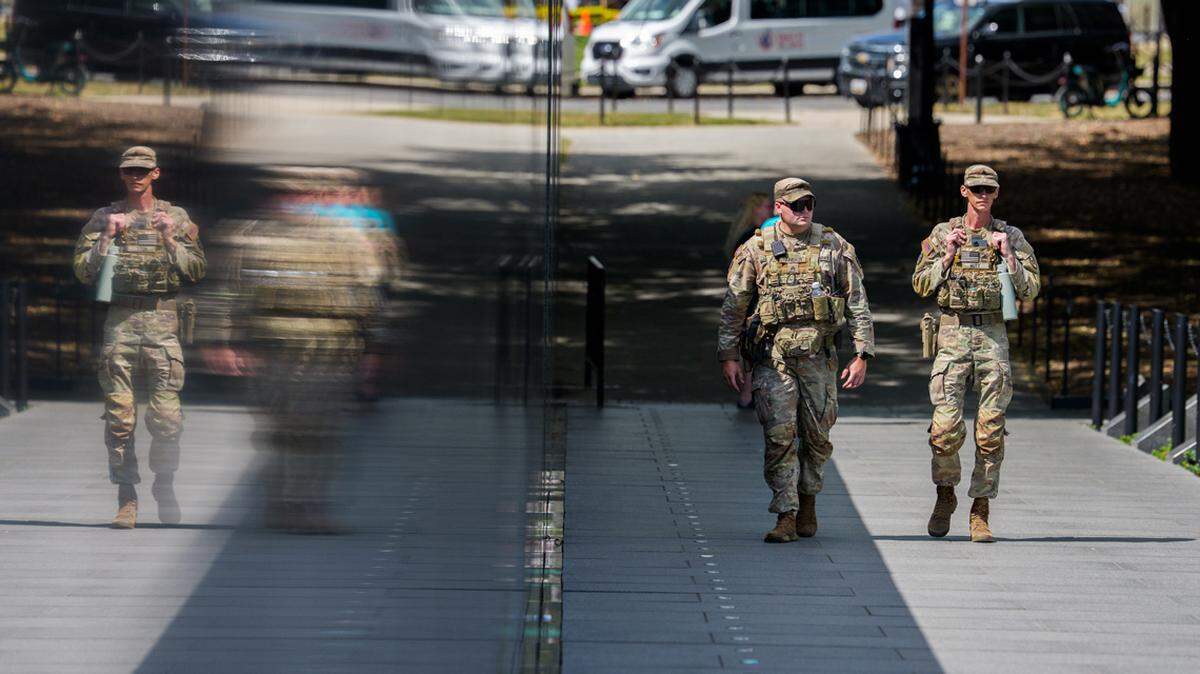
President Donald Trump continues his campaign to deploy military personnel to police some of America’s most populous cities. He said he could send troops to clean up the mess in San Francisco supposedly caused by Democratic leadership there. And more recently, he threatened to send forces to Chicago or New Orleans. This comes months after he sent troops to Los Angeles to quell a so-called rebellion against the United States, and weeks after he began using the District of Columbia’s National Guard as an auxiliary police force.
The list of potential sites for Guard deployment continues to grow. And with violent crime rates similar to — and sometimes exceeding — those of Chicago, Baltimore, Washington, D.C., San Francisco, and New Orleans, according to recent FBI data, Kansas City and St. Louis may be next.
Utilizing the military for general law enforcement is misguided. Troops are trained differently from police officers. Federal agents and those who lead them are not politically accountable to the communities they police, and this strains fundamental notions about the importance of local control over local issues. Nevertheless, one significant but underappreciated problem is that federalized National Guard members and active-duty military personnel typically cannot be sued for violating the constitutional rights of the people with whom they interact.
After the Civil War, the Ku Klux Klan waged a terror offensive aimed at formerly enslaved people. Unfortunately, Southern state governments and their agents, including sheriffs and judges, often turned a blind eye to the carnage or, worse, encouraged it. Congress responded by permitting individuals harmed by a state officer’s violation of their constitutional or statutory rights to sue the officer in federal court in what is now codified as Title 42 of U.S. Code Section 1983. It is under this law that the family of George Floyd, like countless others, could seek money damages for his murder at the hands of local law enforcement agents.
The ability to sue police officers and other government actors when they violate a citizen’s constitutional rights offers a direct check by the people on the authority of the government by allowing a jury to decide whether a state official crossed a legal line.
Yet, Congress never created a similar right to sue federal officers. The Supreme Court implied one from the Constitution itself in 1971 in Bivens v. Six Unknown Named Agents of Federal Bureau of Narcotics, a case involving allegations of unreasonable search and seizure, and created what are now called Bivens suits, allowing people to sue federal agents. But the court has limited liability under Bivens to three narrow circumstances: some unreasonable searches and seizures, sex-based employment discrimination and prisoner inadequate care claims. Recently, the Supreme Court has all but explicitly said, including at the end of its latest term, that it will not extend Bivens further.
So, if Trump sends troops to Chicago, San Francisco or Kansas City to “clean up” those cities, what happens if a federal agent violates someone’s constitutional rights? If it involves excessive force, the injured person may be able to sue under Bivens. But even that is not certain. The Supreme Court has declined to allow lawsuits based on excessive force where national security or border integrity are at stake. The Trump administration could, and likely would, argue that the military’s actions were pursuant to such an interest, given the White House’s references to migrant crime. And the Supreme Court traditionally has deferred to the president’s foreign affairs and national security powers. Thus, recovery is no guarantee. Moreover, if the harm was not the result of one of the three types of Bivens suits, the injured parties would be out of luck. Their constitutional rights were worth less than the paper on which they were written.
Americans across the political spectrum should want law enforcement officers to be accountable to the people. That is not a partisan issue. Regardless of who occupies the White House, we should incentivize those tasked with enforcing the law to follow it.
Ultimately, if the president deploys federal agents to America’s cities in a general law enforcement capacity and the courts do not stop him for exceeding his authority, it is up to Congress to ensure that Missourians and all Americans can hold soldiers accountable for any constitutional violations they cause. Congress, with support from Sens. Josh Hawley and Eric Schmitt and the rest of Missouri’s delegation in Washington, D.C., should allow lawsuits against federal agents for alleged constitutional deprivations.
As we seemingly edge closer to a federalized paramilitary police presence in multiple cities, the need to create a path for direct accountability to the people is perhaps as strong as it has ever been.
Bailey D. Barnes is a professor at the University of Missouri School of Law in Columbia.