
Mexican sister city sculpture doesn’t belong on Kansas City streets | Opinion
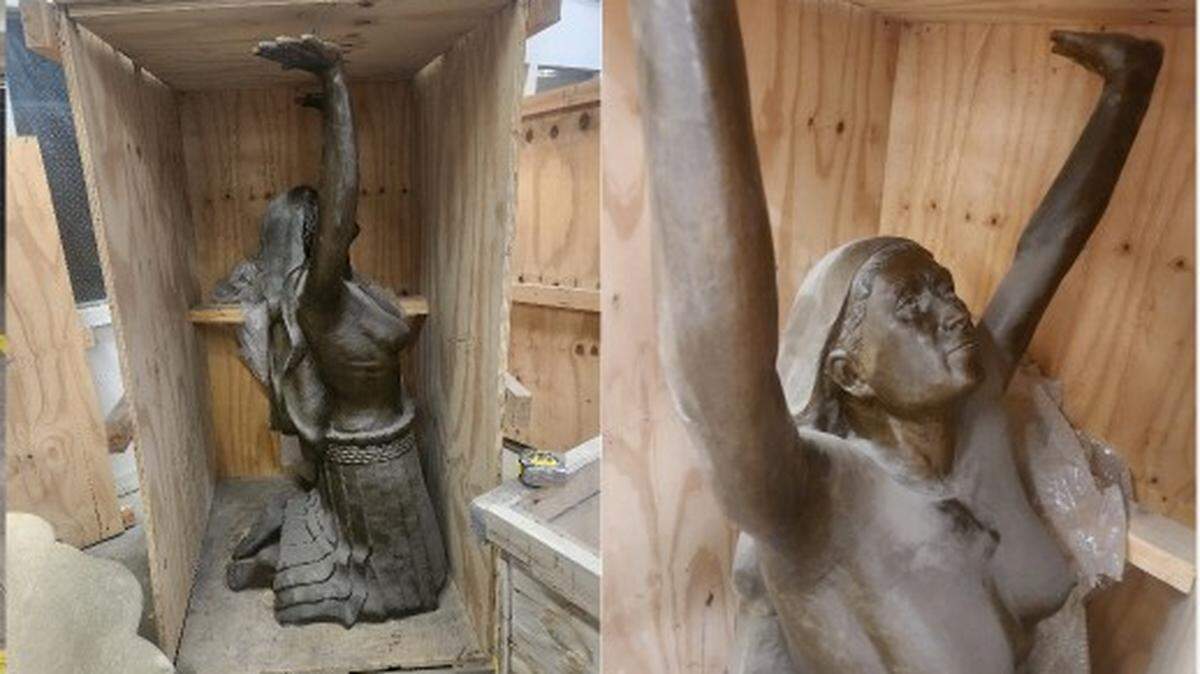
As The Kansas City Star reported earlier this month, a replica of the sculpture “Las Tarascas,” gifted to Kansas City in 2013 by its sister city of Morelia, Mexico, may come out of storage and be placed at a triangular swath of public land at the busy intersection of Southwest Boulevard, West 23rd Street and West Pennway. While the news story presented a general overview of “Las Tarascas’” provenance, a more detailed history of this artwork is necessary to fully understand its origin, meaning and identity in relation to its proposed contemporary setting.
Antonio Silva Díaz and Benigno Lara were the artists of the original piece, called “Fuente de las Indias,” a polychromed, concrete fountain placed in the center of Morelia in 1931. In 1964, the fountain, now called “Las Tarascas,” was removed from its setting (and replaced with an unrelated sculpture), as Fernando Ochoa Ponce, the city’s president, considered it inappropriate and out of context for the site. It wasn’t until 1984 that Morelia artist Jose Luis Padilla Retana was commissioned to create a replica of the original “Las Tarascas,” this time in bronze. It still stands in the center of town. Subsequently, a third iteration by José de los Santos Sánchez Martínez was donated by state government to the city of Buenos Aires and installed in 1998. To date, it can’t be confirmed whether Martinez also sculpted Kansas City’s gift.
Based on the original sculpture, Kansas City’s bronze “Las Tarascas” features a trinity of topless Tarascan women on their knees, gazing skyward, with arms raised holding a large basket of fruit. Given its iconography, “Las Tarascas” is bound up in history that we have come to critique, where the obvious sexualization of a group of Tarascan women in this instance is exploitation at its worst. This message is deeply inappropriate in our time. Instead of monumental dignity, we have subjugated humility. Without any distinguishing features, albeit the fact that they represent three tribal princesses, they become an avatar for something else. As author Paulina Nava wrote: “The names of the women become irrelevant even though their indigenous bodies are significantly credited as an ethnic marker of Michoacan’s sociological pride.”
In 2022, a letter signed by 23 residents of Kansas City’s West Side was sent to the director and commissioners of Kansas City Parks and Recreation voicing objections to the placement of “Las Tarascas” at 17th and Holly streets. While no action was taken, it may have stalled the permanent placement, at least until now. While the Municipal Art Commission recently unanimously approved the installment of “Las Tarascas,” it is curious to ask if the sculpture’s complicated history and the impact of the proposed placement — adjacent to a busy thoroughfare in a mixed use neighborhood — was deliberated.
With the current political and cultural climate that we are in the throes of in the United States, it is imperative to carefully consider not only the goals of arts administration but what should be the historical discourse moving forward. Representations of marginalization and disempowerment must not be part of our collective narrative, lest it becomes a colonialist platform.
There are other matters to consider, such as the very term Tarascas (a name given to the indigenous community of the Purépecha by the Spanish), the gesture of the three princesses offering a basket of fruit, and the display of overt exoticism. Over time, the various iterations of “Las Tarascas” have been a source of criticism by locals and their native communities, including erecting an “Antimonumenta” artwork of feminist protest, next to “Las Tarascas” in Morelia on March 8, 2021. This event was a show of solidarity with women who are victims of violence.
So how do we respond? As suggested by Gaylord Torrence, curator emeritus of Native American Art at the Nelson-Atkins Museum of Art: “Let’s honor the intent of the gift to Kansas City in 2013, preserve and properly interpret ‘Las Tarascas.’ Perhaps it would be most appropriate to house the sculpture in a museum setting such as the Nelson-Atkins or the Museum of Kansas City, thereby offering permanent protection and hopefully thoughtful presentation of its complex history and meaning.”
Cydney E. Millstein, Hon. AIA, is the founder and principal of Architectural & Historical Research LLC. She lives in Kansas City.