
Medicaid is a commitment. Missouri and Kansas health is at great risk | Opinion
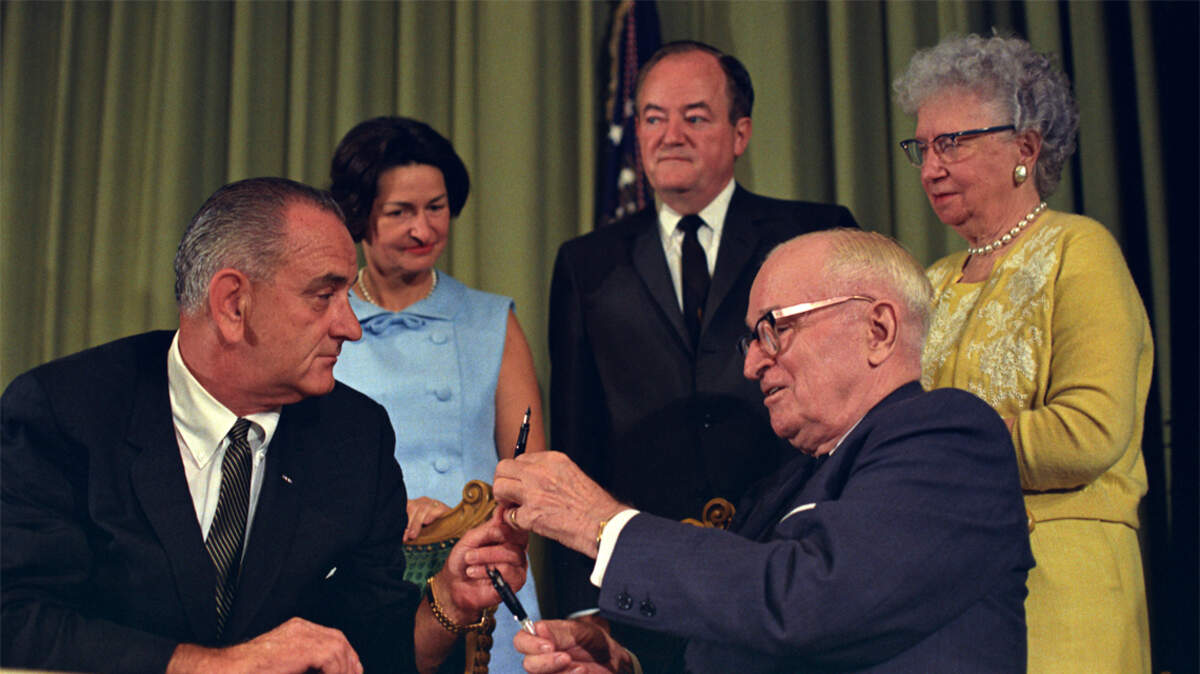
Sixty years ago, President Lyndon B. Johnson stood with former President Harry S. Truman at the Truman Presidential Library in Independence and signed Medicaid into law as part of his Great Society vision — a bold commitment to health equity and economic justice.
Johnson felt it fitting to honor Truman, the first president to champion national health insurance. The signing symbolized a culmination of Truman’s vision.
Quoting Truman from a generation earlier, Johnson stated: “Millions of our citizens do not now have a full measure of opportunity to achieve and to enjoy good health. Millions do not now have protection or security against the economic effects of sickness. And the time has now arrived for action to help them attain that opportunity and to help them get that protection.”
Reformers of 60 years ago envisioned Medicaid as a stepping stone toward universal health coverage. Today, that vision is slipping further out of reach, partly because of our nation’s conflation of employment with health care benefits.
In America, we’ve been conditioned to believe that providing health care is not a fundamental role of government, but a benefit accrued through employment or a service obtained through one’s own resources. Instead of seeing a basic human right to healthcare, we are a short step from mandating work requirements as a precondition for granting healthcare.
For example, the U.S. agriculture secretary recently suggested that a combination of automation and forcing Medicaid recipients to work could cover the loss of farmworkers removed in mass deportation efforts.
The recently passed budget reconciliation bill — dubbed the One Big Beautiful Bill — threatens to strip Medicaid coverage from millions. The Congressional Budget Office estimates nearly 17 million Americans could lose coverage nationwide. In Missouri, up to 160,000 residents may be affected annually. In Kansas, 13,000 people are projected to lose access to Medicaid, with rural hospitals facing a $2.65 billion loss in funding over the next decade.
The real impact is felt in places like St. Joseph and Leavenworth — communities where Medicaid isn’t just a policy, but a lifeline.
In St. Joseph, a city of just over 70,000, the local hospital system relies heavily on Medicaid reimbursements to keep its doors open. Missouri’s Medicaid program, MO HealthNet, covers 1 in 5 residents statewide, including 40% of children and two-thirds of nursing home care. The proposed cuts would force hospitals to reduce services or close altogether.
Already, 21 hospitals have shut down in Missouri since 2014, and 25 more are at risk. St. Joseph’s rural neighbors depend on these facilities for emergency care, cancer treatment and maternal health services. If the bill’s work requirements and funding caps are implemented, patients undergoing chemotherapy could be forced to work 80 hours a month to retain coverage — a cruel irony for those too sick to work.
In Leavenworth, the city’s proximity to rural counties makes it a hub for health care access. Yet Kansas stands to lose $3.897 billion in Medicaid funding under the Senate-approved bill. Rural hospitals in the state are already operating in the red — 87% of them, to be exact. The bill’s work requirements and provider tax restrictions will only deepen the crisis. According to the United Methodist Health Ministry Fund, 63 rural hospitals in Kansas are at risk of closure, with 26 at immediate risk. Leavenworth’s hospital system, which serves thousands of Medicaid recipients, could be forced to cut services or shut down entirely.
Medicaid is arguably among the most impactful health care legislation in U.S. history, perhaps second only to the Affordable Care Act. It was signed into law in the nation’s heartland, where it became a lifeline for rural and urban populations alike.
Now that lifeline is frayed, and the heartland braces for pain.
Jeron Ravin is the president and CEO of Swope Health, a community health center that provides comprehensive primary care, dental care and behavioral health services in 23 locations throughout Missouri and Kansas.
This story was originally published August 17, 2025 at 5:08 AM.