
Raytown, show your pride in our city and vote yes for our parks Aug. 5 | Opinion
On Aug. 5, the residents of Raytown will go to the polls to vote on a sales tax to support Raytown parks. In Jackson County, every city has a sales tax to support its local parks. The rates in the surrounding communities range from one-fourth to one-half of a cent. Independence, Liberty, Lee’s Summit and Gladstone are at one-fourth. Blue Springs and Grain Valley are at one-half cent. Raytown’s park sales tax is just one-eighth cent. A yes vote would go toward setting Raytown’s rate in line with other cities in the county.
Raytown’s city parks budget is literally the lowest in the county, and has been virtually unchanged since 2010. The budget for 2010 was $1.242.000, while 2023 it was 1.219.000. In fact, Raytown’s park budget has actually shrunk over the years, with its 2003 budget being $1.645.000.
Meanwhile, inflation has risen about 75% since 2003. In 2013, staff salaries for Raytown Parks and Recreation made up 33% of the department’s budget. In 2023, salaries made up 62%. I could throw out numbers all day, but the bottom line is that the current budgetary situation for Raytown parks is totally unsustainable.
To add to this, the parks department is now spending more money to address security issues. Safety is a priority in the parks, and crime is something that concerns all of us. Parks are for families and must be safe. Additional security lighting has also been added to all parks in recent years. In response to several recent events, security patrols have been increased. Security is important, but with the current budget situation, those security measures come at the cost of other areas.
We now reach the question of deferred maintenance. As we’ve seen, the parks budget has not increased in over a decade, while inflation and the overall cost of living has marched on. Salaries, security costs, utilities (parks use electricity and water, too) and gas continue to increase, as well as the cost of general maintenance on park facilities. Just as you might delay painting the house or fixing the driveway during rough economic times, our parks department has had to defer maintenance. In this case, that deferred maintenance has been going on for well over a decade, and at present totals $5 million.
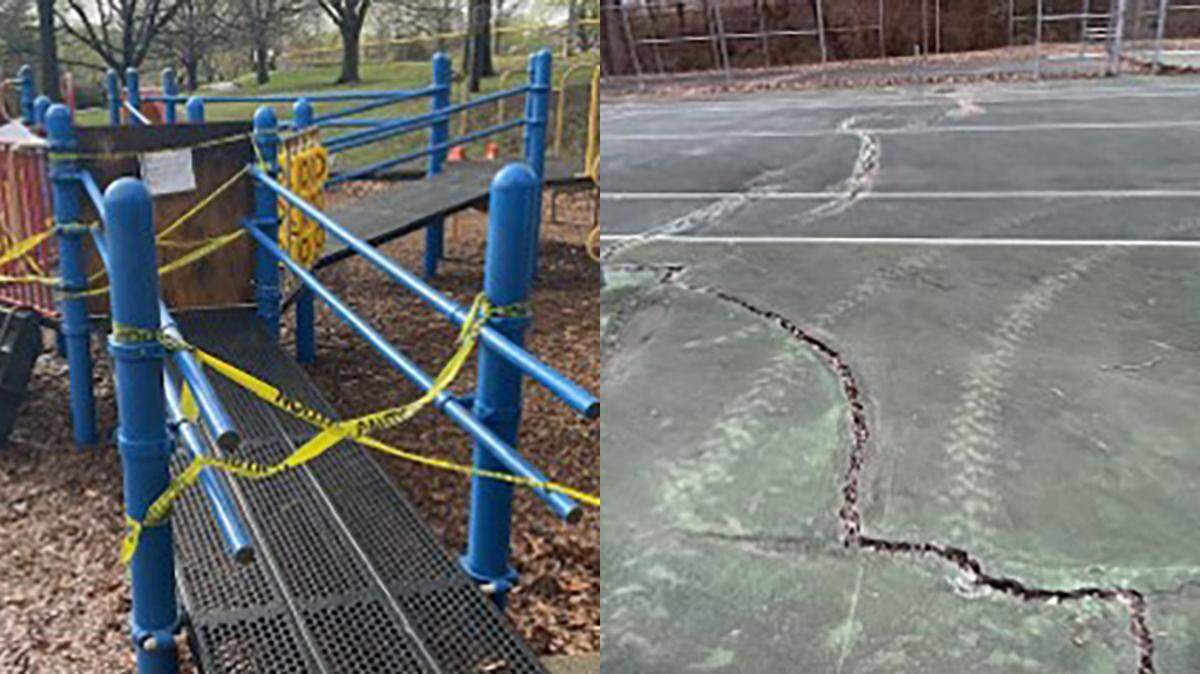
That was not a typo. The list of park facilities in need of replacement is long. Most of the shelter houses are at best 25 years old. Playgrounds for public parks are not designed to last 20 years, and yet that is what we are seeing. You have seen with your own eyes the pond wall in Kenagy Park, which is crumbling and has become a safety issue. The cost to repair the pond wall is estimated at $850,000. That’s 67% of the entire annual budget needed for one project.
The pond is not the only park feature in need of replacement. All playgrounds in Kritser Park are the originals from when the park opened, and are at the end of their lifespans. The cost to replace them is $290,000. The tennis courts at Minor Smith need resurfacing, as do the pickleball courts at Southwood, at a cost of $330,000 and $220,000 respectfully. The bathroom at Kenagy, the shelter house at Colman, that Minor Smith shelter house — all these facilities are decades old and should have been replaced over the years from the annual budget, but haven’t because that budget wasn’t enough to do so.
While some of these facilities can be addressed through grants, those grants require matching funds — funds that the budget simply no longer has. Five million dollars in deferred maintenance can’t be fixed overnight, but the first step needs to be to at least to tread water. This tax initiative would go toward attacking our parks’ deterioration. This tax initiative would cost 2.5 cents on a $10 purchase to anyone who spends money in Raytown, not just our residents.
I want to leave you with one final thought: Your parks department is taking care of your parks. Make no mistake — these are your parks. They reflect our community. Last year, Kenagy saw more than 90,000 unique visitors, meaning that at least 60,000 people from outside Raytown came and used Kenagy Park.
Show the people of Raytown that you care about your community. Vote yes.
Brian Morris is board president of the Raytown Parks and Recreation Department.