
Social media distorts young people’s self image. Safe Reflections can help | Opinion
When I founded Safe Reflections, I envisioned it as more than just a charity — it was my response to a growing societal need for awareness and compassion surrounding body dysmorphia. My project began in December of 2023 as a spark of concern, rooted in my personal journey of overcoming body confidence struggles. Along with my co-founder and vice president, Ipsi Bapat and Sahasra Balusu, I set out to address the stigma surrounding body dysmorphia and create a safe space. Today, it has transformed into a beacon of hope for individuals grappling with self-image and mental health challenges.
Safe Reflections focuses on three pillars: awareness, advocacy and community support. From the start, we used creative outlets to engage our community. We organized charity dance performances to raise funds and spark conversations about body positivity, partnering with dance studios such as Nartan Academy. We also set up booths at local events such as India Nite and the KU Medical Center Diwali Festival, where we shared resources and talked with attendees about the seriousness of body dysmorphia. These events allowed us to connect directly with people, fostering an open dialogue in spaces where mental health is often overlooked.
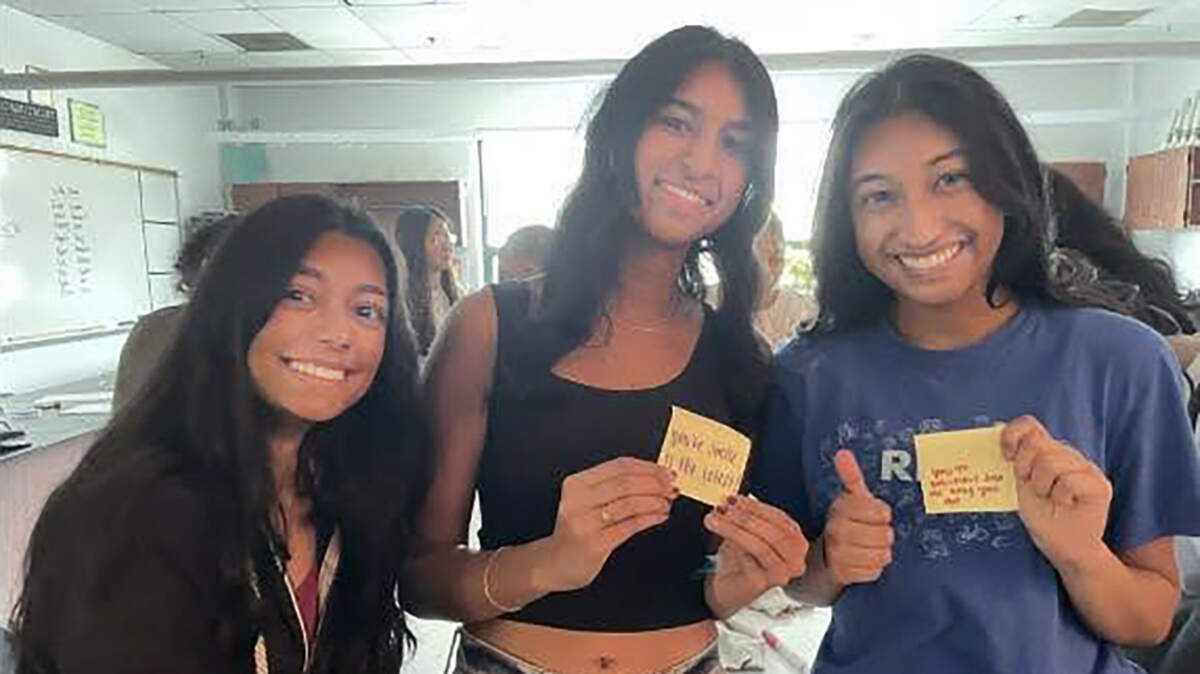
Our outreach extended into schools, specifically our school Blue Valley West, where we gave presentations and led activities to engage our peers and emphasize the importance of addressing body dysmorphia as a serious issue. These presentations were designed not only to inform but to inspire action. We shared real stories, statistics and solutions, creating a ripple effect of understanding and empathy among our school community. Additionally, my favorite activity encompassed making a group of people write an insecurity on a note. They then passed the note to the person next to them, and that person instead wrote a compliment on the back of the sticky note and handed it back.
This activity was implemented to show that even if you may feel insecure about one specific aspect about yourself, others see so many positive things about you that you can miss if you hyperfixate on one flaw. In some cases, it even highlighted the fact that the aspect you may hate about yourself, others actually love. To add, we placed positivity posters all over the school to remind students constantly the value they hold regardless of how they look.
Comparison to others online a trap
Social media also is a vital part of our mission. Social media has become an integral part of modern life, with billions of people around the world using platforms such as Instagram, Facebook and X to connect with others and share their experiences. However, social media can exacerbate body dysmorphic disorder by perpetuating unrealistic beauty standards, fostering comparison and competition, and promoting the objectification of the human body.
Individuals with body dysmorphic disorder may become trapped in a cycle of negative self-comparison and self-criticism, further reinforcing their disorder. In fact, we interviewed some people in our community to gain more insight on when a varying perspective about body image begins and what could have led to such thoughts.
We asked them the following questions:
- Who is someone you think you should look like?
- Why do you feel that way?
- Is this a healthy mentality?
To summarize our findings, we discovered that as the age of the interviewee increased, there was an increase in insecurity in one’s body. One 8-year-old girl who has no form of social media was interested in simply having her friend’s hair, while two older girls who have been exposed to social media felt disheartened by looking at others and have set unrealistic expectations for themselves. As the age of primary exposure to social media decreases, the negative impact of this technology is clearly increasing. Thus, by making an account that spreads awareness about body dysmorphic disorder and positive messages, we hope to make social media less scary and a better place.
Through our Safe Reflections Instagram platform at @safereflection, we continued to spread awareness online, posting inspirational quotes, actionable tips and stories from celebrities who have faced similar struggles. By showcasing these stories, we remind our audience that they are not alone in their journey. This online presence allowed us to reach a broader audience and keep the conversation alive even beyond our local events.
Personal stories of transformation
One of our most poignant initiatives was our partnership with SAMHSA, the Substance Abuse and Mental Health Services Administration of America. SAMHSA invited Safe Reflections to its first Youth Summit, where we connected with like-minded mental health advocates to further amplify our message to the national level.
Through all of our efforts, we were able to raise a total of $1,500, a number that only continues to grow.
The ripple effect of Safe Reflections has been profound. Beyond the numbers, the project’s greatest impact lies in the personal stories of transformation. After our events and presentations, we ask for feedback on anonymous online forms for future improvement. The input given has been invaluable. One participant of our charity dance (unnamed for privacy reasons), only 10 years old, shared how she never realized how the issues she faces in the mirror is something others can relate to. She continued by sharing how knowing that others can share her pain made her feel less isolated, affirming that she would continue taking part in our charity to ensure a greater impact. Additionally, many people left comments thanking us for our project and were surprised by the amount of engagement we received. Witnessing these individual ripples expand into waves of change reaffirmed my belief in the power of kindness and community.
For me, Safe Reflections is deeply personal. I created it to provide others with the support I wished I had during my own journey. It is an issue that is prominent in our society but often overlooked because it is so common. I hope to reduce the notion that it is seen as “common” to not love your body, encapsulating my belief that every individual deserves to feel seen and valued. While Safe Reflections began as a local initiative, today, its mission has grown beyond geographical boundaries. My team and I work for the expansion of Safe Reflections every week, attending all possible events. Through educational programs and online resources, we continue to raise awareness and foster a culture of acceptance.
For me, it is not just a project — it is a promise to create a world where kindness and understanding prevail.