
Kansas universities face brain drain threat as tenure protections could be gutted | Opinion
Kansas has more than a few challenges these days. Do we need to add a heaping dose of self-inflicted brain drain to the list?
Steven Lovett seems to think so. Lovett is the general counsel and vice president for risk management at Emporia State University — an institution best-known in academia these days for a post-pandemic firing spree of nearly three dozen tenured faculty a few years back, part of a dramatic “realignment” driven by the university’s Koch-connected president.
Correlation isn’t necessarily causation. But we do know that ESU’s enrollment dropped by 13% the next fall after all those faculty were turned out. So there’s that.
Now Lovett wants to spread that magic to the rest of the state’s public colleges and universities. He has authored — in his capacity as a private citizen, he says — a bill that would gut tenure protections for roughly 2,800 faculty at higher ed institutions across the Sunflower State.
Technically, the bill declares that professors and instructors have no “property interest” in the tenure they receive from a university.
Which means all those campus eggheads — researchers and scholars and teachers — would suddenly become really easy to get rid of. No more due process. No more requirements that firings can only happen for a good, well-defined reason.
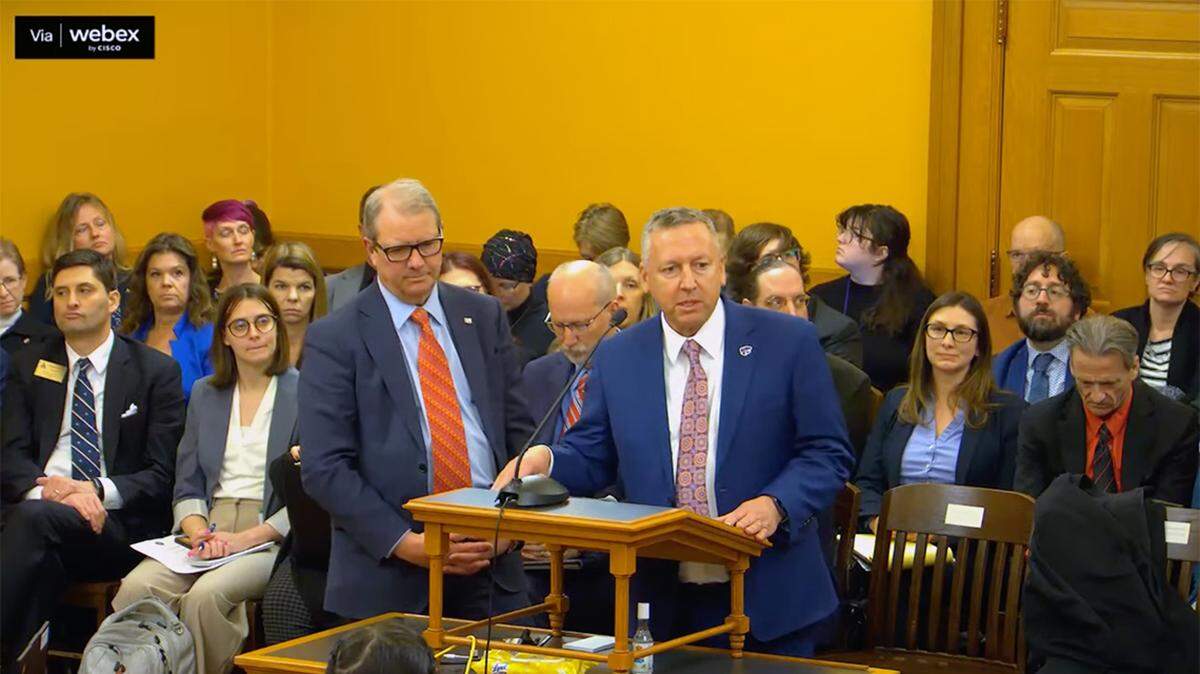
The bill is necessary, Lovett said Tuesday at a packed meeting of the Kansas House Judiciary Committee, because tenure protections leave the state’s universities unable to nimbly respond to changing budget and enrollment situations.
“Public universities are encumbered, culturally and financially” by those protections, Lovett said.
You know what? Lovett raises a fair concern.
Universities in Kansas and across the country face a baby bust-driven “enrollment cliff” that will most likely force big uncomfortable changes in how academia operates. Nimbleness will be the order of the day if those institutions want to survive. Everybody understands that.
‘Devastating impact’ on scholar quality
So it’s interesting that University of Kansas Chancellor Douglas Girod, Kansas State University President Douglas Linton and Kansas Board of Regents CEO Blake Flanders — three men with a real stake in ensuring that survival — all showed up Tuesday to oppose Lovett’s proposal.
Why? Because whatever problems might exist with tenure, it’s also the engine that powers higher education across the country.
Take tenure away, and you’ll see some of the state’s brightest minds flee to all the other states and institutions that will give them protections.
Loviett’s bill would have a “devastating impact on our institution’s ability to retain and recruit the very best scholars in the country,” Girod said.
Linton said those protections have helped K-State attract scholars who have led research — in agriculture and biosciences — that are critical to some of the most important sectors of the Kansas economy. Junk tenure, he said, and the university “would struggle” to do work that gives the state a “competitive edge” in those fields.
A brain drain would be costly, in other words.
It’s easy to see why Kansans might support Lovett’s bill, though. Not a lot of private sector jobs come with the kind of job guarantees you can get working for a university.
Why should professors get all the privileges?
Girod said it’s not so simple. Tenure is difficult to earn in Kansas — a multiyear process, with tenure granted only after a scholar has undergone a “stringent” review by their peers. Keeping it isn’t automatic: Tenured professors at KU undergo a post-tenure review every seven years to ensure they’re still making contributions to the university.
“It’s a job for life,” Girod said, but only “if you do your job and do it well.”
What seemed clear Tuesday is that the process is being rushed. Lovett’s bill was introduced in the Legislature on Thursday, a hearing held just a few days later, and a committee vote could happen by the end of the week.
That’s not a lot of consideration for a proposal that could upend a university system that has enormous economic impact and educates tens of thousands of Kansans.
It’s time to slow down. If legislators decide to inflict a brain drain on Kansas, after all, the least they could do is be thoughtful about it.
This story was originally published February 12, 2025 at 5:04 AM.