
Antidemocratic moves of Josh Hawley, Democrats are just symptoms of our real problem | Opinion
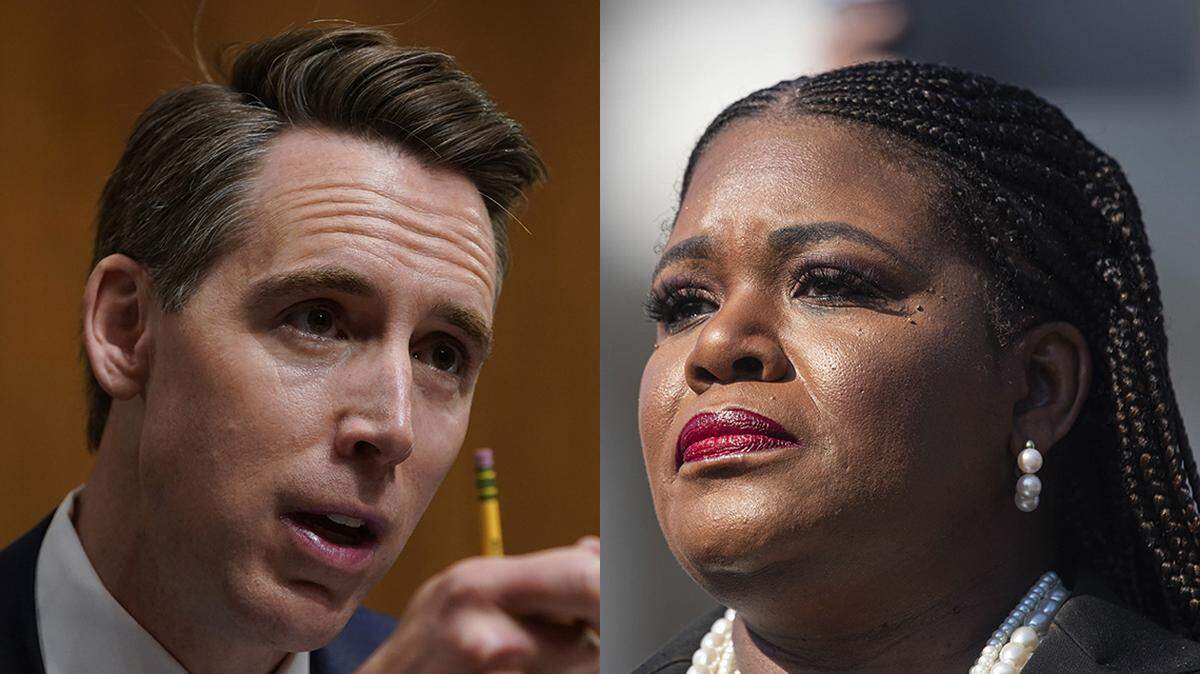
Donald Trump’s violations of democratic principles are the most obvious. His loyalist Missouri Sen. Josh Hawley was among Republicans who actively supported Trump’s attempt to overturn the 2020 presidential election results. In addition to repeatedly characterizing the violent Jan. 6, 2021, attack on the Capitol as peaceful protest,” Trump has rejected court decisions — and now proposes a Jacksonian spoils system in his second term that would replace apolitical civil service administrators with handpicked loyalists.
Democrats also violate democratic principles. More than 500 Democratically-controlled communities and some states declare themselves sanctuaries against federal law. Missouri’s former U.S. Rep. Cori Bush opposed support for border security. Democrats’ preferred word — “undocumented” — redefines these people’s illegal immigration status. Democratically-controlled states led in legalizing recreational use of marijuana against federal law — some even decriminalized the use of hard drugs. (Recreational marijuana became legal in Missouri in 2023.) Leading Democratic politicians want to get rid of the Electoral College, which would disenfranchise most counties in the country in our presidential elections. Others advocate packing the Supreme Court.
These measures are not designed to improve governance. Their purpose is partisan control.
What’s troubling is the number of people in both parties who accept these developments. At the initial Lincoln-Douglas debate in August 1858, Abraham Lincoln said: “Public sentiment is everything. With public sentiment, nothing can fail; without it nothing can succeed. … He who molds public sentiment, goes deeper than he who enacts statutes or pronounces decisions.”
Americans suffer information deficit
Contributing to the problem is the decline of American journalism in the electronic era. A recent story in the Atlantic magazine included the loss of hundreds of journalists over recent years at The Washington Post, NBC News ABC News, National Public Radio, Vice, Vox and BuzzFeed. Public radio and television have largely detached themselves from public opinion. NPR shut down its listener comment line in 2016, and the PBS News Hour lets informed corrections or serious comments go into black holes. In spite of their unique coverage, these organizations’ culturally exclusive tendencies punt wider outreach to Fox News. They failed to see trends that helped elect Trump. Magazines and social media communications now tend to serve people according to their preferred political orientation.
A major problem is the public’s lack of knowledge and interest in political affairs, demonstrated by a poll of the Annenberg Center for Public Policy in 2017. It found that only 1 in 4 Americans could name the three branches of the federal government. Minimal interest in public affairs is confirmed by the trivial subjects on the covers of magazines in the racks in any supermarket or drugstore. This means that people can be manipulated by sophisticated strategies.
The foregoing conditions don’t include disagreement on climate change, with half of the Republican members of Congress and the incoming president adopting positions contrary to concerns of 195 nations that signed the Paris Agreement of 2015 to limit global carbon emissions. How do we account for these problems? Historical developments can be shown to have contributed to polarization, and it’s not any one party. Transformation of the civil service system by the Civil Service Reform Act of 1978 was described in favorable terms in official statements. The reality is that the act allowed presidents to take substantial control of federal agencies. President Ronald Reagan’s first administration used the Civil Service Reform Act to roll back enforcement of environmental regulations, leading to congressional backlash and subsequent political polarization. That led to congressional gridlock, which since 1990 has blocked normal functioning of the federal government.
Gridlock has prevented congressional action on critical national problems. Frustrated by inability to enact legislation, presidents have taken action through executive orders and other initiatives. But since President Jimmy Carter administration, initiatives from each subsequent president have been overturned by subsequent administrations. Dysfunction in government, the increasing role of money and interest groups on policy and other developments have caused public confidence in the federal government to decline from 77% in 1964 to about 20% in 2023, according to the Pew Research Center.
Except for the Clinton-Gore Reinventing Government program, presidents have failed to recognize underlying problems and propose meaningful reform. Discord was aggravated by President G.W. Bush’s record signing statements, declaring that he would not implement parts of congressional laws. President Barack Obama undermined constitutional order by appointing “czars” with policymaking responsibilities without approval by the Senate. He and his attorney general declined to support the Defense of Marriage Act, signed by President Bill Clinton, declaring that it was unconstitutional, although this function is entrusted to the federal courts.
Carnegie: US ‘pernicious polarization’ unique
An international study by the Carnegie Foundation for International Peace reported that the U.S. suffers from a “pernicious polarization” unique among wealthy democracies. Its major research report on that polarization concluded that elite groups of both political parties became polarized since the 1980s, and that politicians are ideologically polarized with little overlap. The general public is less ideologically polarized than people think, but they are emotionally polarized — they don’t like members of the other party. “Advocacy that amplifies the belief that members of the other party are bent on destroying democracy itself is likely to deepen polarization and support for antidemocratic action,” the report said.
Following up Lincoln’s point about the role of the public in politics, I queried the chatbot ChatGPT on “U.S. educational principles” to learn American educators’ goals in preparing youth for citizenship. ChatGPT is a leader in artificial intelligence and draws on views from dominant sources. It reported eight major principles: equity and access to free and public education; student-centered learning; inclusion and diversity; accountability and standards; community and parental involvement; lifelong learning; critical thinking and problem solving. These seem to offer minimal focus on an informed and active citizenry regarded by the founders as critical for democracy. There was no mention of history, civics or citizen responsibility.
This is the bad news. For a more positive view, I go back to Alexis de Tocqueville, the perceptive French student of American democracy. He saw Americans as headstrong and prone to serious mistakes. But once they recognized those mistakes, they were quicker than other nations to correct them. If the causes of our current problems get the proper attention, Hawley and his counterparts can be sidelined and we can return to a more harmonious society.
This story was originally published January 17, 2025 at 5:02 AM.