
How great Kansas Republicans Bob Dole and Dwight Eisenhower would view Trump’s GOP | Opinion
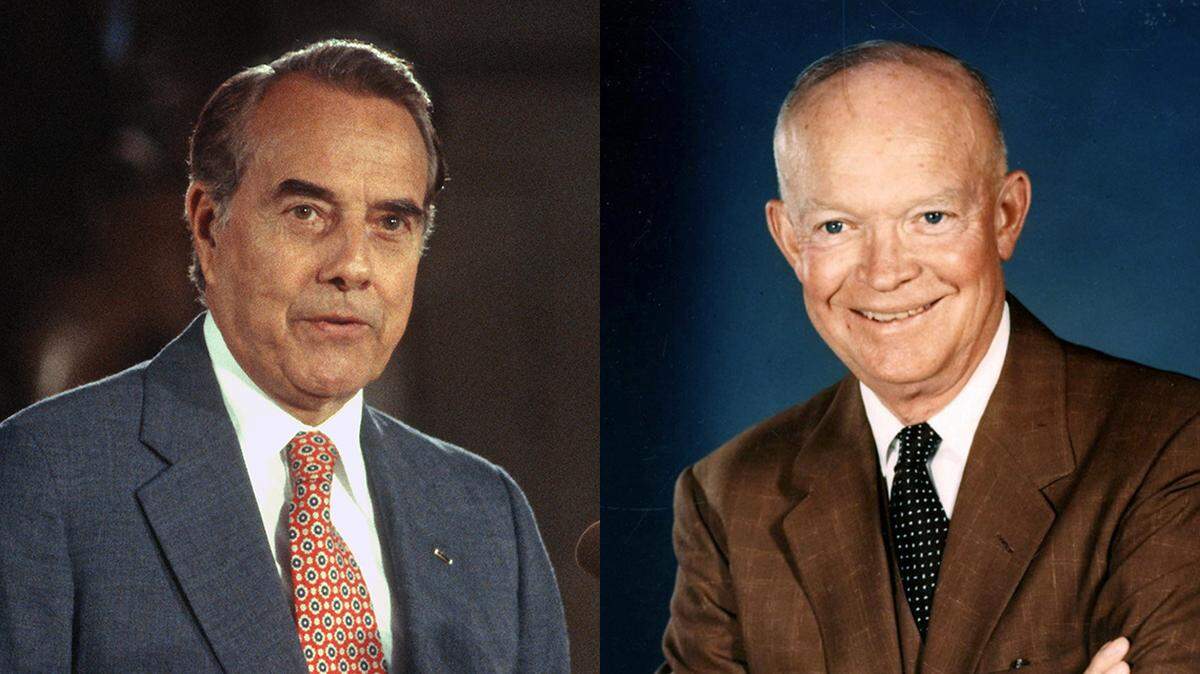
As the presidential campaign enters its final weeks, it is worth remembering the observations of 80 years ago by famed Kansas newspaperman, William Allen White.
On May 15, 1941, White wrote in his newspaper The Emporia Gazette: “If this republic ever totters to its fall, it will be because the moron minority mind shall sometime, somewhere, somehow, gain a party majority by unscrupulous leadership and vote with a fascist group.”
Then, in early 1943, White wrote to a friend: “The pretension that a candidate’s utterances are omniscient when everyone (knows) he is talking damned nonsense is one of the large reasons why the American people lose faith in democracy.”
While not identifying him personally, of course, White was effectively describing Donald Trump’s ascent to the pinnacle of American political power within a Republican Party that today is unrecognizable to nearly all pre-2016 party members.
The words by the “Sage of Emporia” ring as true today as when he typed them in his office. In fact, White’s observations serve as a cautionary tale as the country prepares for the coming election.
It is obvious that Trump is not a serious person.
He is essentially a carnival barker, huckster and entertainer. Nevertheless, Trump, as with many radical populists before him, has tapped into a wellspring of grievances and resentments. Post-industrialism has taken a toll on the future well-being and aspirations of many Americans, and for them Trump is literally “lightning in a bottle.”
For this group, Trump offers not thoughtful policies and programs, but rather vacuous promises and a laundry list of falsehoods: That the 2020 election was “rigged.” That Mexico was going to pay for the border wall. That the United States pays for nearly all of NATO. That tariffs are paid by foreign manufacturers and not by American consumers. And most recently, that no altercation took place during his visit to Arlington National Cemetery, despite the military’s statement that it did.
Elections often present voters a choice of character.
This presidential election highlights clearly that in Trump’s case, we witness the absence of responsible character. His character is that of a quintessential fabulist: a person who invents dishonest and elaborate stories, a defamer — for which he has already been found liable by a jury — and an effusive liar.
Trump’s recent warning that in the coming election, “WHEN I WIN, those people that CHEATED will be prosecuted to the fullest extent of the Law” is yet another reminder of his unserious nature, his contemptuous mockery and misunderstanding of the rule of law.
We yearn for a Republican Party that truly represents legitimate conservative interests, not interests fueled by personal anger, grievance and incessant lying. The Republican Party of Dwight Eisenhower and Bob Dole would not recognize today’s MAGA version of Trump’s Republican Party. And that is a shame.
We write as native sons of Kansas — raised in Dodge City and graduates of the University of Kansas — who grew up listening to people discuss sensible approaches to politics, the kind reflected in William Allen White’s writings.
We are also reminded of White’s observation about the nature of persuasion: “To be persuasive, we must be believable; to be believable, we must be credible; to be credible, we must be truthful.”
Donald Trump is not believable, credible or truthful. He possesses neither the personal character nor the moral compass to be allowed back into the White House.
This story was originally published October 7, 2024 at 5:05 AM.