Rise in hostility at public meetings is a nationwide issue, threatening democracy | Opinion
Editor’s note: This commentary is part of U.S. Democracy Day, a nationwide collaborative on Sept. 15, the International Day of Democracy, in which news organizations cover how democracy works and the threats it faces. To learn more, visit usdemocracyday.org.
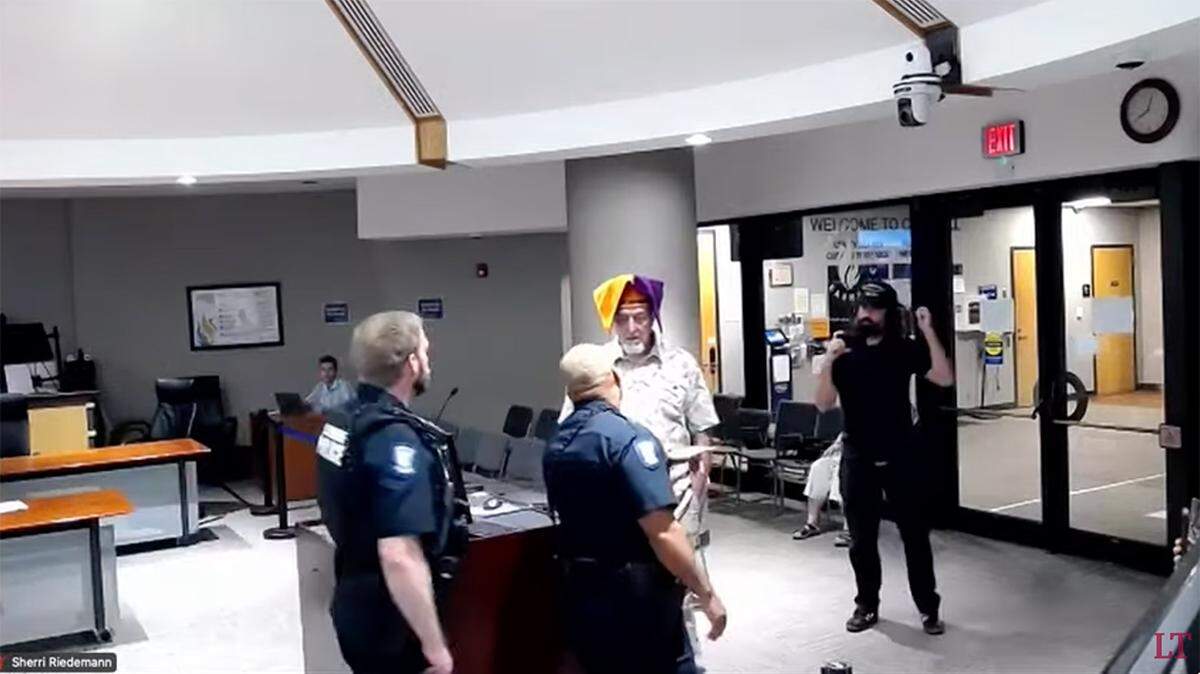
Near the end of Tuesday night’s meeting of the Lawrence City Commission, a man in a jester’s hat approached the speaker’s podium with a smile on his face. The room was tense.
“Public comment time?” the man, Michael Eravi, asked Mayor Bart Littlejohn.
Not quite, Littlejohn said.
Eravi proceeded anyway. He said the commission meeting was a “goddamn clown show.” He berated Littlejohn and called him “Mayor Little Man.”
“You’re not a strong mayor, Bart,” Eravi said.
When Littlejohn tried to take back control of the meeting, Eravi put a finger to his lips in the universal signal for “hush” — ordering the mayor to be silent.
“This is my time,” Eravi said.
It wasn’t his time.
Littlejohn declared that Eravi was being disruptive. Police officers escorted Eravi out of City Hall and told him he was being cited for trespassing. It was a mess.
And it’s become routine at the Lawrence City Commission.
I went to the commission meeting on Tuesday night — when much of America was watching Donald Trump and Kamala Harris face off in a presidential debate — because democracy at the national level feels all too fragile these days. I wanted to see how it’s doing at the local level, where neighbors and community members often know each other and have to look each other in the face to get stuff done.
What I found was grim.
Commission meetings in Lawrence are built to solicit and hear public input. On nearly every agenda item, citizens are given up to three minutes apiece to weigh in. There is even a section of the meeting to hear public comments about city business that isn’t on the agenda.
It ought to be a First Amendment triumph. In practice — these days, at least — it looks like a slow-motion disaster.
Right to publicly disrupt?
Eravi and a small group of commenters have turned the public comment portions of the meeting into a parade of grievance. Sometimes these speakers are on topic, sometimes not. A favorite subject? How they’re not being allowed their full right to speak.
But they’re frequently abusive and profane, even racist: Eravi drew national attention for using the n-word during a July meeting of the commission. (Littlejohn and Commissioner Amber Sellers are both Black.)
“That’s protected speech,” Eravi declared at the time.
Maybe. But it’s a grind to witness. And — racial slurs aside — it happens nearly every week.
This isn’t just a Lawrence issue. Officials across the country report that public meetings — town councils and school boards — have become nastier in recent years, especially since the COVID-19 pandemic. One study found a 15% rise in threats and harassment of public officials just the year.
“Officeholders serving in local and state government across the country have faced a barrage of intimidating abuse,” the Brennan Center for Justice reported in January. The result threatens “the free and fair functioning of representative democracy — at every level of government.”
You could argue that all of this is simply the way democracy functions. It’s always messy. I don’t think so. It wasn’t always like this.
Real-life denial of service
I covered the Lawrence City Commission years ago as a young journalist, you see. There was always a culture of vibrant public input — I can remember the gadflies and their names; the meetings could stretch deep into the night — and there could be hurt feelings. But one could watch the process and come away with a firm sense that the public’s business was being done.
Not so much now.
Dealing with the commenters consumes an inordinate amount of the commission’s time and resources, mental and otherwise. They’ve changed the rules — pushing the main comment session to the end of the meeting, no longer broadcasting that portion on the city’s YouTube channel. And they’re fighting a lawsuit from another notorious commenter, Justin Spiehs, who says his First Amendment rights have been curtailed by the commission for being a “troublemaker and instigator” at meetings.
It all resembles a real-life “denial of service” attack — that form of cyber-hacking that shuts down websites by flooding them with an overflow of useful traffic.
And you have to ask: Why would anybody sign up for public service, simply to endure all this?
Commissioner Amber Sellers won’t. She announced last week that she’ll no longer sit through the end-of-meeting comment sessions — instead, she’ll witness them from an “alternative location.”
On Tuesday, Eravi seemed to take that personally.
“How come you can’t make your commissioner stay out here?” he asked Littlejohn as Sellers exited the commission room before public comment started. A few minutes later, Eravi was himself forced to leave.
Civility can be overrated in a democracy. The rules of polite discourse can get in the way of making necessary changes. But if incivility is itself the point — and it sure looked that way on Tuesday night — all then democracy takes a back seat. All that’s left is nihilism.