
We Mennonites have deep roots in Palestine-Israel. And we’re calling for a cease-fire | Opinion
My hairdresser Chrissy recently asked me: “When it comes to Palestine-Israel, what goes through your mind and heart as a Mennonite right now?” I thought about saying, “It’s complicated” — and leaving it at that. While it’s true that it feels complicated, it also feels like a lazy response sometimes.
My answer? I told Chrissy that where I serve as a Mennonite pastor, there are many who have traveled and studied (myself included) in Palestine-Israel. In fact, Mennonites have been building relationships and working for peace with justice alongside Palestinians and Israelis for over 60 years, soon after the establishment of Israel in 1948. The Mennonite Palestine-Israel Network, or Mennopin for short, includes this on their website:
“After the horrors of the Holocaust, many Jews welcomed the creation of the State of Israel, viewing it as a potential safe haven. The establishment of Israel in 1948, however, went hand in hand with the massive dispossession and displacement of over 750,000 Palestinians and the destruction of over 500 Palestinian towns and villages. Mennonite Central Committee (MCC) responded in 1949 to this newly created refugee crisis with material assistance and numerous other ways including education and rural development. Another example was selling needlework made by Palestinian refugee women, one of the first products sold by what eventually grew into the alternative trading organization Ten Thousand Villages. … MCC has supported the work of both Palestinians and Israelis committed to non-violence and a future of peace, justice, and reconciliation for both peoples.”
In addition to these global Mennonite history and ties, there is a family at Rainbow Mennonite Church who has deep and familial connections with those at Bethlehem Bible College in Bethlehem, where they see firsthand the experience of many Palestinian Christians. And there is at least one Jewish-Mennonite marriage in the congregation. In addition, I participate in a weekly interfaith Torah study and thanks to those relationships, a local Jewish rabbi joined me in a heart-to-heart dialogue sermon in November.
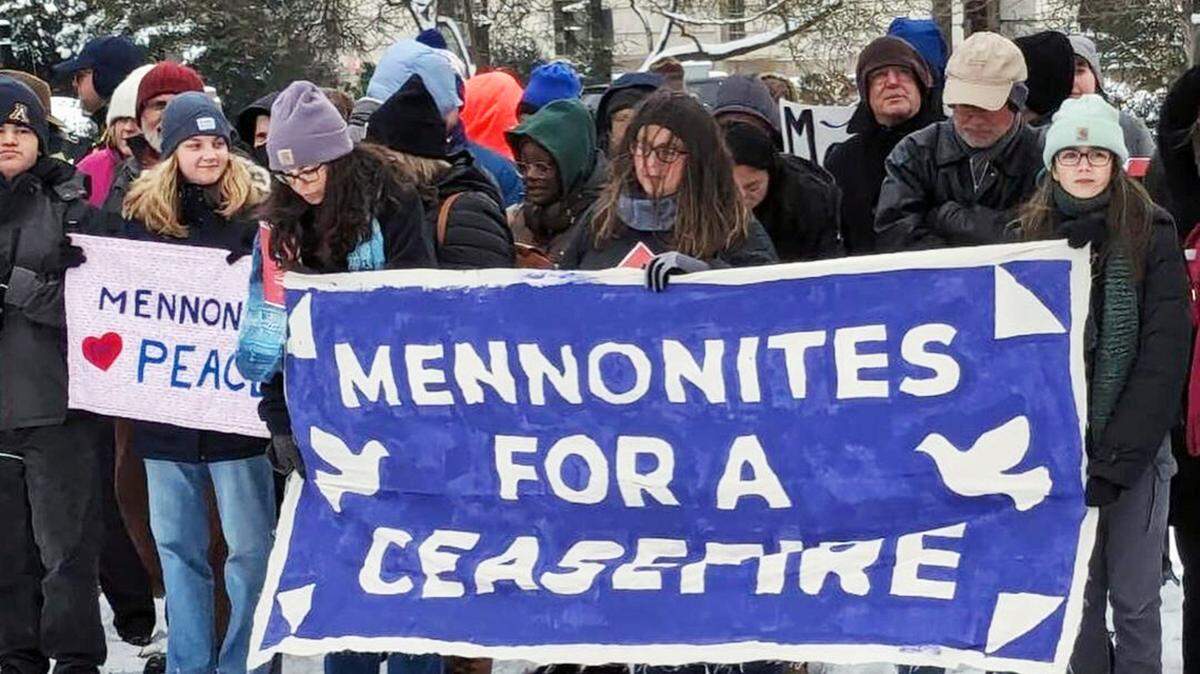
And as I write this, Rainbow’s Peace and Social Justice Committee is supporting two members as they prepare to travel to Washington, D.C. On Jan. 16, they participated in a Mennonite peace service calling for a cease-fire in Gaza and the release of hostages and prisoners, as well as advocating for long-term sustainable peace.
People from many walks of life will be quick to condemn or ridicule this Mennonite action calling it naive, insulting or downright ridiculous, not worth any attention. Even some Mennonites (perhaps even at Rainbow Mennonite) will have concerns about such an action.
Then again, aren’t we all just a tiny bit curious what four-part Mennonite hymn singing might sound like throughout D.C.’s halls of power?
As for me, I have generations of brave and imperfect pacifists running through my DNA. Ever since the start of Anabaptism in the 16th century, Mennonites have had to grapple with what a nonviolent Christian ethic means and where it might take us (or not take us). Pacifism itself can be complicated and messy. And we as Mennonites are no strangers to criticism, especially regarding pacifism and active nonviolent resistance. Many Mennonites are used to standing in the minority in that respect. And being ridiculed.
What many people don’t realize is that Rainbow Mennonite, just like a lot of Mennonite churches, consists of veterans, active duty personnel, conscientious objectors, non-combatant personnel and those who served the country through alternative service opportunities. So if you would ask each Mennonite what is going through his or her mind and heart right now concerning Israel-Palestine, each answer will likely be different.
Each person at Rainbow, just like each person we encounter at work or at community events, probably has a lot going on in our hearts and minds regarding Israel-Palestine. Just imagine if we took the time to get to know one another: As a (fill in the blank: Jew, Muslim, Arab, Palestinian, Palestinian Christian or something else), what goes through your mind and heart right now?
When I returned home from my haircut, I texted Chrissy and thanked her for asking me such a good question. I then shared this quote from human rights activist: Mohamad Safa: “You cannot build a Holy Land for your children on the mass graves of other children.”
We both expressed hope, my hairdresser and me, that cycles of revenge and violence will some day be reversed, even if not completely or permanently. Until then, let’s keep asking deeper questions and responding more deeply, and not just during haircuts.