
What does Harry Truman’s 1948 bid for reelection tell us about Joe Biden’s chances? | Opinion
Every day or so another report — via newspaper, television or the internet — tells of President Joe Biden’s seeming political vulnerabilities in one way or another vis-a-vis the upcoming quadrennial election of 2024.
Instantly this brings to mind President Harry S. Truman’s fraught prospects to retain his hold on the White House in the protracted multicandidate run preceding the hard-fought balloting in 1948.
Such baleful signals suggested that citizen-Truman would return, at the hands of the American electorate, to Independence once President-elect Thomas E. Dewey reached the White House on Jan. 20, 1949.
Signals were gathering. Republicans had gained control of Congress in 1946 for the first time since 1928. Inflation was a paramount domestic issue as a consequence of the complicated readjustment to the post-World War II economy. International challenges — the Soviet Union, China and the Middle East — seemingly proved interminable. More often than not, criticism of President Truman was expressly heard virtually day in and day out. Also, public opinion polls — then as well as to this very today — frequently foretold the incumbent’s baleful prospects. Often these predictions, we now know, entailed a substantial element of miscalculation.
Tellingly, the political landscape proved complicated. In addition to the Republican nominee Dewey, Truman encountered high-profile challengers from the left (Progressive Party nominee Henry A. Wallace) as well as the right (the Dixiecrats’ Strom Thurmond).
Undaunted, the incumbent president nonetheless repeatedly revealed his mettle. He campaigned unceasingly with a sense of resolve. Frequently, Truman addressed crowds from the rear platform of a railway car. Routinely he would arrive at the crack of dawn, addressing blue-collar workers at factory gates. He also made his pitch for reelection in farm belt states, which were mostly inclined toward Republicans. One signal, infrequently mentioned in this very moment: As the campaign unfolded the size of crowds expanded turning out to witness the incumbent president’s presence, as well as to hear his energetically delivered speeches.
A less well known fact about the presidential campaign of 1948 had to do with then-New York Gov. Dewey‘s disposition as lackluster as well as uninspiring on the stump. He revealed himself as temperamentally disdainful especially about rising at dawn’s early light. Contrary to Truman, more often than not, Dewey would appear on the campaign trail at mid-morning. Truman’s savvy campaign advisors sensed this pattern, taking strategic advantage of his opponent’s predilections.
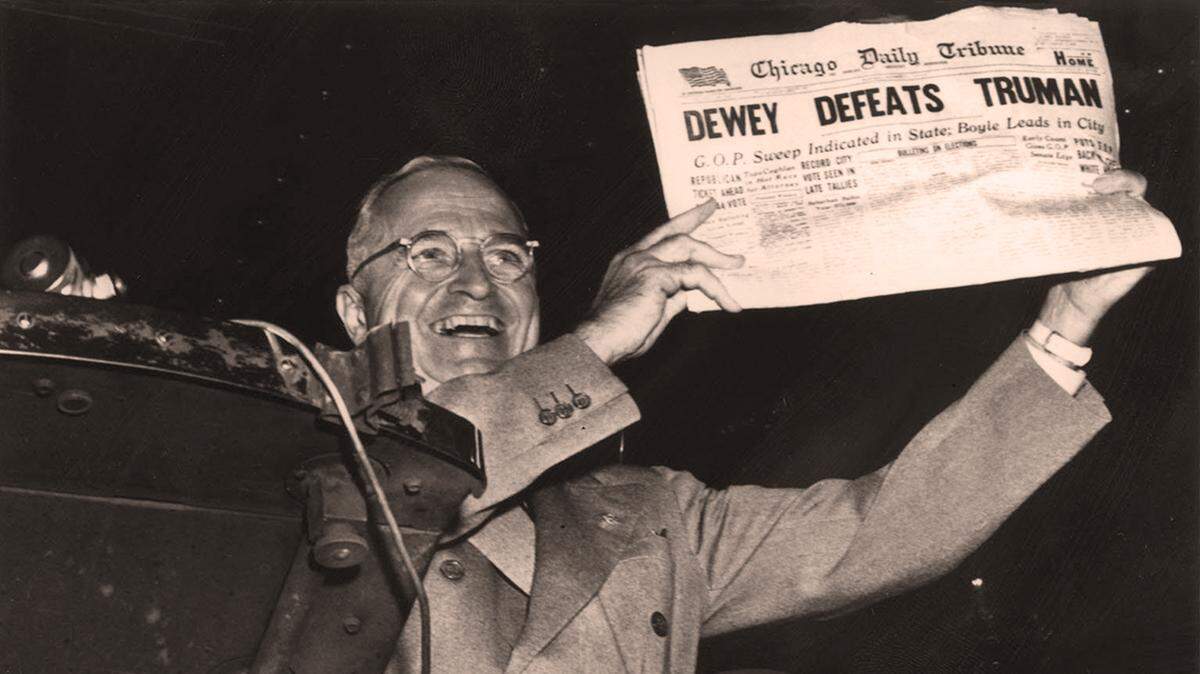
The classic image of the outcome of the presidential election of 1948 — encountered to this very day in history as well as political science textbooks with a beaming Harry S. Truman holding it aloft — is the misbegotten boldface Chicago Daily Tribune banner headline prematurely declaring, ”Dewey defeats Truman.”
Margaret Gates Wallace, Truman’s mother-in-law, had not only supported the candidacy of Dewey but years before had acerbically diminished Truman — a Missouri dirt farmer and co-owner of a haberdashery — as unlikely to find a pathway to success.
Every day or so, another news report foretells Biden’s diminished prospects for one reason or another in the presidential election next year. Inflation, Ukraine, Russia, China, climate change and immigration in particular hang ominously on the perilous political landscape.
Seven years after handing off the American presidency to Dwight D. Eisenhower in 1953, Harry S. Truman volunteered to campaign on behalf of Sen. John F. Kennedy during the 1960 presidential campaign. Reminiscent of Barack Obama’s high-energy role in election campaigns during 2020 and again in 2022, Truman delivered more than a dozen stem-winder speeches during the closely contested election, in which the narrow outcome resulted in Kennedy’s much-disputed victory over Richard M. Nixon.
Allegations of a bad count in Illinois, spotlighting Chicago’s well-oiled political machine supposedly exercising a significant role in controlling the process of counting the ballots, played into this lingering conundrum — much like questions about the presidential elections of 2000 and 2020. Widespread apprehensions also loom in the present tense, regarding the integrity of ballots in next year’s presidential election.