
How driverless trucks got drivers’ licenses in Kansas | Commentary
Many big businesses in America have a running legislative wish list: a series of bills designed to push more products and services out to the masses for public consumption with less oversight and overhead.
For fitness empires, the list might include a bill designed to avoid basic property taxes under the guise of leveling the playing field with not-for-profits, like the YMCA. For weapons manufacturers, it might include a bill shielding them from civil liability under state laws when their products are used to open fire on schoolchildren.
All these businesses need is a conduit — one or more skilled lawmakers who can ram the bill from the CEO’s desk through both legislative chambers and over to the governor’s desk, then back through the Legislature for veto override if necessary.
But think about how omnipotent a corporation would be if it didn’t even need a conduit to get its wish list passed: a corporation so powerful that no elected official would dare wage battle for fear of being squashed like a bug on the windshield of a 50,000-pound driverless semitruck hauling hazardous materials down a crowded highway at 70 miles per hour.
Companies like Walmart come to mind.
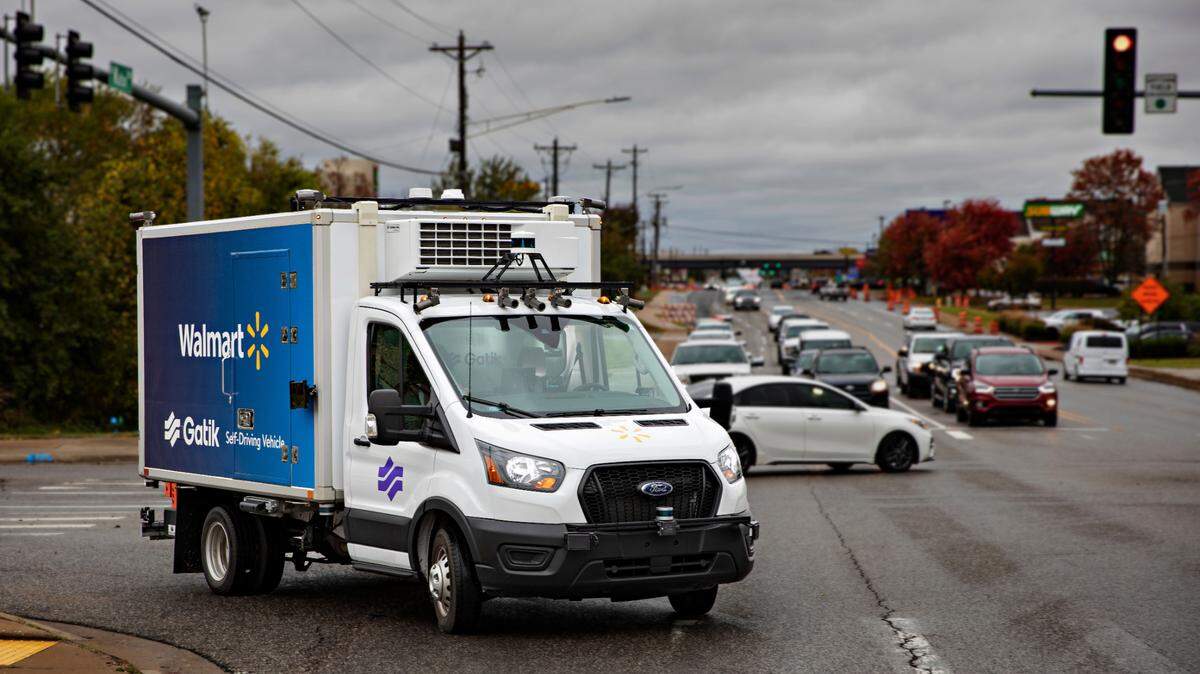
Speak of the devil, Walmart and its autonomous trucking startup companion, Gatik, decided last year they wanted to start running their driverless truck experiments on Kansas roads.
The idea was raised in the 2022 legislative session, and by the end of May, Gov. Laura Kelly had signed Senate Bill 313 into law. If you blinked, you probably missed it.
Driverless vehicles, like artificial intelligence, are both promising and scary at the same time.
They have the potential both to improve our world and to wreck lives. Careful oversight is crucial to avoid the latter.
For this reason alone, the frantic speed at which driverless vehicles got the green light to operate in our state is deeply troubling. And how it came to be is just as troubling.
The message was delivered to House members early in the 2022 session that Walmart was pushing autonomous vehicles and the bill needed to pass.
We’ve seen bills hit the ground running with vigor before. But the fact that few questions were being asked by anyone was concerning — as was the bill itself.
For those tracking the bill, it seemed to morph and evolve constantly, getting increasingly larger in scope and magnitude after each hearing.
The first version came through the Senate Transportation Committee labeled as Senate Bill 379: “An Act concerning motor vehicles; relating to autonomous motor vehicles; providing for the use and regulation thereof.”
It came up for hearing on Feb. 2 and only authorized 10,001-plus-pound autonomous commercial vehicles to operate in the “middle mile” — a fixed, repeatable route involving the intrastate commercial movement of goods in a business-to-business capacity.
For Gatik’s part, their lobby was a well-oiled machine. They had plenty of help from Walmart’s paid lobbyists under the Capitol rotunda, but their own team made slick presentations from skyscrapers via WebEx at standing desks near large windows.
Gatik is highly focused on safety, they assured lawmakers. The problem with this assurance is that the safety decisions aren’t made by lobbyists giving planned speeches into cameras behind standing desks — the decisions that decide life and death are made in the heat of battle by engineers and executives, who must determine whether spending more money to run more tests is good for the bottom line.
The bill had enough opposition that the hearing was spread over multiple dates in February, and some lawmakers seemed to feel that the complexity of the technology and the magnitude of the legislation made it important to avoid rushing things.
S.B. 379 stalled in committee, but Walmart pushed forward, undeterred.
The legislation reemerged as Senate Bill 546 under a similar name.
It came up for hearing in the Senate Transportation Committee on March 10 and was passed out of committee with some amendments. It was then amended again by the full Senate before passing on March 23 by a 24-12 vote.
On March 29, S.B. 546 came before the House Transportation Committee. By this time, the bill had been amended to increase the weight limit to 34,000 pounds on tandem axles through July 1, 2025, and to add a requirement that a conventional human driver be present in every driverless-capable vehicle providing transportation services (e.g., Uber) for the first 24 consecutive months.
But the “middle mile” restriction was gone — travel was now extended to “the public highways of this state.”
And no liability insurance was required beyond the state’s basic minimum limits.
Questions were again raised about the complexity of the bill, the number of jobs that would be lost to computers and the safety risks of allowing the testing and eventual operation of these driverless vehicles on our roadways.
S.B. 546 stalled in the House committee, and Walmart pushed forward, undeterred, with a new plan.
Enter Senate Bill 313. It was originally filed in the 2021 legislative term as “An act concerning roads and highways; designating a portion of United States Highway 69 as the Senator Tom R. Van Sickle Memorial Highway.” Following its progress from that point forward requires a great deal of patience and concentration.
S.B. 313 was originally introduced and referred to the Senate Committee on Transportation, where it sat for the remainder of 2021.
When the 2022 term started, the bill came up for committee hearing on Feb. 15. On Feb. 17, a committee report was filed, recommending the bill be passed as amended with some minor changes that had nothing to do with autonomous vehicles. The bill passed the Senate as amended on a 40-0 vote.
The bill was then referred to the House Committee on Transportation on March 1 and came up for hearing on March 8 — two days before the second pass at autonomous vehicles, S.B. 546, came up for hearing in Senate Transportation.
The House Committee made one extremely minor edit and recommended the bill be passed. The committee report was again adopted on March 21, but no final action was taken to vote on the bill in the House. The autonomous vehicle bill, S.B. 546, was still alive in House Transportation at the time, and was about to come up for hearing there on March 29.
S.B. 313 sat idle with its proposed honorary highway in Linn County until late April, when a House-Senate conference committee submitted a report on the bill on April 27. Before the report could be submitted, a motion was passed in the House to suspend ordinary deadlines for the submission of legislation. The committee recommended gutting all 21 lines in the bill about honorary highways and replacing them with hundreds of lines about autonomous vehicles. The title was changed as well to reference “autonomous vehicles” and not “memorial highways.”
One thing was clear: This new version of S.B. 313 had a rocket behind it. The “gut and go” came at blinding speed. The House and Senate both adopted it the same day.
As with the last time the bill resurfaced, the new language was even more robust and detailed. There were provisions about advisory committees, law enforcement reporting, and lots of other clever things. Where the changes came from and who suggested them is not clear: No one else was in the room when it happened. As with the prior version, the “middle mile” restriction was gone and driverless-capable vehicles were authorized “on the public highways of this state.”
S.B. 313 then went to the governor’s desk on May 6. A week later, the bill had the governor’s signature on it. On May 13, 2022, self-driving vehicles became a real thing in Kansas.
It had been three months since Walmart and its partner first broached the topic of allowing self-driving vehicles to test and operate on our roads and highways. Lots of confusion ensued over this enormous piece of legislation and a small number of hearings were even held — none of which resolved the confusion.
But self-driving vehicles were on Walmart’s wish list, and Walmart would not be denied. A totally different bill about memorial highways was gutted and replaced with Walmart’s bill, which became more expansive each time it stalled under a different bill number.
What happened with self-driving vehicle legislation was hardly unprecedented. This process replays itself over and over, year after year. Only the companies, wish lists and bill numbers change. But this is a democracy. Our government doesn’t have to work this way.
If we’re all on board with these new laws, there’s no problem. But what if it all comes at us so hard and fast that we can’t even decide if we’re for or against it?
As long as they have us asleep at the wheel, we’ll need these self-driving vehicles.
This story was originally published May 3, 2023 at 5:32 AM with the headline "How driverless trucks got drivers’ licenses in Kansas | Commentary."