
Gorbachev saw democracy is the future. He shared that vision right here in Missouri
By the time Mikhail Gorbachev ascended to the supreme leadership of the Soviet Union in 1985, the lifelong communist had become convinced that one-party rule, the suppression of the press and aggressive militarism in Afghanistan were threatening the survival of the superpower. He set about changing that in hopes of preserving the Soviet Union, proposing the perestroika and glasnost policies that would so radically transform life in and out of the empire.
When he died on Tuesday at age 91, Gorbachev, the last leader of the Soviet Union, was widely recognized as a central figure in the complex and dynamic history of the end of the Cold War. When viewed from the contemporary prism of Russia’s current aggressive military action against Ukraine and President Vladimir Putin’s tight control over Russia and the Commonwealth of Independent States, Gorbachev’s legacy stands in stark contrast.
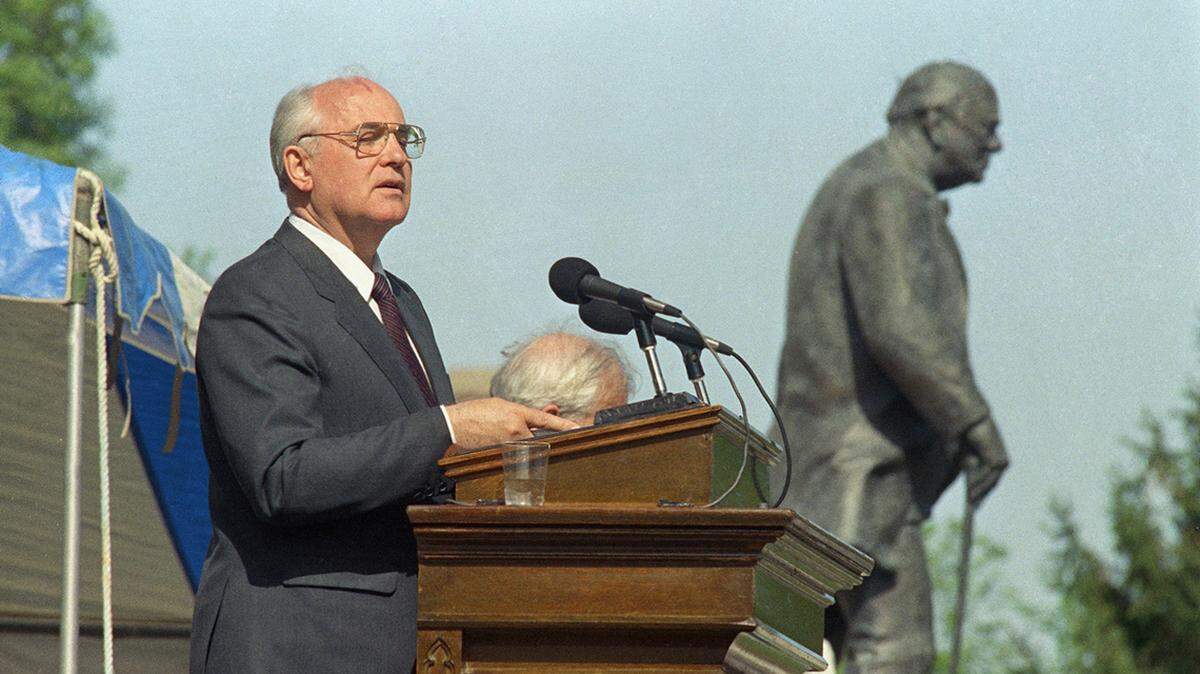
Nowhere is that more clear than in the power message he shared right here in Missouri, just five months after dismantling the Soviet Union. The leadership at Westminster University and the National Churchill Museum in Fulton asked Gorbachev to speak at the 46th anniversary of Winston Churchill’s famous “Iron Curtain” speech. Gorbachev presented his “River of Time and the Imperative of Action” address, where he outlined Churchill’s skills as a politician and spoke of the historic context of the Cold War.
As he concluded, Gorbachev established that he hoped the global community would remain committed to “acting in concert on the principles of democracy, equality of rights, balance of interests, common sense, freedom of choice, and willingness to cooperate.” With these words, Gorbachev cemented his place as a historic figure in the history of the Cold War, and more importantly as a champion of democratic ideas.
In tandem with the economic reforms he championed, Gorbachev also believed that the government of the Soviet Union had to move beyond its oppressive and controlling past, by allowing more openness and participation in the political system. Glasnost and his demokratizatsiya policy served this objective, as Gorbachev championed the slow and deliberate relaxing of one-party rule and state control over the press. He believed his efforts were within the ideals of Marxist-Leninist ideology, which his generation of politicians believed had been corrupted and subverted since Stalin’s rule.
Viewed from within, Gorbachev’s actions appealed to a younger generation in the Soviet Union, as well as its satellite nations. His efforts at openness and limited democratic reforms struck a chord that had been reverberating throughout central and eastern Europe since 1956, and most definitely since 1968’s Warsaw Pact to counter NATO, as previous leaders of the Soviet Union violently oppressed any public demands for reform.
From the outside, U.S. President Ronald Reagan, West German Chancellor Helmut Kohl and U.K. Prime Minister Margret Thatcher supported Gorbachev’s efforts at reform. They believed that his willingness to engage in frank and open discussion with the West on strategic, economic and social issues signaled a very different tone. Gorbachev’s relationship with Western political leaders, specifically Reagan and Thatcher, produced a genuine friendship that transcended the ideology that had dominated the Cold War.
Though Gorbachev’s efforts at reforms were welcomed by the West and by young people in the Soviet Union, he faced stiff opposition from hard-liners within his own government. These traditionalists led an attempted coup in August 1991, in which they arrested and briefly detained Gorbachev in an attempt to make him resign. Gorbachev refused, and with assistance from Boris Yeltsin, he returned to Moscow. However, this internal struggle served to accelerate the demise of the withering Soviet Union, which Gorbachev dissolved in December 1991.
Hence, the memory of Gorbachev as a champion of democracy and freedom blossomed in the aftermath of the Soviet Union, as the world recognized that the last leader of the Soviet Union strove to initiate economic and political reforms to provide more open and favorable opportunities within the decaying Soviet system.