
Run a KC Streetcar line to The K — then build new Chiefs and Royals stadiums there
I am in complete agreement with The Star Editorial Board that it would be a mistake to extend the KC Streetcar to the Truman Sports Complex by 2026, in time for the World Cup.
But I also think that the best route for the next streetcar extension should be to the sports complex on a sensible timetable.
The first east-west route should be one that best serves the minority community in the inner city. Today, the 39th Street bus route has the highest east-west ridership — a position it has held for at least 50 years. Providing a streetcar line farther north on Independence Avenue or 18th Street would produce fewer riders.
A streetcar line using 31st Street or Linwood Boulevard, from the route under construction on Main Street connecting to the existing Rock Island Railroad Corridor railroad tracks’ right-of-way that now runs to The K, would provide not only the best service for the existing transit market, but also a great opportunity to park and ride from restaurants and hotels downtown, at Crown Center and on the Plaza.
I understand that Kauffman Stadium is a poor candidate for major remodeling. If that is the case, the same can probably be said for Arrowhead Stadium. Thus, the solution may have to be totally new stadiums.
I believe the best location for building both stadiums is at the existing complex.
Neither of the proposed locations for a downtown Royals stadium would attract any significant transit ridership. As the former general manager of the KCATA, I know that our transit system — both rail and bus — is undersized and not capable of providing large numbers of bus or other transit riders. That’s because our existing systems have very limited service in suburban parts of Kansas City. And our metropolitan area’s low population density is such that it would cost a fortune to make it meaningfully better. The cost of significantly upgrading transit service to affluent areas with primarily single-family developments on large lots is justifiably a low priority for taxpayer dollars. It deserves that low priority. Over the last 50 years, the KCATA and Johnson County have made numerous costly attempts to encourage suburban ridership with the same result: Some initial success that soon turned into empty buses.
In our best days, KCATA never transported more than 3,000 fans to a Chiefs game and the numbers to Royals game were minuscule. A downtown stadium has little probability of doing much better.
The cost of upgrading our transit system to provide significant service to a downtown ballpark would exceed the cost of constructing two new state-of-the-art stadiums and would be a most unwise public investment.
Wherever we build one or both new stadiums, the automobile will be the mode of transit for most fans. And what better location than the sports complex with free land and abundant space for adequate parking? Add to that adjacent to two interstate highways, and there is no better location in the metropolitan area.
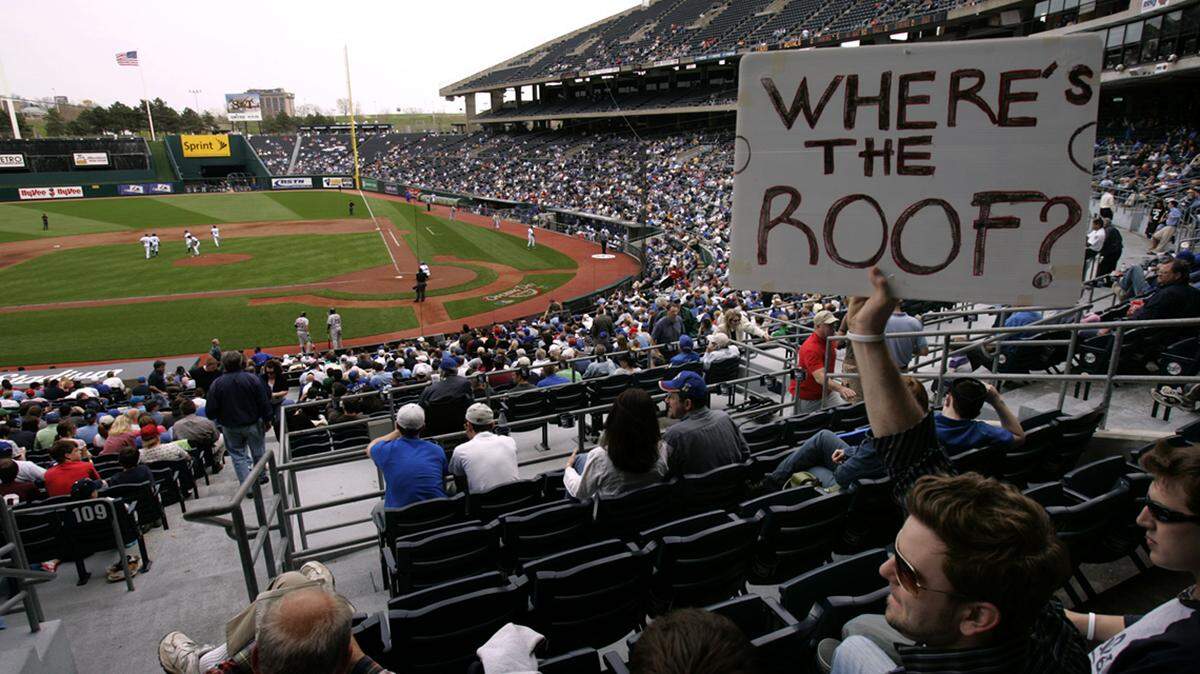
Building at the complex would make the possibility of the previously considered rolling roof covering both stadiums much more doable since they would be built on cleared land. The teams would probably prefer two enclosed stadiums, but one rolling roof would be an enormous money saver not only in construction, but in operating costs as well.
Kansas City does not have the temperature extremes that demand air conditioning. But rain in an open stadium is a frequent fan inconvenience. A roof would mean no more rain delays, 1 a.m. ninth innings or muddy football games.
Previous sports complex improvements have been funded primarily by a Jackson County sales tax. Rebuilding both at the existing site would be a big win for Kansas City and might be the justification for its investment in an east-west transit rail line. It would make every downtown, Crown Center and Plaza hotel and restaurant a great park-and-ride location for games at both stadiums.
It appears that the push to move the Royals to a downtown location has the advantage of strong, well-funded support from downtown developers. Conversely, our wonderful Truman Sports Complex does not have the same advantage. Come on, Star — be an advocate for the more practical stadium option that would save hundreds of millions of dollars