
What Churchill said in Missouri about fighting tyranny in 1946 applies to Ukraine now
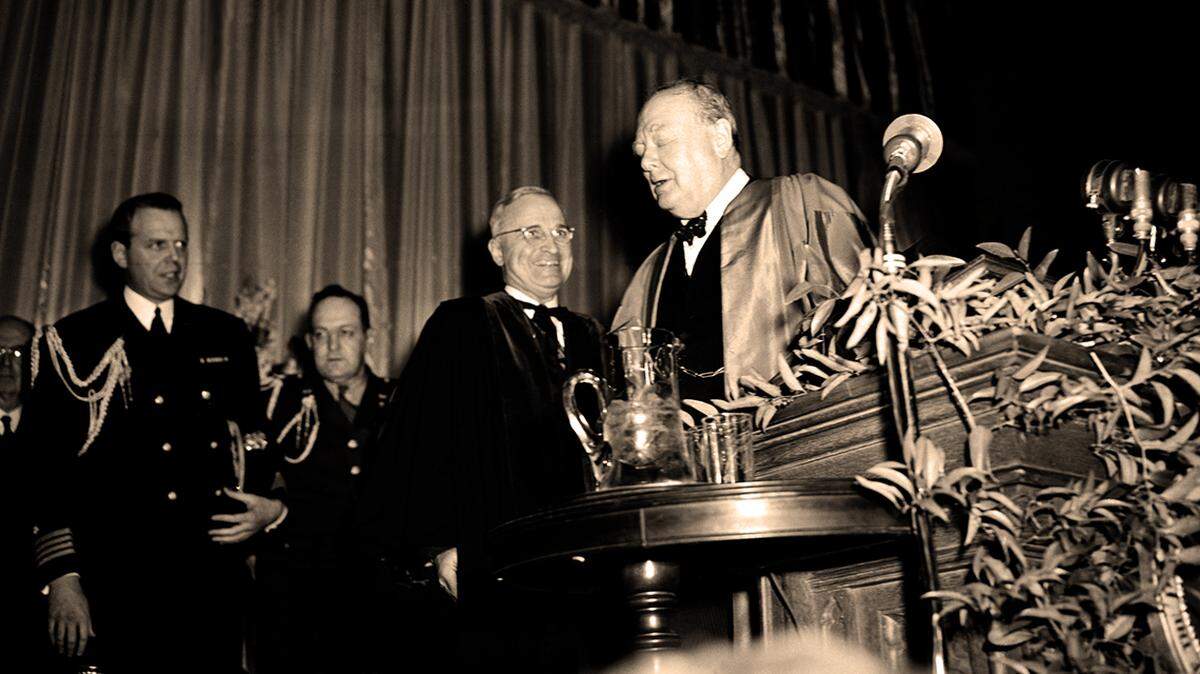
In March 1946, Winston Churchill came to Missouri to warn the world of the impending threat that communism posed to Europe, and to the world. Though he titled the speech “Sinews of Peace,” the major takeaway was that an “iron curtain” had fallen across the European continent. To the ears of many listeners and pundits, Churchill seemed to be issuing a call to conflict against a one-time ally.
Today, Churchill is again being taken to task, now for his belief in English imperialism and views of Western and English superiority. Last year, The Sunday Times reported, “Churchill College held a conference that heard the British Empire was worse than the Nazis, Churchill was a racist murderer and that Britain had a ‘delusional understanding of the world.’”
I believe that neither view is fully correct, and that Sir Winston’s lessons may be as relevant today as they were when he warned of the Soviet threat to the west. Today, as peace arguably hangs on a precipice in Ukraine, as China asserts itself in the Indo-Pacific and in regional and global institutions, and as distrust of government and neighbors at home threatens domestic tranquility, reviewing the wisdom of Churchill lends itself to concerns of today.
Churchill saw his most important American address as offering the sinews — soft, connective tissues — that would guarantee peace for the world. In some ways, the speech offers a blueprint to ensure that democratic ideals triumph over tyranny.
As Sen. Bernie Sanders noted in speech at Fulton, Missouri’s Westminster College, on the same campus where Churchill gave his speech, Churchill “defined his strategic concept as ‘nothing less than the safety and welfare, the freedom and progress, of all the homes and families of all the men and women in all the lands.’” Sanders, further channeling Churchill, noted that “to give security to these countless homes, … they must be shielded from the two giant marauders, war and tyranny.”
Richard Ledgett, former deputy director of the National Security Agency, like many, suggests that Churchill “foretold the Cold War, which began quietly in the two years after World War II, was in full force by 1947.” During those four-plus decades, Ledgett argues, “the United States and Great Britain learned how to fight against an ideology that ran directly counter to our values, that relied on a prioritization of state interests over individual rights and intolerance of opposing ideals. … Sadly, those lessons are applicable today in parts of the world. History must be our teacher. If not, we disadvantage our future. Churchill would likely agree, having once said, ‘A nation that forgets its past has no future.’”
Judge James E. Baker, director of the Syracuse University Institute for Security Policy and Law, like many scholars, is concerned that “we all have read essays asking, ‘Is democracy dying?’ … An equal number of essays ask whether the liberal world order will survive, by which is meant the international governance structure President (Harry) Truman and Prime Minister Churchill did so much to build. Like (former Secretary of State) Dean Acheson, Churchill and Truman were present at the creation of the United Nations and NATO. These institutions — the liberal world order — were designed to address the two great themes of Churchill’s (Sinews of Peace) speech — the prevention of war and defense against tyranny. If we are going to tear that order down, we ought to know what we are replacing it with.”
More concerning, perhaps, than the proposed demise of the U.N. and NATO, is the demise of shared belief in the rule of law. Baker reminded us during a 2019 speech at Westminster that during the Cold War, U.S. dedication “to law as a bulwark against tyranny” was central to our ideological struggle. … “Law was our strength, which is why the Soviet Union worked so hard to highlight instances, like Jim Crow law, when the U.S. fell short of its legal ideals. Law remains our strength today, which is why Russia (and others) work so hard to undermine the institutions that sustain the rule of law — our elections, our courts, and a free press.”
As democracy at home and abroad is again staring down a long barrel, it is imperative that like Churchill, we remain true to democratic ideals and the connections the keep the peace.
This story was originally published February 23, 2022 at 5:00 AM.