
A Kansas Citian in Paris ponders what a wrapped Arc de Triomphe says about our future
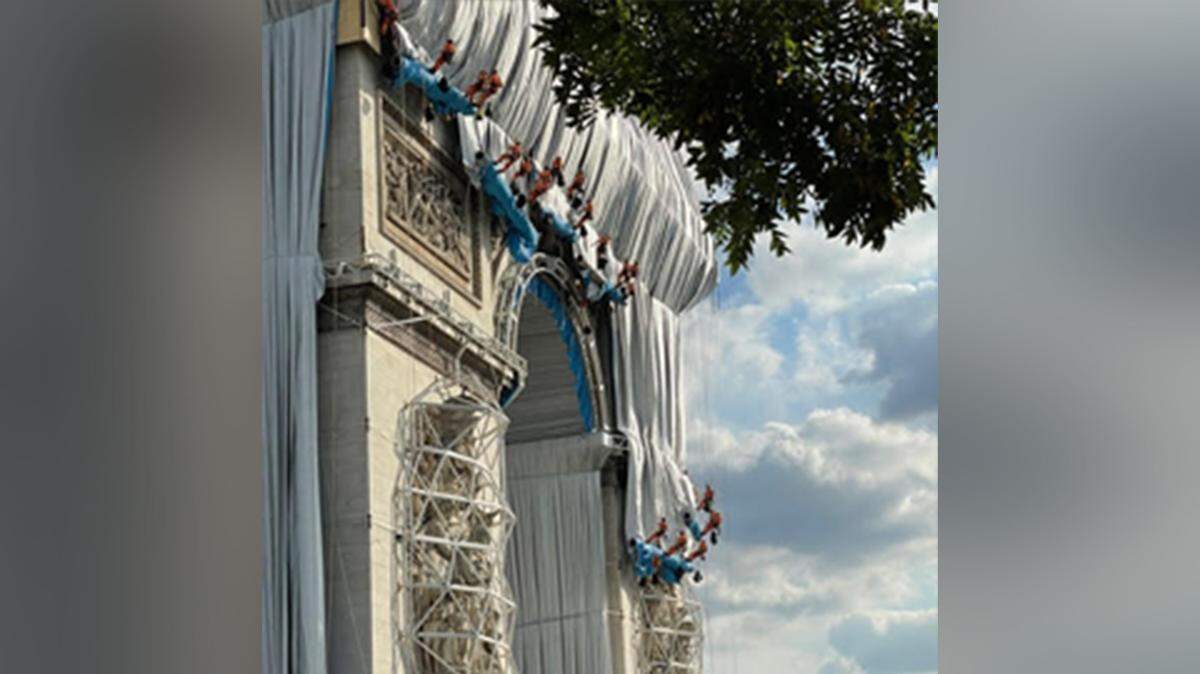
The Arc de Triomphe has disappeared. Until Oct. 3, the iconic Paris monument will be enclosed in 25,000 square meters of silvery blue fabric. It is the latest work of the artistic duo Christo and Jeanne-Claude.
My family and I are from Kansas City. We have moved to Paris to work and study for a year. This has given us a front-row seat to the project. Here is a hot take from one of my kids: “I get that it’s these guys’ thing to cover up important places in napkins. But I don’t like it.”
Actually, it used to be their thing. Jeanne-Claude passed away in 2009 and Christo died in 2020. Back in 1961, wrapping the Arc de Triomphe was just the crazy dream of two young artists in Paris. But they persevered with their vision of wrapping buildings and public spaces in fabric. They filled New York’s Central Park with billowing fabric gates. They wrapped the Reichstag in Berlin. In 1978, they even wrapped the walkways of Kansas City’s own Loose Park.
My other two kids don’t like the posthumous Arc de Triomphe project either. Our dog spent more time than anyone observing the installation process during his daily walks along the Avenue Foch. But since no one had ever peed on it, he wasn’t interested.
In a culture famous for its love of debate, the opinions I have heard in cafés, cabs and conversations have been surprisingly muted. Something about the act of covering must have that effect. Think of how you feel waking up to find your neighborhood covered in snow. Perhaps it is respect for the dead. (This, obviously, isn’t the case online, where comparisons range from “trash bag” to “diaper.”)
I’m ambivalent. I appreciate public art that encourages a new appreciation for the beautiful things we walk past every day. It also fills me with dread.
In 2018, “yellow vest” protesters stormed the Arc de Triomphe, trashing its gallery and defacing its exterior. These protests against the government’s environmental policy were an early show of strength among enraged conservatives worldwide. I won’t equate the yellow vest protests to the Jan. 6 insurrection at the U.S. Capitol. The former was at least based in a disagreement about objective reality. But I can’t shake the feeling that the pot that boiled over in 2021 was set to simmer in 2018.
Then there is the sheer act of covering something up in the age of COVID-19. Do we really need another thing we crave to gaze upon every day hidden behind cloth?
After weeks of watching the arch disappear bit by bit behind the veil, I realized the answer is yes. This isn’t a mask. It’s a bandage. After the yellow vest protests, the pain and loss of COVID and the Jan. 6 attack, I see that Christo and Jeanne-Claude somehow knew back in 1961 what we would all need 50 years later. From now through Oct. 3, everyone around the world who loves this grand arch will have their wounds of recent years beautifully dressed.
The official completion of the work was Sept. 18. Car traffic has been closed during the weekends. That has allowed everyone a close-up look. Now that it is part of the landscape and not a work in progress, people are adjusting. Our family continues to adjust — to the arch and everything else about our new surroundings. We miss our friends and family every moment. As an open-hearted Midwesterner, I’ve struggled to get into the habit of not exchanging smiles and hellos with people on the sidewalk. The barbecue situations is, to put it politely, suboptimal.
At the same time, we are appreciating how this culture has built more secure levees between work and family life. We feel as though we are expected to do fewer things, but to dive more deeply into each of them. These subtle shifts are giving us more time together — mostly around the table — to ponder new questions. What will be possible when all these bandages come off?
Phil Glynn is president of Travois, a Kansas City business that finances and supports housing and economic development projects in American Indian, Alaska Native and Native Hawaiian communities.