Jackson County prosecutor: KC ‘cannot incarcerate our way out’ of crime | Opinion
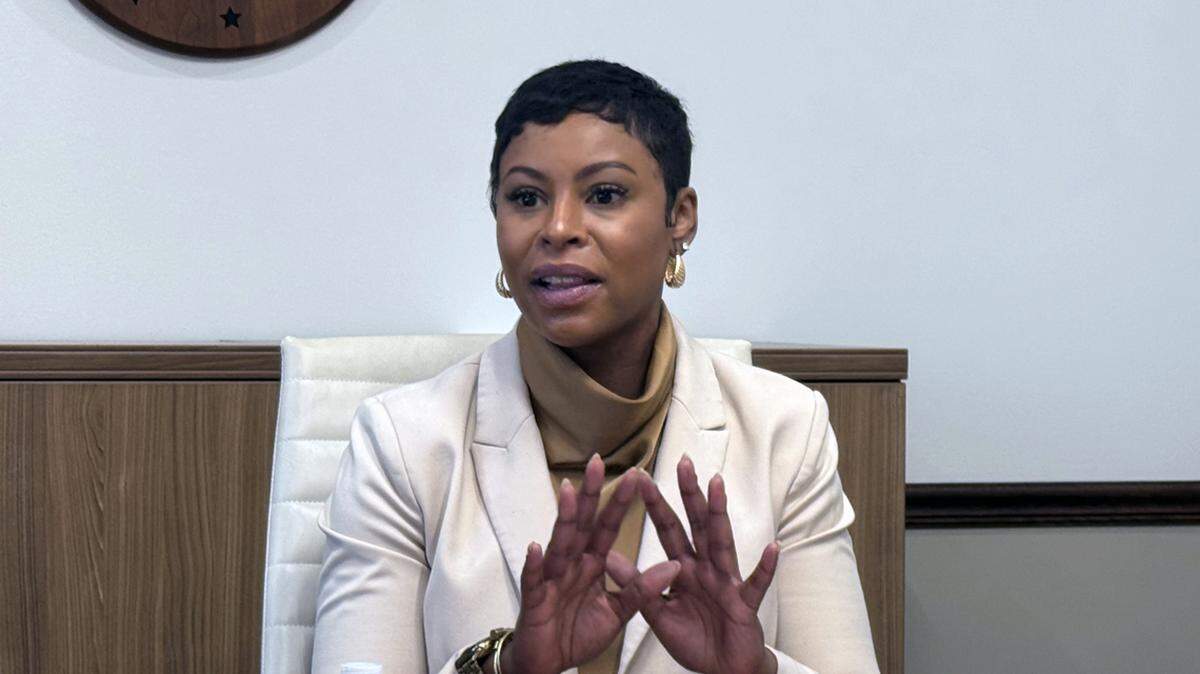
Jackson County Prosecutor Melesa Johnson said she was anything but soft on crime during 2025, but only relying on police officers and the prosecutor’s office won’t solve the ongoing problem of criminal elements in the Kansas City area.
In an interview with The Kansas City Star Opinion team Tuesday, she talked about her first year: focusing on property crime and high-impact offenders; assigning prosecutors to all patrol stations — including the violent crimes unit, assault squad, general crimes unit and, of course, the homicide unit; as well as attending all Board of Police Commissioners meetings.
And she didn’t let us forget that she charged a police officer.
“A lot of people don’t know that I already charged a police officer in year one of my administration. … I think it goes to show that, yes, you can have a positive relationship, but you can also not shy away from your role of holding officers accountable, because that is inherently within my job description.”
KCPD officer Christopher Showalter was indicted on one count of fourth degree assault, stemming from a July 2024 incident in Westport, where Showalter allegedly pulled a man off his bicycle and injuring him. At the time, Showalter was working off duty as a security guard in that area. A pre-trial conference is scheduled for March 13, and his jury trial is set for March 23, according to the prosecutor’s office.
When it comes to building a relationship with law enforcement, she said: “It’s not always sunshine and rainbows, and I love that we’ve been able to strike a balance. … I did what I needed to do, and I made sure that I was upholding my ethical obligations as the Jackson County prosecutor, which does center on police accountability, right?”
The Star’s team of opinion editors and writers sat down with Johnson in her office for an extensive discussion. She listed her challenges, her need for more attorneys as they prosecute more cases — even though her office is fully staffed — and her thoughts on some national issues. The interview is edited for clarity and length.
‘Utmost respect’ for Police Chief Graves
Star: What do you want the community to know about how you attack your role as prosecutor? Could you just talk a little bit about how you and Police Chief Stacey Graves work together now?
Johnson: The community needs to know that they have a police department and a prosecutor that are working well together. Do we agree all the time? Absolutely not. That’s just unrealistic and improbable. But what we do do, is pick up the phone and speak to each other directly if there is an issue. And I think we just have the utmost respect for one another, especially as women that are in leadership, that have high-stakes jobs and have a lot of weight and burdens on us. We’ve bonded in that arena, and I think it’s starting to really show up in our work.
Star: A guest commentary in The Star recently chided Mayor Quinton Lucas about praising the 5% decrease in homicide last year, saying that’s not enough. What do you think has to be done to lower crime?
Johnson: Before I dive completely into my response, I do just want to briefly address any criticism about a 5% reduction. We could easily be trending in the opposite direction, and frankly, in recent history, we have, and so any reduction year-over-year is a good thing, and we can’t talk about it as if it’s not. Of course, we would all like to see a larger percentage. We would all like to see crime drop a lot quicker. But we cannot scoff at the fact that we have had the lowest amount of homicides last year since 2018. That’s not a laughing matter, right? And then even when you talk about nonfatal shootings, the community deserves to know that, and to be able to extrapolate some level of comfort from that. But the way that we reduce crime does not center on the police and the prosecutor exclusively. If it did, we would have been in a much different predicament by now.
Star: So where does the responsibility lie?
Johnson: It is investment in communities. Where there are healthy communities, there are safe communities.
The Star: What kind of investment are you talking about? (Johnson talked about initiatives happening in other cities, such as community centers open at night for youths in the summer; literacy programs; workforce development programs for people between the ages of 18 and 25; education funding and eradicating food deserts.)
Johnson: And if we don’t have that piece — which I would argue we don’t to the degree that we need it — what police and prosecutors do is just going to continue to add to this ongoing hamster wheel of us taking 10 steps forward just to take seven steps back. Change is incremental, and it’s happening, but it could really happen in a real way if we had those investments from the state, if we had those investments from our local communities, and frankly, if our laws looked different.
Star: What do you mean by that?
Johnson: The Jackson County prosecutor’s office can only operate under the applicable state laws. When we have expansive self-defense laws that means that I can’t prosecute certain shootings that happen in our community. When young people are not legally barred from possessing firearms under state law, when we have stand your ground and there’s no duty to retreat, which often results in the loss of life — that all contributes to a feeling of lawlessness, and that lawlessness then impacts how people move about this county. And so in order to really reduce crime, we need more community investment, and we need to change our laws, and if you marry that with the ongoing work that police and prosecutors are doing together, I think that’s how we get to a better place.
Save KC, new detention center
Star: In 2025, your first year in office, what did you accomplish?
Johnson: Looking at my website not too long ago from the campaign that listed all of my priorities, it’s really cool to see that majority of what we talked about, we did: The crime strategies unit focused on property crime and high-impact offenders in our community. That also kind of oversees our work in Save KC, a focused deterrence program that is seeing measurable results. You know, some of the other things really engaging community in a robust way: We held over 100 community meetings in 2025 — neighborhood association meetings, Downtown Council meetings, Kansas City Chamber meetings, you name it. We were there. We would go anywhere somebody invited us to because I think we talk a lot about community policing, where we don’t talk enough about community prosecution. Our conviction integrity unit, or conviction review unit, continues to operate.
And then, you know, understanding that we cannot incarcerate everybody. We cannot incarcerate our way out of this issue, and just practically speaking, we don’t have the infrastructure to do so. The moment that the new Jackson County Detention Center opens, it will likely be at capacity. And when we prosecute 5,000 cases on an annual basis, what are we supposed to do with that approximately 4,000 individuals that will not be able to be detained?
Star: Tell us about your office’s new position, director of impact.
Johnson: That’s Mike Enos, who sits on my executive staff and is really tasked with the responsibility of engaging in more community partnerships, expanding our diversion programs so that we can reach more people. And he’s also in the process of creating an expungement clinic, because we got a grant from the Health Forward Foundation last year to set up our own expungement clinic.
Star: Expungement means helping people clear eligible convictions from their records, right?
Johnson: Yes, because barrier reduction is a means of violence reduction, the more that we can get people connected to housing and jobs and things of that nature by removing certain offenses, expungable offenses from their record, the better off they will be, and the lower our recidivism rates will become. And so all that happens in year one, on top of increasing charging rates, increasing conviction rates, and of course, our robust focus on domestic violence, which was another one of my campaign promises. And I’m really, really proud to see not only an increase in the amount of those cases that we’ve charged, but also an increase in the amount of referrals that we’ve received from law enforcement, which I think is data that supports our robust and collaborative working relationship.
Star: You also appointed a director to COMBAT. Tell us about that program. (COMBAT – Community Backed Anti-Crime Tax – is funded by a quarter-cent sales tax, and supports violence prevention programs, treatment services, and law enforcement initiatives.)
Johnson: We have a new executive director by the name of Murray Woodard. He spent nearly a decade at the Kauffman Foundation because I believe COMBAT needs to be running like a well-oiled private philanthropic machine. Excellence has to touch every single corner of this office, and Murray is really bringing a lot of that. We’ve transitioned to two-year contracts to give the agencies a bit more time to show results, and again, to be better customer service representatives to them. And as we sit at the cusp of our renewal campaign, I feel really, really good about the direction that combat is heading in, and have heard from the agencies that they feel like it’s a much better experience.
Glorification of violence a cultural phenomenon
Star: What didn’t get done that is Priority 1 for you right now?
Johnson: The diversion court program expansion (diverting some eligible people from the criminal justice system). We’re fundraising for it. We’re in the process of getting that done. I think that that’s the key missing piece, right? Year 1 was about accountability, reestablishing a code of conduct in Jackson County, making sure people know that this is a different office now, and that we are approaching things a bit differently. And that’s no disrespect to my predecessor, because I have the utmost respect, but I would not have run for this office if I did not want to put my imprint on it.
Star: Recently, you charged a teenager with some crimes, and he confessed or admitted to shooting more than 400 people. Is that even possible?
Johnson: Well, we don’t know it’s possible because we don’t have the evidence to support his statement. We are living in a time when the glorification of violence is a cultural phenomenon in a lot of ways. And I’m not in that young man’s head. I don’t want to portray like I know exactly where he was coming from, but I suspect that statements like those are made in an effort to gain a level of street cred that gets you a level of notoriety in the streets. But some of that cultural work kind of turning that type of stuff on its head, whether it’s through Save KC or going to speak to students at a school, all of those type of initiatives that we have done in our first year are efforts to try to curb some of that glorification of behavior, frankly, that is tearing our communities apart.
Star: What resources does your office lack most right now?
Johnson: We need more prosecutors, we just do. And we need more detention space. And we also need more money to expand our diversion programs. We’re pretty much trying to privately fundraise to expand our diversion programs. We’re looking to raise about $3.3 million to really do it. And so money, additional prosecutors while we’re charging more cases, that’s great for the community to hear — but I think it’s also important for the community to understand how that actually impacts our office.
Star: You talked about support from the state of Missouri. Are you in conversation with Gov. Mike Kehoe? What relationship do you have with him?
Johnson: Before I even got sworn in, I had the opportunity to travel to Jefferson City and sit down with Gov. Kehoe. I’ve had the opportunity to speak with his office on a couple of other points. And then fairly recently, our new attorney general, Catherine Hanaway, was in town, and we had a great introductory meeting, so much so that we’ve collaborated on a couple of different investigations since then. That’s the type of work we need to continue, especially as we’re striving toward the World Cup, where we’re going to need additional support to curb human trafficking. We’re going to need additional support to make sure that we are securing the safety of our communities while we have so many visitors, et cetera.
Ruling might lead to more lethal force
Star: Say you have a magic wand. You get to change one thing this year. What would be the top of your wish list in 2026?
Johnson: We received a pretty troubling ruling out of the Eastern District Court of Appeals last year that states assault in the third degree, which essentially can be (a light shove), warrants return of lethal self-defense, warrants the return of lethal force. So that means if a shooting stems from a bar fight under applicable law, it’s really difficult for me to charge that. Right now, it’s a huge public safety concern for us. And so I know that I have been in talks with the attorney general’s office and a number of other state legislators to hopefully cure that defect through legislation and definitively say assault in the third degree, assault in the fourth degree does not constitute a forcible felony that would warrant the return of self-defense. And so, I’m hopeful to see that happen during this legislative session, but we’ll see. We’ll see. But if I could wave my magic wand, I would like to see that decision reverse, because it really does harm our ability to do our job in a lot of ways.
Star: As a prosecutor, when you, when you saw the reports out of Minneapolis with Immigration and Customs Enforcement and Renee Good, what were your thoughts about what you saw?
Johnson: A badge and a gun does not make you beyond reproach. And unfortunately, I feel like with scenarios like that, and just the refusal to even investigate it, to see how it could be avoided in the future, set aside criminally charging the officer, right? We can’t investigate it to see how we can prevent it from happening again? We can’t investigate it to see how we can refuse to take a mother of young children away from her kids? It’s hard for me to reconcile, especially, you know, when we do have so many other departments locally that participate in weeding their bad apples out. I want to rebuke any notion that every single law enforcement agency (believes in) this band of brothers mentality, and you can never hold one of our own accountable. That’s just not true. But when you have incidents like that, it creates a culture where some individuals with a badge and a gun feel like, ”I can do what I want, no matter what it results in.” And of course, as a prosecutor who is charged with holding law enforcement accountable, albeit local law enforcement, that’s a huge problem for me. That’s a huge concern for me, and I’m very, very worried about the precedent that it sets.
Star: Your thoughts on law enforcement agents wearing masks ?
Johnson: When you sign up to do these jobs where you are serving community, some of your privacy goes out the window. I’ve learned that the hard way this past year. We don’t get the luxury, as public servants, of hiding. We don’t get the luxury of anonymity. We don’t get the luxury of not standing behind our actions and the statements that we make. Each one of my prosecutors has to sign any document they file. They have to stamp their name with their work product. Law enforcement should stamp their conduct with their badge numbers, with their faces, with their names, with their identities, because that shows skin in the game.
This story was originally published January 14, 2026 at 11:56 AM.