With public funds out, these groups help Kansas City’s immigrant families | Opinion

With federal assistance ending for programs that deal in diversity, equity or inclusivity, someone has to pick up the gap in helping immigrant families with basic needs, like paying rent and keeping utilities on.
Several Kansas City organizations are helping area Latino and immigrant families with these basic needs. But sometimes it’s not easy to help communities who try to remain in the shadows for fear of being outed and deported.
Leaders of these organizations don’t believe Kansas City is welcoming to immigrants now.
“What would it mean to actually have a welcoming city in Kansas City?” asked Trinidad Raj Molina, the Accompaniment Organizer for AIRR, Advocates for Immigrant Rights and Reconciliation. Molina explained that you can’t say Kansas City is a welcoming city for asylum-seekers “when most people will get a deportation order eventually only because they can’t afford a lawyer.”
Kyla Pitts-Zevin, executive director at the Northeast Community Center, said today’s federal government doesn’t support Kansas City’s immigrant communities. “The appetite’s not there to welcome people like we want to welcome people, but that’s not the overwhelming feeling from people in political power right now.”
So, organizations like AIRR in Kansas City, Kansas, Project Harmony KC in Northeast Kansas City and Revolucion Educativa’s Adelante Fund step in to help, each in their own, sometimes unique way.
This is timely, of course, but especially this week because UnidosUS, the nation’s largest Latino civil rights and advocacy organization, will host a listening session Thursday in Kansas City with local community leaders and advocates to discuss the economic challenges facing Latino families, particularly around rising housing costs, wage insecurity and the cost of living.
Today, I’ll tell the stories of three aid organizations, but there are other groups and opportunities to help Latino and immigrant populations in Kansas City.
Adelante Fund pays bills
Edgar Palacios, CEO of the Latinx Education Collaborative Group, believes helping others help themselves is the way to build community. Finding a way to financially support this community continues to be challenging.
In today’s changing funding environment with federal support waning more and more — especially targeting groups with a DEI label — Palacios and other partners decided to seek private means.
“We understand that the world is complex and complicated and that there are solutions that are specific to communities that help improve those communities,” Palacios said.
One of those solutions is Revolucion Educativa’s Adelante Fund, privately funded by local and national philanthropic partners, to help get money into the hands of Kansas City area Latinos. The fund has raised more than $20,000 so far.
Adelante means “forward,” and since February, according to the Adelante Fund summary report, the organization has awarded more than $16,000 in 44 separate grants, depleting a large portion of the fund.
While 63% of applicants received some level of support, the average amount granted per applicant covered only about one-third of the requested amount. The fund is small but mighty, and it could use some assistance.
The fund has received 70 applications for help; the group was able to support a little over half.
When talking to Palacios, who is on the board of the fund, I expected that a need related to immigration status would have topped the list of requests, but instead, housing aid remains the most urgent and frequently cited need, accounting for nearly two-thirds of all requests.
The majority of requests for need was for housing (59%), followed by legal support (30%) and food assistance (11%).
Because the fund is made up completely of private donations, Palacios said these organizations have a responsibility to help the community, not follow federal regulations.
“I think the pressure is being built by the government and we’re seeing the state mimic federal-level policies. At the end of the day it’s about money. I think what’s interesting about philanthropy in this moment is that they have a choice to make. I think philanthropy understands the inequities in our community deeply, right? That’s part of the reason that they exist.”
Palacios says charities should listen to grassroots community leaders with expertise.
“If they are listening to those that have been in the work for a while and they understand that these are the folks who have the solutions and can also effectively implement and deploy those solutions, I think philanthropy is going to make decisions that are going to say, ’Hey, we’re going to double down on our efforts and we’re going to continue to make sure that organizations doing the work get the money that they need to not just survive but also thrive.’”
The Adelante Fund provides direct financial assistance to immigrant families in urgent need of legal support, housing assistance, and food security.
- Emergency Assistance — Up to $250. Covers immediate needs such as food, transportation and short-term essentials.
- Housing & Stability Support — Up to $500. Helps cover partial rent, security deposits or emergency housing costs.
- Legal Support & Crisis Relief — Up to $1,000. Supports attorney fees, immigration applications and urgent legal expenses.

Harmony Project KC
When you think of mutual aid funds that help families, you might not think of trombones and violins along with checks that pay bills.
I didn’t either, but in asking a few questions about how organizations are helping Northeast KC immigrants and other families, I found help can mean more than money.
Kyla Pitts-Zevin and the Northeast Community Center utilizes Harmony Project KC’s transformative power of music to grow young minds into musicians, as well as supporting families.
The decor in Pitts-Zevin’s office represents her passion to be a welcoming city to immigrants.
“This is a violin,” she explained when pointing out a beautiful piece of Mexican art.
“When I was a child, my family lived in Chihuahua, Mexico, for three years. The Spanish culture is very welcoming and warm of outsiders. That is an expectation that, if anything, you treat an outsider even better than you would treat somebody within your own community.”
Living in that perspective from ages 6 to 9 years old, she said she was surprised — she used the word “shocked” — when she came back to the United States.
“I saw how intense and ugly the anti-immigrant rhetoric was. I did not understand it because I was nine. I was just like, ’You guys don’t even know these people. What are you saying?’”
Today, she uses her Spanish and her love for the culture by working with Harmony Project KC. Children as young as 8 years old through high school graduation are given a musical instrument to keep and trained to play it. They have to give it back at the end of the yearslong program, but often Harmony Project KC helps them buy their own.
The surprise is what else the program does. It helps the families pay bills.
The family assistance fund was formalized during the pandemic in 2020 but it has grown every single year since then, in support of the needs of the families, Pitts-Zevin said.
“It’s been an important part of families being safe, secure and stable. … We can’t expect them to get their kids here if they don’t have gas money, if their car is broken down, if, you know, the any other host of things that are happening in their lives.”
The fund caps support at $1,500 a school year per family, which could include more than one child.
Financial assistance might be why some people come through the door, but it’s not why they stay. Pitts-Zevin says music learning and performance has an impact on literacy, numeracy and self-confidence.
“And so, we are really using the power of music to impact young people here in Kansas City.”
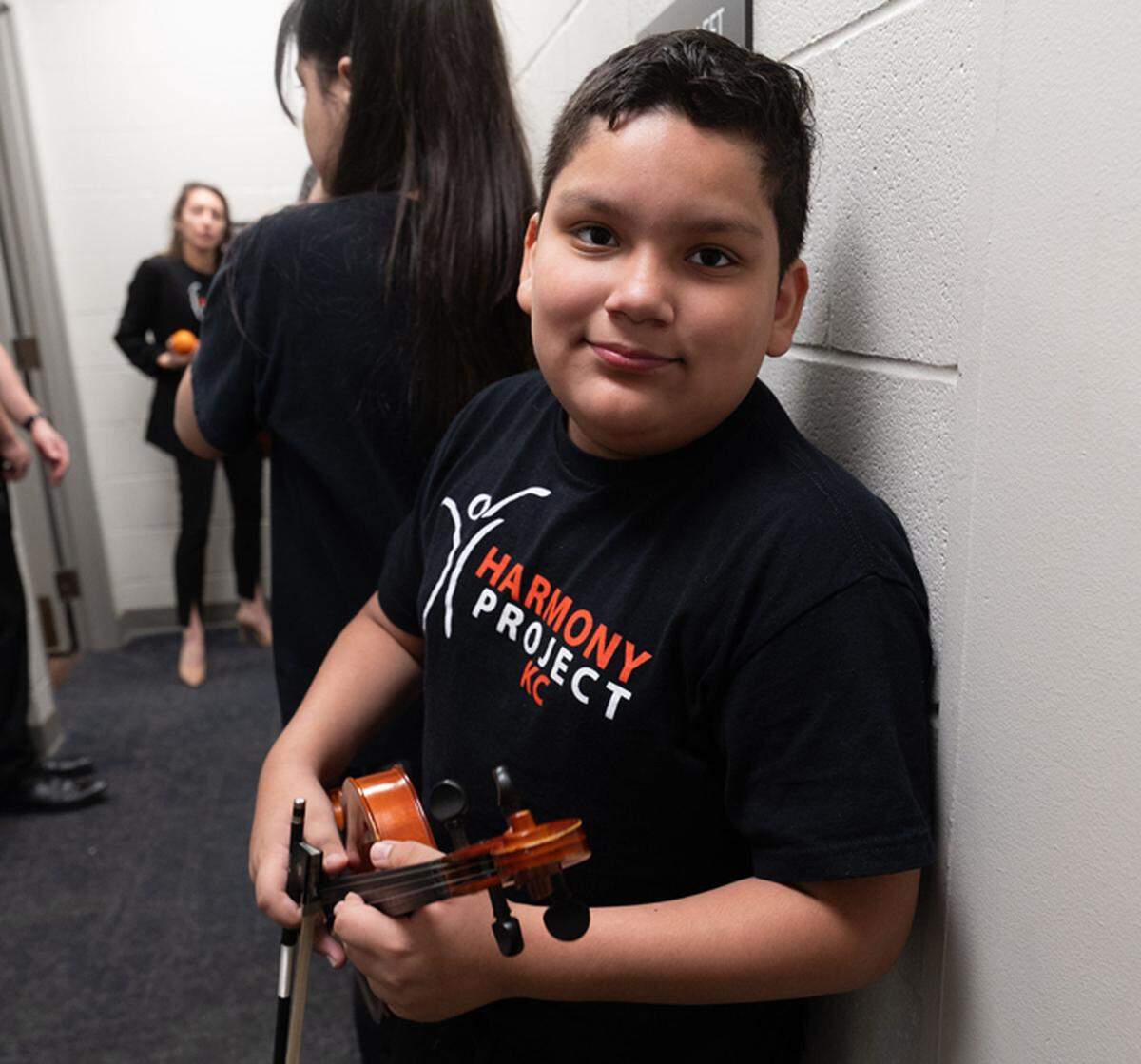
The program has an annual Spring concert. This year’s was Tiempo Para Florecer, or Time to Bloom, held May 10 at the Folly Theater. Michael Stern, former music director of the Kansas City Symphony, applauded the program at a 2024 fundraiser.
“This is much much more than just a little local project in the Northeast community,” he said. “This is something which should infect every single corner of the United States and the fact that it’s happening so successfully here in Kansas City is a credit to the idea that we can actually make change happen. Harmony KC makes change happen.”
Pitts-Zevin’s time in Mexico was the start of her journey of learning Spanish and she says she uses it on a daily basis at the center. And that’s why she’s here.
“I always tell people this is not a bleeding heart situation for me. I’m literally just giving back what was given to me.”
Enrollment information can be found here.
AIRR: Going to court
Trinidad Raj Molina calls AIRR “primarily community organizers,” specializing in programs such as ”Your Rights” trainings and Immigration 101 training.
“We’re training the immigrant community to be the catalyst. Mobilizing money to create change.”
The money is just part of it, Molina said. “We’ve always also had an accompaniment aspect to what we do. … In practice, that ends up meaning going with asylum-seekers to the immigration court dates and to the ICE office check-ins.”
Molina said AIRR saw an increase of this kind of need since 2019: “It just was clear there were more asylum-seekers over the years coming to Kansas City, especially last summer.”
There’s never enough housing resources for people who are new to this country, Molina said.
“So maybe (immigrants) were starting to work out something here in Kansas City, but they don’t really know how to work with American landlords yet. And then that lack of understanding sometimes can lead to misunderstandings, big disputes where I’ve seen at times whole families of asylum-seekers just go on the streets overnight in the winter.”
Another issue is a lack of funds when asylum-seekers arrive. Molina said that unlike refugees, these immigrants are not eligible for housing resettlement and are on their own when they arrive.
“Usually the refugee organizations, their funding was federal, which could limit what they could do. Not their fault. So even though we were smaller, we realized that sometimes we were the only ones trying to come up with those grab bag solutions when asylum-seekers had housing issues.”
Molina said grab-bagging it meant organizing community connections and finding creative solutions within the community. And that would work, for a while. Then came the summer of 2024.
“So over the years especially since maybe 2018, 2019, it just was clear there were more asylum-seekers over the years coming to Kansas City, especially last summer. It was crazy. So what we found was that for asylum-seekers there’s never enough housing resources.”
Molina said last year AIRR was able to receive a grant to have a specific emergency fund. “This is our second year with the grant. So we have a lot more capability now to be able to do something a little more tangible. It’s not a huge fund, so we usually say we can use it one time per person every six months if they make a request. And it often ends up being, especially for housing-related things like rent help.”
Occasionally, AIRR is able to help in unique ways. Molina talked about a terminally ill patient who wanted to go back to his home country of Haiti.
“All he wants is just to go die in peace back home at this point. We have a small fund that sometimes has really come through for people doing what I think consulates should be doing.”
Molina said the applicant, a young man in his 30s with cancer, wanted help paying for the plane ticket back home. “This was not a typical request, right? But it made sense why he wanted to do this. He is basically dying now. He’s getting weaker every week. And he wouldn’t have any other means of doing so otherwise.”
AIRR was able to buy the plane ticket. Because of the unusual circumstances, Molina met with the cancer patient, to make sure he could handle the connecting flights. He also heard from his advocate, who wrote a letter explaining the man’s condition.
“We considered it for a while. If we do that every time, we would run out (of funds). But yeah, he was being completely genuine.”
Applicants for AIRR assistance must reside in Kansas or Missouri and must be an immigrant or a member of mixed status family. Applicants can only send one request in a period of six months and should be referred from partner organizations or individuals.
More help for immigrants
Here are other local organizations helping immigrants. You can donate or find out more information about submitting an application:
- Cross Border Network’s Bienvenido Fund
- Eye of an Immigrant helps with United States Citizenship and Immigration Services (USCIS) fees
- Asylum Clinic KC offers free legal clinics for asylum-seekers
This story was originally published June 3, 2025 at 5:08 AM.