Christians are thinking about the election, too. Here’s what they want to know | Opinion
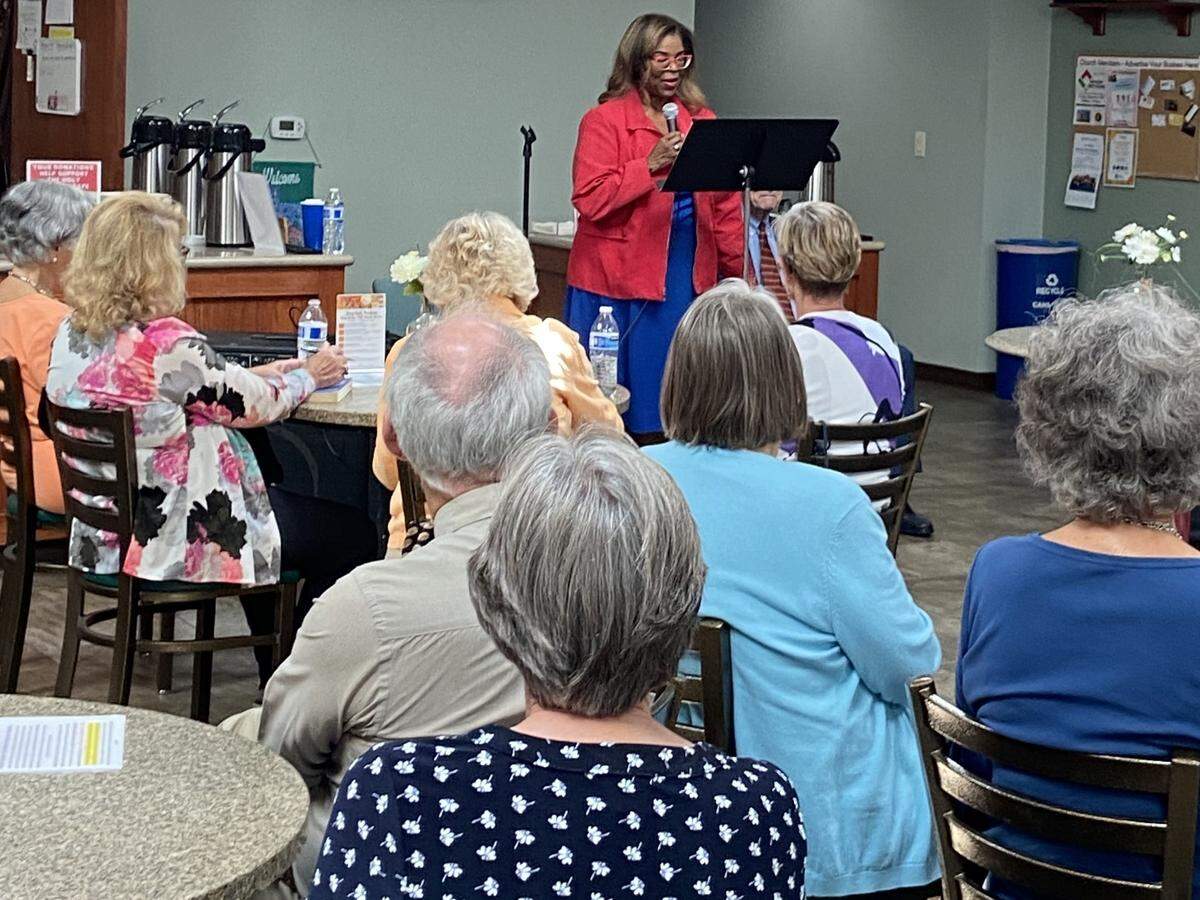
.jpeg "Blogger Bill Tammeus and Star Opinion Editor Yvette Walker spoke about the 2024 election at the JOY Center in St. Joseph, Mo., a day after the assassination attempt of Donald Trump.")
If you wonder what mainline Christian protestants think about the upcoming election, I can tell you a few things. You might be surprised.
I’ve chatted with quite a few of them this year, on a speaking tour of churches organized by the Heartland Presbytery in the Kansas City area.
In 2024 and previous election cycles, you’ve probably heard about evangelical Christians, said to have been a conservative voting bloc that sweep in Republican candidates. What you might not know is it’s commonly believed that evangelicals descended from mainline protestant groups, such as Baptists, Lutherans, Methodists and Presbyterians.
But these groups are no monolith. They all have different ways of thinking about the election.
Former Kansas City Star faith columnist and blogger Bill Tammeus and I visited seven different Presbyterian churches both north and south of the Missouri River from June to October. The Mission and Social Justice Committee of Heartland Presbytery arranged the talks, titled “Democracy: Use It or Lose It.”
Tammeus said he jumped on board.
“People around the world have lost their freedoms because of political leaders who want to be, in effect, unquestioned monarchs. If we allow that in this country, we’d be abandoning the American democratic experiment that so many of our citizens have fought for and died to defend. That’s way too high a cost to pay.”
Why did I speak to these groups? I’m not Presbyterian, but I agree with Tammeus. And, if a bunch of churches want to talk about our system of government, our elected representatives and our democracy, I’m all in.
From KC to St. Joseph
Our first talk was in late June at Ward Parkway Presbyterian Church in Kansas City, and our last was in mid-October at Village Church in Prairie Village. To be honest, I didn’t know what to expect, and each of the churches was different. However, the groups, large and small, were welcoming and curious. After we each spoke, we took questions from the audience. Each time we had to close down the Q&A or we would have been there for hours.
One talk in St. Joseph at the JOY Worship Center was scheduled on the day after the attempted assassination of Donald Trump at a rally in Butler, Pennsylvania. Frankly, I thought the church might cancel, but it didn’t. Instead, members wanted to talk about violence and social justice.
In general, the groups mostly were older people, but there were a few Generation Xers and millennials present.
Over four months and seven churches, what did the hundreds of members want to know? Surprisingly, not about ballot initiatives. Not about local candidates or whom to vote for. Not even about our presidential candidates, even though we spoke of them in our remarks.
These folks were more interested in America’s future and how to get information they needed to be more well-informed.
They just wanted to know … more.
Claudia Ellermann, chair of the Adult Education Committee at Pine Ridge Presbyterian Church said the discussion was needed at her church. “We agreed that this would fit in nicely with our focus this year on nonviolence, civil conversations and supporting democracy.”
“We can’t change a system unless we understand what’s happening behind the scenes,” said Michele Stowers of Village Church in Prairie Village. Stowers is the co -chair of the Social Justice Ministry committee.
Among the many questions asked:
- How should we respond to people who are repeating political lies the candidates are telling?
- What are the most reliable sources of news and analysis among the media?
- How do faith communities get involved in all this without jeopardizing their IRS nonprofit status?
And perhaps the most important question of all: What can I do?
Registering to vote and then getting out and voting, of course, was the answer to that question.
Mainline to Christian Nationalism
Christian nationalism has been associated with far-right evangelicals, but here’s what many may not know, said Tammeus: “We find Christian nationalism almost everywhere in the history of mainline protestant churches. The widespread belief that Christian Nationalism is a relatively new idea promoted by fundamentalist, evangelical or conservative Christians doesn’t match up with history.”
Tammeus was referring to the new book “Baptizing America: How Mainline Protestants Helped Build Christian Nationalism,” by Brian Kaylor and Beau Underwood. “Kaylor and Underwood offer to show how mainliners have promoted this terrible idea for a long time, though often in softer, less extreme ways than some kinds of Christian nationalism we see today,” he said.
I wanted to know what other mainline protestants were thinking and so I spoke with Adam Hamilton, pastor of Church of the Resurrection, a United Methodist Church with campuses in eight metropolitan area locations.
Our conversation ranged around a host of issues, from decreased attendance in church to MAGA Christian institutions.
But first, I wondered, does he put yard signs out? The answer is no.
Adam Hamilton of Resurrection
“I would, except as a pastor I feel like then I’m not just Adam Hamilton private citizen. I’m Adam Hamilton, pastor of Church of the Resurrection. … But the other day one of our members stopped by who didn’t realize it was my house and asked to put up a sign.
“I said, ‘I desperately want to, but I don’t put signs or bumper stickers because that implies the church’s endorsement even though I’m just a private citizen.’ But my wife’s another story. So, the last campaign I think she did put a sign out. I’m like, ‘Honey, they don’t know that’s from you. And not for me.’ ”
Hamilton had some thoughts on church attendance and wondered where the far-right perspective in the church is coming from.
“I think it’d be interesting to know what percentage of those folks don’t go to church. I do think that there are churches that are very much aligned with MAGA and with the more extreme elements that are out there, but I think there’s a lot of folks in more fundamentalist churches for whom this is their way of seeing the world and it is largely fear-driven.”
Hamilton said, “Church is community,” and if you aren’t in community you aren’t interacting with others. This can contribute to fear of others and the unknown, he said.
Resurrection is using several resources to help its members come together and talk about democracy. “The After Party” is one. It’s a global project created by pastors and journalists to help people understand politics and beliefs.
Curtis Chang is founding executive director of Redeeming Babel, which produces the After Party. He said he has been deeply disturbed by the white evangelical church, which he says has been hijacked by partisan forces.
“Simply saying ‘Protect democracy,’ for many Christians that’s not actually compelling. There’s nothing particularly appealing to their faith about that because they have not been taught the connections between Christianity and democracy. And so we realized we needed to actually make a case for democracy.”
That made sense to Hamilton. “The After Party was trying to bring people together in conversation. So when we found out about it a month or two ago, it’s like, ‘this lines up exactly with what we’re trying to do.’ ” he said.
The election will come and go, but the need for a strong democracy remains. So does the people’s appetite for information, even if those people are sitting in church pews.