License plate cameras: Is your data used against you, Kansas City? | Opinion
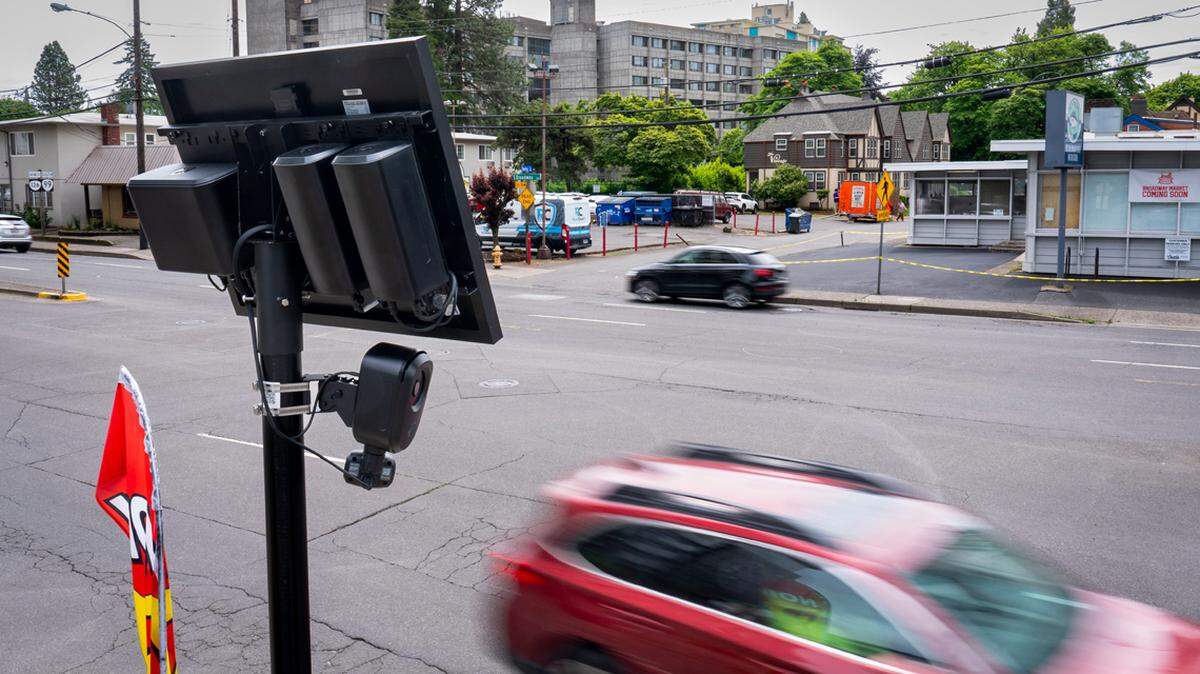
You are not alone on the road.
Each day, Kansas City motorists in our six-county region have their vehicle data collected by cameras known as automated license plate readers, or ALPRs. These cameras are designed to take a photo of a license plate or vehicle to help police track down criminals. Hundreds of them are affixed to structures and patrol cars in Cass, Clay, Jackson, Johnson, Platte and Wyandotte counties.
One company, Flock Safety — which is being used in the Kansas City area — was concerned enough itself about how your data is being used that it stopped cooperating with the federal government.
In our metropolitan area, multiple police agencies use license plate reader cameras to collect vehicle information including license plate numbers, a vehicle’s make and model and time and date. They include but are not limited to agencies in Blue Springs, Clay County, Gladstone, Grain Valley, Jackson County, Lee’s Summit, Kansas City and other jurisdictions.
Many of them that contracted with Flock utilize the company’s transparency portal to publicly display their usage and policies around the system.
But that doesn’t mean any of these law enforcement agencies should ignore the recent allegations that Flock data was shared with federal agencies.
While public-facing cameras of all kinds could be used to fight crime and keep us safe, as law enforcement officials and other advocates contend, their use is ripe for abuse, according to privacy rights groups such as Electric Frontier Foundation, or EFF and Electronic Privacy Information Center, or EPIC.
Because of that potential, every local jurisdiction in the metropolitan area that uses automated license plate readers should consider, if they haven’t already done so, conducting an audit to make sure that drivers’ data is not being used by local or federal officials for nefarious reasons.
As the American Civil Liberties Union suggests, “You are being tracked,” and these audits should be made yearly and the results must be released publicly.
Alleged abuse was reported
Flock Safety, one of the nation’s leading operators of ALPRs, recently announced it had halted pilot programs with the Department of Homeland Security’s Customs and Border Protection and its law enforcement arm, Homeland Security Investigations. The company cited “confusion and concern” about the purpose of the federal agencies’ investigations as the reason for the pause, according to CBS News.
In Illinois, Secretary of State Alexi Giannoulias recently announced that an audit found Customs and Border Protection had accessed drivers data in that state, CBS news reported.
The possibility of local agencies sharing our data with federal authorities without a legal reason to do so is frightening.
Illinois bars sharing license plate data with federal authorities — specifically information on people seeking out-of-state abortions or undocumented immigrants, according to CBS.
In Missouri and Kansas, some safeguards are in place to prevent abuse. But are they enough?
What happened with Flock?
In a statement, Flock founder and CEO Garrett Langley said it entered into an agreement with Homeland Security Investigations to help combat human trafficking and fentanyl distribution.
And while that is all well and good, Illinois — one of Missouri’s neighboring states — alleges the company’s technology was used in immigration-related searches by federal agencies. Parameters have been put in place to guard against those searches, Langley said Aug. 25.
An email message sent to Flock Safety seeking comment was not returned.
“We clearly communicated poorly,” Langley said in the statement. “We also didn’t create distinct permissions and protocols in the Flock system to ensure local compliance for federal agency users.”
EPIC, the electronic privacy group, has routinely urged legislators and courts to take meaningful steps towards protecting the privacy interests of motorists, according to EPIC counsel Maria Villegas Bravo.
In response to an emailed inquiry I sent to EPIC, Bravo said in a statement that mass surveillance of the public by law enforcement agents offends the right of individuals to operate vehicles on public roads while maintaining privacy and their right to be free of unreasonable searches.
Courts have already indicated that law enforcement needs a targeted warrant supported by probable cause to query Flock’s massive, searchable databases due to Americans’ reasonable expectation of privacy in their long-term movements, Bravo wrote.
“The fact that Homeland Security and other federal entities have queried these databases is part and parcel of the current administration’s project to expand its surveillance dragnet,” she wrote.
According to Flock Safety, its cameras capture billions of photos of license plates each month. However, the company doesn’t own that data — the local agencies do. Those jurisdictions reserve the right to share information with other law enforcement agencies when asked.
Even if you are the most hardcore anti-immigrant, pro-life proponent out there, you should support a transparent look on how this information is being used. It wasn’t that long ago that a police chief in Sedgwick County, Kansas, used Flock Safety cameras to track his ex-girlfriend and her new boyfriend.
Like EPIC’s Bravo said, we all have some expectation of privacy in public. But we also have a right to know if the data being extracted by these cameras is being used for legitimate reasons.
This week, I emailed officials in several local cities about their use of ALPRs. Below is a summary of each of those responses.
Blue Springs
Blue Springs uses ALPRs, specifically Flock cameras, according to Police Capt. Kyle Flowers.
He said he was not certain of the exact number of ALPR cameras the city has “but we do have stationary and mobile versions (patrol vehicles),” Flowers wrote. He added he is not certain about the cost.
Flowers said the department does not store data in house and accesses the system only with legitimate investigative inquiries or through automatic alerts provided through Flock such as stolen vehicles or warrants.
Data collected through the system is available to any Flock subscriber, Flowers wrote. He said he was not aware of any direct requests for information from federal agencies.
Gladstone
In Gladstone, Police Chief Fred Farris said the city has 12 fixed location Flock cameras throughout the city.
“We still have one vehicle with a mounted system, however, it has not been used in quite some time and will not be replaced when that vehicle is rotated out of the fleet,” Farris wrote in an email.
Gladstone pays $2,500 in yearly subscription fees per camera, according to Farris.
“We do not store any data,” Farris wrote. “This is a subscription based system and the data is stored by Flock.”
When asked if Gladstone PD had shared any Flock data with federal agencies, Farris wrote: “We would share information with any law enforcement agency making requests for official law enforcement purposes. Flock is a very large company that is used by agencies all across the nation. If granted permission by the host agency (Gladstone PD in our case), our cameras can be accessed by any other agency on the same system.”
In a follow-up email, Farris said permissions are given to the agencies that request access for law enforcement related investigations and he was “not aware of any city, state, or federal agency that uses technology like this for anything other than criminal investigations,” he wrote.
Grain Valley
Grain Valley currently has 13 ALPRs: five in patrol vehicles, two mounted on vehicles and six public street mounts, according to city public information officer, Tiffany Lor.
“Our vendors are Safe Fleet (not operational yet), Motorola, and Flock,” Lor wrote. “The in-vehicle cameras are approximately $1,300 per year, and Flock cameras are about $3,000. We do not store any ALPR data; however, it is stored by vendors, and we have access to the data for law enforcement investigation purposes only. Any additional questions about data releases will need to be directed to vendors (Flock, Safe Fleet, Motorola, etc.) Homeland Security or ICE.”
Independence
Independence has nine ALPRs along Noland Road courtesy of the Noland Road Community Improvement District, according to City Clerk Susanne Holland.
The city’s vendor is Genetec and the cameras were funded through a collaborative effort between the CID and Independence Police Foundation, Holland wrote in an email. Data is retained for one year from the date of the recording, Holland said, adding that ALPR cameras have proved to be invaluable in solving serious criminal cases.
There are an additional 131 mobile ALPRs mounted coaxially with the police department’s in-car cameras, according to Holland.
“We routinely share information with federal agencies in the furtherance of investigation into criminal matters,” she wrote.
Lee’s Summit
Lee’s Summit has a total of 55 Flock cameras mounted on public roads or in vehicles, according to Police Sgt. Chris Depue. The cameras are leased and data is stored for 30 days, according to Depue.
At least once a year, an annual audit is done by the department’s crime analyst and forwarded to the police chief for review, Depue wrote.
“The purpose of the audit is to verify ALPR system integrity is maintained,” he wrote.
Depue added the department has not shared data with federal agencies.
“Nothing indicates that we have ever had a need to share data directly from LSPD to those agencies,” he wrote.
Kansas City
According to Kansas City Police Officer Alayna Gonzalez, KCPD has approximately 375 cameras on police vehicles and city streets. Its vendor is Genetec, she said.
The department spent approximately $4,400 for each camera, Gonzalez wrote. She added there is not a policy pertaining to general data storage.
With the enormous amount of cameras on Kansas City streets, there should be one.
KCPD has not shared any data collected by these cameras with federal agencies and the system is monitored on an almost daily basis, according to Gonzalez.
Clay County
The following is a brief Q&A with Sarah Boyd, public relations manager for the Clay County Sheriff’s Office:
Toriano Porter: Does Clay County Sheriff’s Office use APLR? If so, who is the vendor?
Sarah Boyd: Yes, Flock Safety.
TP: How many APLRs does the Sheriff’s Office have? Are they on public streets or on police vehicles?
SB: We have 12 cameras affixed on public roadways. None are on vehicles.
TP: How much did it cost to purchase these cameras?
SB: We have a four-year contract with Flock for $84,400, which includes the equipment.
TP: What is the Sheriff’s Office policy regarding data storage?
SB: Flock retains the data for a 30-day period. Here is our ALPR policy, which includes retention information.
TP: Has the Clay County Sheriff’s Office shared any data collected by these cameras with federal agencies, including Homeland Security or ICE? If so, when and what was the purpose in sharing that information?
SB: Flock data can only be shared among law enforcement agencies with Flock accounts. Agencies must request access to another agency’s data in Flock, and that agency must approve the request to share data. We reviewed all our Flock requests, and we have received none from any federal agency.
TP: How often does the sheriff’s office conduct an audit on the system to make sure policy is being followed and are those audits publicly available?
SB: Every month, the Patrol captain conducts an audit in Flock, but it is a visual review only: there is not a record created when that takes place. Flock has an audit function that automatically pulls up a log of all Flock entries and inquiries made by our deputies and investigators. The Patrol captain visually reviews those logs to ensure all entries and inquiries follow our policy for use of the technology.
Jackson County
The Jackson County Sheriff’s Office currently operates two fixed-location ALPR systems on public streets and two mobile ALPR systems mounted on patrol vehicles, according to Sheriff Darryl Forte. The systems are manufactured by Leonardo US Cyber and Security Solutions, Inc., Forte said.
In an email, Forte said, the vehicle-based ALPR systems were $20,800 each and the fixed-location cameras were $8,000 each.
The sheriff’s office ALPR systems utilize the Houston High-Intensity Drug Trafficking Area LPR database, Forte wrote. He said participation is governed by a memorandum of understanding with Houston HIDTA.
“The data contributed to the Houston HIDTA LPR database is stored according to the terms of that MOU, which is a public record accessible via Jackson County’s Legistar legislative records website,” Forte wrote.
He added data sharing agreements with other participating agencies are in place with federal agencies, including Homeland Security and ICE.
“The Houston HIDTA LPR database MOU requires prosecuting agencies to notify the Sheriff’s Office before release of data as part of the criminal discovery process; the Sheriff’s Office has not been notified of any such use or release of our ALPR data,” Forte wrote. “The MOU was signed by me on March 23, 2023.”
Johnson County
I reached out to law enforcement agencies in Johnson County but hadn’t heard back by Tuesday afternoon. As late as 2022, at least two cities had used the readers:
In 2022, Mission Hills had installed cameras and automatic license plate readers at “key intersections to help police solve crime,” Capt. Ivan Washington with the Prairie Village Police Department told The Star. Prairie Village police contracts with Mission Hills for police services.
In Overland Park, The Star also reported police using the technology as early as 2015, Several vehicles in its patrol division were equipped with license plate readers as well as some in stationary locations in strategic areas within its city limits.
Along with its contract with Mission Hills, Prairie Village police also have used the readers. In a 2022 document, the department described them as crime prevention tools, “since many criminals have learned to recognize them, and will go elsewhere to commit crimes,” and adding that “traffic cameras and ALPR’s have already proven to be effective tools for solving crimes in Prairie Village.”
Other local municipalities
I sought information on license plate readers from other law enforcement agencies in Cass, Platte and Wyandotte counties and the Missouri State Highway Patrol. When I hear back from them I will update this story. But it’s important to note that Kansas City police use these cameras in Platte, Jackson, Clay, and Cass counties.
This story was originally published September 3, 2025 at 5:07 AM.