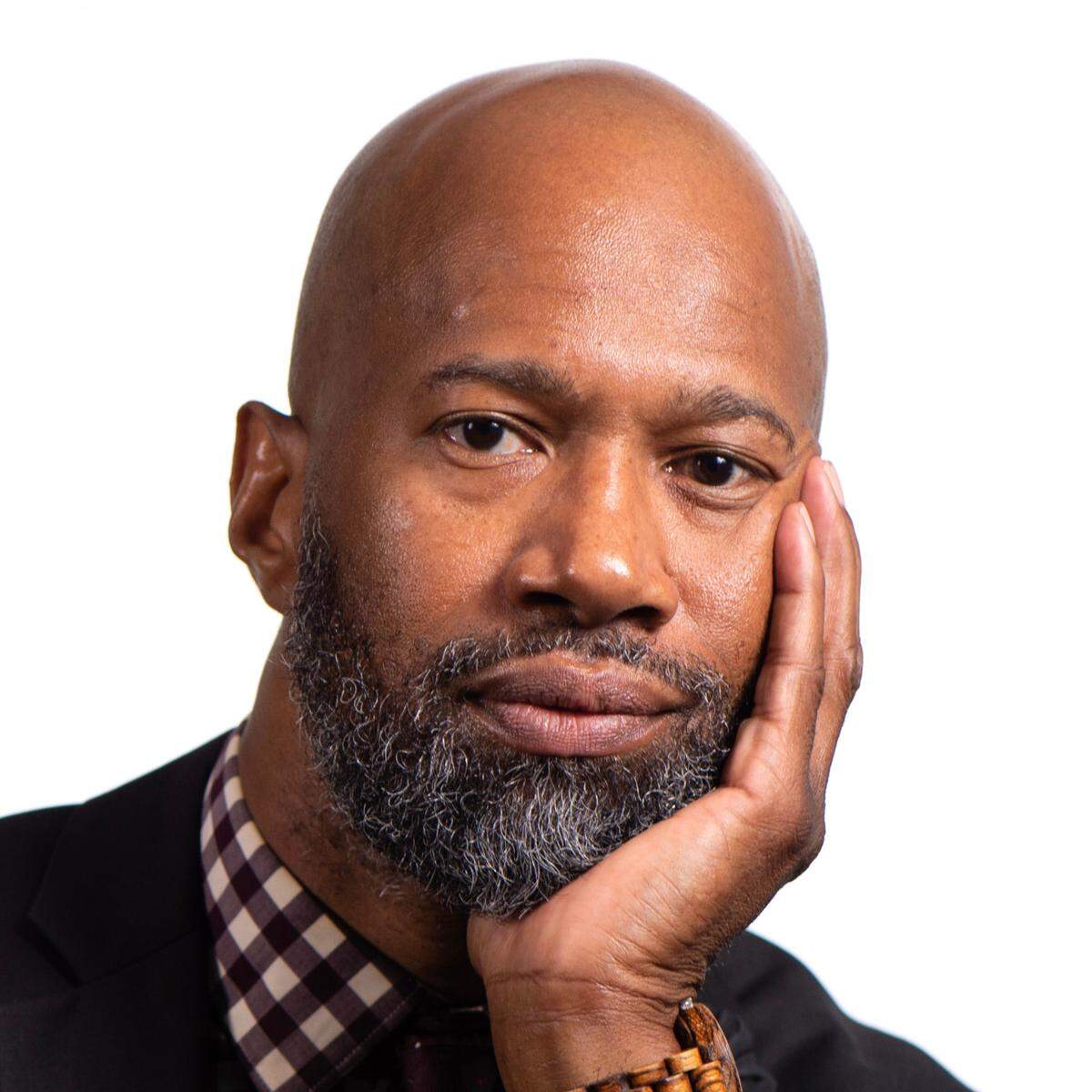
As Myron Piggie rebuilds his life, he can’t shake the basketball scandal shadowing him
The modest ranch style home Myron Piggie owns is a five-minute drive from the Truman Sports Complex in Kansas City. The grass is freshly cut. Gigantic banana plants dot the front entryway. It has the look of domestic tranquility.
I was there to talk to Piggie, a one-time crack cocaine dealer who became a figure of national notoriety for being convicted of paying elite high school basketball players to suit up for his summer Amateur Athletic Union team and going to prison.
But that was a long time ago. More than two decades have passed since Piggie’s demise as the so-called “Godfather of AAU.” And collegiate athletes are now allowed to make money — in some cases a lot — off of their names, images and likenesses.
Piggie met me at the doorbell. He is 61 and moves with a limp courtesy of recent surgery to replace a bad knee. But there’s no mistaking the man: With his chiseled frame, smooth bald head and piercing eyes, he doesn’t look all that different from when he was once one of Kansas City’s most feared gangsters. Only the goatee has some traces of gray.
Inside, Piggie was inviting and warm, his home neat and clean, not one dirty dish in sight.
“This is what I do,” Piggie said. “I cook, clean, wash dishes and lay out my daughter’s clothes for the week. That’s just how I was raised. I’ve been on my own and taking care of myself since I was 16.”
I had never met the man but was curious about him. What does he now think about what he did back in the 1990s, the national scandal that was called “pay for play,” especially since college athletes can now make money? What’s he like now?
Over the next few hours that day, and over several more visits, Piggie was jovial at times and defiant at others, especially when talking about the late ‘90s federal investigation that sent him to prison for three years on mail fraud charges.
When he spoke of federal law enforcement, he became visibly angry, his nose flaring and his eyes blazing. “I’ve been fighting the feds since 1987,” Piggie said.
But one question hanging between us, which he asked me during one of our conversations, weighed on me: “Do you think I’m a bad person?”
It was a question I could not answer. I didn’t know the man and I wasn’t raised to pass judgment on anyone. Piggie had done some bad things — of that there was no doubt.
Illegal payments to youth athletes
Myron Piggie was born on March 7, 1961, in Kansas City, one of 12 children. At an early age, he was introduced to street life. When he was 20, an older brother was fatally shot. Another brother was gunned down in 1999.
Long before his coaching career, Piggie got in trouble with the law. In 1989, he shot at two off-duty Kansas City police officers, according to court documents. The officers were in plain clothes, Piggie said, and he didn’t know they were cops. He pleaded guilty to exhibiting a firearm, according to court records. Other serious charges were dismissed. God spared him a long jail sentence, he said.
Because of previous gun and drug convictions, he was a felon when he took over the AAU program tied to the federal fraud case.
One of Piggie’s sons played on a local AAU basketball team, but organizers weren’t happy with the results. Urged on by other parents, Piggie soon took over as coach.
He had the equivalent of a scholastic basketball dream team, headed by JaRon Rush, a celebrated local phenom already attracting strong interest from the nation’s top collegiate basketball schools. Piggie had known Rush and his younger brother Kareem Rush since they were preteens.
Nike, Reebok and Adidas reps soon took interest in the talent the first-year coach collected. All offered lucrative sponsorship proposals. Nike won out.
Nike’s sponsorship paid team expenses and provided shoe and apparel for players, as the team traveled the country playing in high-profile tournaments from April to August under the names Children’s Mercy Hospital 76ers and later Kansas City Rebels.
Piggie’s cousin, Korleone Young, was drafted out of high school right into the NBA. Other talented high school ballplayers — some were future pros — suited up for Piggie.
JaRon Rush ended up at UCLA. However, the NCAA investigated his relationship with a Kansas University booster and his old AAU coach, Piggie.
Piggie was accused of, and later admitted to, jeopardizing the amateur status of five of his players because they accepted money from him. His crime, providing players some extra cash, shook up college basketball.
At the time, the federal government accused Piggie of defrauding several universities for allegedly using payments from the six-figure Nike contract to steer players to attend certain schools. Had the schools known about the payments, the players’ amateur status would have been forfeited, making them ineligible to participate in college athletics.
Federal prosecutors made Piggie out to be the public face of corruption in college basketball. And the media quickly followed suit.
Allegations of ‘pimping his players’
An excerpt from a 1998 Sports Illustrated article read: “Few in the game can tell you who JaRon Rush’s high school coach is, but most can name his AAU coach: Myron Piggie, a Kansas Citian with few credentials other than a generous cash and merchandise stake from Nike, and a rap sheet with a felony conviction for conspiracy to sell cocaine.”
“The ramifications of the Myron Piggie case hit college basketball hard, especially at UCLA,” The Los Angeles Times reported in 2000.
“Piggie’s bad turn would be his own undoing, but it also proved costly for several players and colleges,” John Gustafson, a writer for ESPN The Magazine, wrote in 2002.
In another piece, Gustafson, in Piggie’s defense, offered: “It is clear that Myron Piggie is not a model citizen, but while he was punished for allegedly pimping his players, it’s important to note that college athletes are also pimped by an outdated monopoly.”
The feds also held over Piggie’s head the possibility of a sentence of up to 10 years in federal prison for being a felon in possession of a firearm.
Piggie, who was 39 at the time of his guilty plea, insists the kids that played for his AAU team weren’t paid to play basketball for him. He was a mentor and father figure to young people, Piggie said, taking care of the young men as his own, which included giving them money from time to time. He never charged parents monthly player fees.
But the NCAA didn’t make the same distinction and saw Piggie’s financial help to the players as a violation of the rules.
I reached out to JaRon and Kareem Rush to ask how they feel about Piggie now, but wasn’t able to make contact. I did find a video of them with Piggie from a few years ago, in which they say any money they received from Piggie wasn’t in return for playing on his team, something Piggie has maintained throughout my conversations with him. I reached out to two other players involved, former Duke star and NBA player Corey Maggette and Andre Williams formerly of Oklahoma State, but those calls and emails came up empty.
“That’s what people really need to know,” Piggie said. “These kids never got paid through my organization to play basketball.”
Piggie’s deal with prosecutors in 2001 allowed him to avoid a decade in federal prison on the gun charge. He pleaded guilty to conspiracy to commit mail and wire fraud and tax evasion. He served more than three years in federal prison for the crimes and was ordered to pay a little over $256,600 in restitution to the universities he allegedly defrauded, according to court records. He was also docked more than $67,000 for failing to file taxes with the IRS.
As of June 13, 2022, Piggie still owed about $252,380 in restitution. according to a spokesperson for the United States Attorney for the Western District of Missouri.
Feds garnish his wages
Myron Piggie is protective and private. He rejected a photo opp with his family when asked, and turned down another request to catch him in action at work. But he beamed with pride when he spoke of taking care of those gigantic banana plants.
“My wife loves them,” Piggie said.
Piggie isn’t fond of the media, he said during a recent trip to his home. He’s been burned more than once. I thought: Why am I here?
“I wouldn’t let you in my house if I didn’t trust you,” Piggie said.
His youngest daughter is 12, and he’s loving and patient with her during the interactions I witnessed. He doesn’t want to subject her to his issues, so no family photo, he said.
He is nothing more than a gentleman when he introduces me to his wife and children. He beams with pride when he says to his wife, “Baby, come meet the reporter.”
“He’s doing a story on me,” Piggie continued,
Piggie was no less polite when we met up a couple of weeks later at his job near Martin City. His employer is supportive and fair but he doesn’t want the company to receive flak for hiring a felon.
He cuts and fits custom-made glass for commercial projects. It’s a laborious job that pays about $600 per week — of which $180 is garnished by the feds.
Nearly 21 years after he was indicted, the federal government is seeking restitution on behalf of the four universities and one private high school Piggie defrauded. In July, the feds garnished his check for the first time. Financially, it’s been rough on the family since, Piggie said.
He owes hundreds of thousand dollars to UCLA, Duke, Oklahoma State, the University of Missouri and the Pembroke Hill School in Kansas City for the cost of lost scholarships and NCAA tournament revenue and pricey internal investigations, according to Piggie’s agreement with the feds. I contacted each school to confirm what Piggie owes them. Officials at Mizzou and Pembroke Hill said they needed time to dig up old records. Officials with UCLA, Duke and Oklahoma State didn’t reply.
Apparently, nobody at these schools is waiting by the mailbox for Piggie’s money.
That he is on the hook for his past mistakes is understandable. But, in Piggie’s defense, none of the schools involved are hurting for cash. Piggie is, though.
“It’s a big difference between $420 and $600,” he said.
Piggie isn’t shirking his responsibilities. Three of his seven children, including his 12-year-old daughter, live with him and his wife.
He is doing his best to take care of them, he said. Working a full-time job. Helping around the house. Should the government really be squeezing him, a 61-year-old father of seven?
He told me he wasn’t a victim, and he was not looking for sympathy.
“I’ve done a lot of things,” Piggie said. “Things that could have sent me to prison for life. But I know God has bigger plans for me.”
Over time, I thought more about the question Piggie posed to me. Is Myron Piggie a bad guy? Ultimately, that’s not for me to decide.
What I saw was a flawed man, devoted to his family, trying to make the best of the rest of his life. A human being that had made terrible mistakes. We shouldn’t forget that.
But at what point is someone’s debt to society paid? From what I can see, all the feds are doing is making it hard for the man to feed his family. Does that seem right?
This story was originally published October 15, 2022 at 5:30 AM.