Can lessons from other moments of mass hysteria help us end the one we’re in now?
The classic Italian novel “The Betrothed,” set during the bubonic plague that wiped out nearly half the population of Milan between 1629 and 1631, could in some ways have been written last week.
“In seasons of public calamity,” Alessandro Manzoni wrote in his historically accurate masterpiece, first published in 1827, “when confusion takes the place of order, we often behold a display of the sublimest virtue, but more frequently alas! an increase of vice,” including “extensive robberies in the houses of the sick, dying and helpless.”
Then as now, “in the same proportion as vice increased, folly increased.” And during the Great Plague of Milan, the folly was a widely shared fear of being intentionally poisoned, not only by an enemy but by a loved one suddenly overwhelmed by the “diabolical voluptuousness of enjoyment” supposedly brought on by a good poisoning.
Though political poisonings weren’t unheard of, this scare was dreamed up, while the very real pandemic was denied. At the height of the frenzy, a number of Milanese even came forward to falsely accuse themselves.
Yet when strong evidence of the Black Death was first reported to the governor, he not only ignored the Tribunal of Health but decreed that a citywide party celebrating the birth of the Spanish king’s first son should go on as planned.
Not unlike Missouri Gov. Mike Parson, who went ahead and hosted his annual fall festival last year, or South Dakota Gov. Kristi Noem, who in the middle of the delta spike called the Sturgis Motorcycle Rally in her state a fun and “fantastic event,” the governor of Milan prioritized the prince’s birthday party. He did so, Manzoni said, “without troubling himself with the danger which would result from so great a concourse of people at such a time.”
“But,” Manzoni added, “that which diminishes our astonishment at his indifference is the indifference of the people themselves.” Yup.
As is still the case, the denialists “heard with a smile of incredulity and contempt any who hazarded a word on the danger, or who even mentioned the plague.”
Many of those who knew better somehow became convinced that imaginary poisonings were more deadly than a plague that in short order killed 60,000 of Milan’s 130,000 residents. When it mattered, they chose to worry about the wrong thing.
Those who did see the poisoning scare as the mass delusion that it was stayed mum, Manzoni tells us, since their “safety rendered it imperative on them to keep their sentiments on the subject to themselves.”
Long past the time when the plague could no longer be denied, they stuck with their error, too. Because at that point, acknowledging it “would have been a tacit condemnation of themselves.”
Which is how, even with dead bodies piled on the death wagons that were everywhere, both Milanese officials and those they governed maintained that “it was absolutely not the plague; the use of the world was prohibited; it was a pestilential fever. … Not the true plague -- that is to say, the plague, but only in a certain sense -- and further, combined with poison and witchcraft.”
“Such,” Manzoni concluded, “is the absurd trifling with which men seek to blind themselves, willfully abstaining from a sound exercise of judgment to arrive at the truth.”
Check, check, and check: “The human mind delights itself with contending against phantoms of its own creating.”
Big Lie, COVID and climate denial
Can anyone doubt that we, too, are in a moment of mass hysteria?
Even as the American West burns in winter, killer tornadoes rip through the Midwest and dust and smoke from storms and wildfires in central Kansas blow all the way to Chicago, we prefer to worry about the imaginary psychic damage supposedly being done by nonexistent lessons in critical race theory.
With the daily average of new COVID-19 cases nearly doubling since Christmas in some places, and hospitals across the country so crowded that a guy can die waiting for a bed, Republican officials and conservative TV hosts continue to undermine commonsense public health measures with bans on the mask and vaccine mandates that we know save lives.
With schools unsure how they can stay open, districts in Kansas couldn’t go back to virtual learning if they had to, because the Legislature has banned that, too.
At this point, even an executive order requiring all Missourians to book a COVID cruise asap would not surprise me.
The Big Lie not only endures, but has become the most bedrock belief of today’s GOP. Despite all evidence to the contrary, only 27% of Republicans accept that Joe Biden won last year’s presidential election, according to a new survey.
Is it possible to be any more unhinged? Yes. Hundreds of QAnon believers have been meeting in Dealey Plaza in Dallas to await the return of JFK, Jr., who died in a plane crash in 1999. They expect Kennedy to reappear at the site of his father’s assassination and announce that Trump is not only still president, but “king of kings.”
That’s a fringe view even among those who believe that top Democrats are running a child trafficking ring that only Trump can stop.
But madness has gone so mainstream that the Federal Aviation Administration reported 4,156 mask-related incidents in the increasingly unfriendly skies in 2021. There were 1,054 investigations into reports of out-of-control plane passengers in 2021, compared to 183 in 2020, 146 in 2019 and 159 in 2018.
Could even Edward R. Murrow help us now?
Unlike the imagined mass poisonings of 400 years ago, most of the misinformation and disinformation that led to our current state of confusion was planted on purpose, for political as well as financial gain, by those whose disregard for the common good is truly staggering.
Still, ever since I read “The Betrothed” last year, I’ve been wondering if there were anything useful that we might learn from earlier moments of mass hysteria.
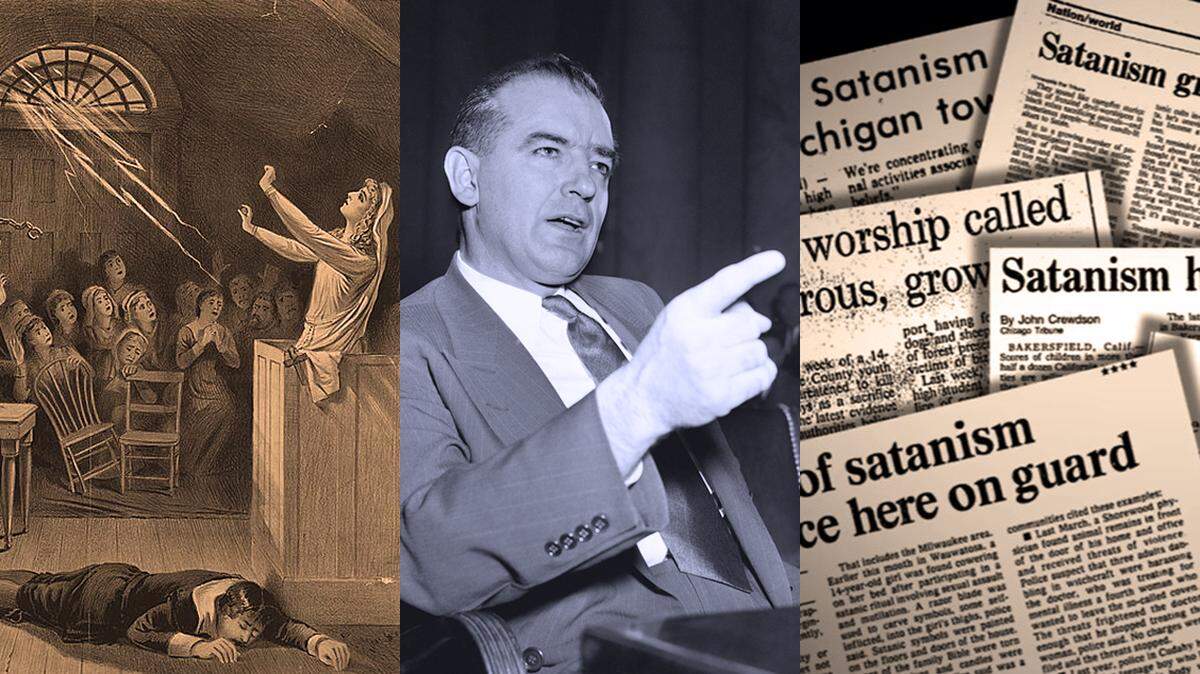
One we’ve all heard about, the Salem witch trials of 1692 and 1693, began by prosecuting women who were already marginalized -- old, poor, disabled or enslaved -- and ended in a hurry after the governor’s own wife wound up accused. Only then, when “the accusations reached into the highest level of the government,” says Rosemarie Zagarri, a history professor at George Mason University, were “the authorities themselves kind of spooked.” In other words, it was suddenly in the interest of the elites to decide that the whole thing had gone too far.
Today’s elites, though, seem no longer capable of snuffing out the delusions they’ve stoked: Donald Trump gets booed for saying he’s boosted, and Republicans are led by their base rather than the other way around.
The worst of the “Red Scare” hysteria stirred up by Sen. Joe McCarthy in the last century was ended by something we don’t even have anymore: shame. First, Edward R. Murrow exposed McCarthy’s cynicism and perfidy at length on CBS, on March 9, 1954. Watching Murrow smoking his way through that broadcast, quoting Shakespeare and strangling McCarthy with his own words, is enough to make you cry for all we’ve lost.
Imagine if the most highly regarded journalist today told America, as Murrow did, “We will not walk in fear one of another. We will not be driven by fear into an age of unreason. This is no time for men who oppose Senator McCarthy’s methods to keep silent. He didn’t create this situation of fear. He merely exploited it, and rather successfully.”
Gorgeous and true as all of that is, I can’t think of anyone who wouldn’t be written off by half of America as just another “enemy of the people.” Back then, when McCarthy responded by calling Murrow a communist, it didn’t work. Today, it very well might.
Three months after that broadcast, Boston lawyer Joseph Welch finished McCarthy off by batting down his accusation that one of Welch’s young attorneys had ties to a communist organization. “Until this moment, Senator,” Welch said, “ I think I never really gauged your cruelty or your recklessness … Have you no sense of decency?”
Almost 70 years later, the legacy of McCarthy’s chief counsel (and Donald Trump’s mentor) Roy Cohn endures. But simply exposing the facts does not now, if it ever did, guarantee a return to sanity.
‘Satanic panic’ of 1980s imagined widespread child sex abuse
The previous panic that I remember happened in the 1980s, when most of America bought into reports that an improbable number of day care workers were Satan-worshipping pedophiles.
As during the witch trials, the accused were mostly poor and female. And that hysteria didn’t end when the criminal cases against them fell apart, says Debbie Nathan, a journalist who wrote a book called “Satan’s Silence: Ritual Abuse and the Making of a Modern American Witchhunt.” She had a hard time even getting the book published, she told me, and “I lost a lot of friends” by writing that the accused were innocent. “People thought they were guilty.”
Did her former friends ever admit to having been wrong? Not really, she says. “People gossiped about me, and later just kind of stopped.” The “Satanic panic” of the ‘80s didn’t so much end, she says, as it mutated into the rash of “recovered memories” of adult trauma survivors. Not all of those turned out to be true, either.
So sure, maybe at some point, those who insist that vaccines kill will decide to take a fresh look at the mountain of evidence that shows they’re almost miraculously safe. And maybe those who insist that Trump won last year will wake up at 3 a.m. some night wondering whether those 60 U.S. courts could all have been wrong when they found no evidence of widespread voter fraud.
But history suggests that they won’t. Or will only if they, like the governor of the Massachusetts colony, come to see a U-turn as in their urgent personal interest. Tucker Carlson would have to lose his audience over the vaccine chaos he encourages. Politicians married to the Big Lie would have to see polling that shows that’s no longer the way to stay in office.
The mass poisoning scare in Milan ended only when the plague did, says historian Franco Mormando, professor of Italian and chair of the Dept. of Romance Languages and Literatures at Boston College.
And did the Milanese then see how wrong they’d been? Hardly, he says.
One poor man who’d been seen touching a pew in the cathedral before kneeling to pray — he was believed to have been rubbing poison on it — was not only executed, but his home was razed, and where it had stood, a memorial column warned passersby about the man’s “evil.” Having “infected the city with deadly creams” the column said, he had rightly been tortured, burned and his ashes thrown in the river.
That column, erected in 1630, stood until 1778 as a warning to other aspiring poisoners.
So unfortunately, I don’t see any lessons from these earlier panics that might ease us out of the one we’re in now: If Edward R. Murrow himself came back from the dead, lit up a Camel and told those who don’t care who they infect to mask up, he’d make no more of a dent in their denial than Tony Fauci does.
But maybe that itself is the lesson: Moments of mass hysteria rarely end any more logically than they begin. And as Manzoni wrote, even life-threatening errors remain unacknowledged because we humans get too committed to our mistakes to learn from them.
This story was originally published December 31, 2021 at 5:00 AM.