
The 4-day funeral John McCain planned isn’t self-puffery, or even a poke at Trump
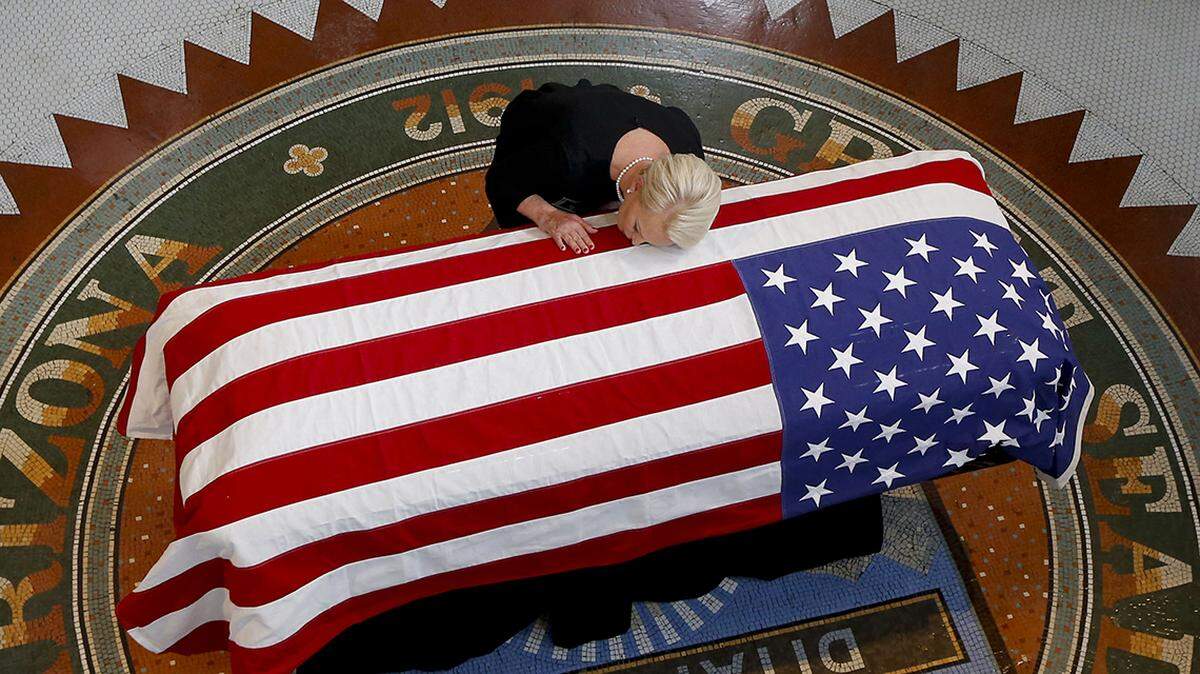
Maybe John McCain’s four-day funeral has been more than a tad presidential, almost papal in its pomp, rivaling Detroit’s weeklong celebration of the Queen of Soul.
Yet his sendoff has also been such an overt call to remember not just who McCain was, but who we as Americans are, that the valediction devised by the deceased doesn’t feel like an exercise in self-puffery. Or even in antagonizing the president, pleasant as that thought may have been for the senator.
Instead, in his leave taking, McCain is leaving us messages as unsubtle as he was about a few of the things he feared we are in danger of forgetting.
In choosing such a diverse group of eulogists, he’s saying we have got to get beyond tribalism and find our way back to some common understanding of what we’re doing here.
In inviting the two presidents he ran against, and lost to, to speak at his funeral, he’s asking us to put aside our political differences and hard feelings, too. In death, he’s all but begging us to find common cause with those with whom we disagree.
Just the sight of McCain’s friend Larry Fitzgerald, one of the NFL’s best expositors of the player protests, at the podium at his Phoenix memorial service told us that one of the freedoms for which the former fighter pilot withstood torture in the Hanoi Hilton was, yes, free speech. Which he clearly believed isn’t only for the big political donors and lobbyists whose influence McCain tried so hard to curb.
In Fitzgerald’s tribute, the Arizona Cardinals wide receiver talked about his unlikely pal’s capacity for appreciating people as they were and upholding principles as they should be. “He embraced humanity, celebrated what was true and just, and saw people for who they were,” Fitzgerald said. “I’d like to honor the love I saw in John McCain.”
When his turn at the microphone came, Vice President Joe Biden talked about his former Senate colleague’s enduring optimism — “he believed in us” — and stubborn adherence to “an ancient, antiquated code where honor, courage, character, integrity, duty” mattered.
House Speaker Paul Ryan, of all people, reminded us in his remarks at the Capitol that subterfuge is overrated and that, contrary to conventional wisdom, honesty remains a viable option even in politics. “The man didn’t feign anything.”
Presidents George W. Bush and Barack Obama have yet to speak, of course, at McCain’s Saturday funeral at the National Cathedral.
But so far, the lessons that McCain wanted to leave us with were best summed up by his campaign “wingman” and fellow Republican senator, Lindsey Graham. He wept as he saluted his mentor’s dumb-joke loving ability to laugh even when he fell short, his grace in conceding the loss of the job he wanted most, and his uncommon courage in standing up to his friends. Graham saw from up close, he said, “how hard it is to tell your base, ‘I think you’re wrong.’ “
“He failed a lot, but he never quit. He taught me that principle and compromise are not mutually exclusive — the foundation of a great person as well as a great nation. He taught me that immigration, as hard as it is to solve, somebody’s got to do it.”
McCain’s death last Saturday, of brain cancer at age 81, even “gave the nation something to talk about at a time when we can’t agree on anything,” Graham said. “If you want to help the country, be more like John McCain.”
Someone, in other words, whose dearest friends weren’t all from his own tribe. Someone who really did believe, as he often said, that “nothing in life is more liberating than to fight for a cause larger than yourself.” Someone who took so much joy in his life that the country he loved so long and served so well needed every one of these four days to mark his passing.
This story was originally published August 31, 2018 at 6:01 PM.