Big blue Star newspaper boxes are gone. Teen-made robot lookalikes are coming | Williams
It’s been five years since The Kansas City Star had big blue metal boxes filled with newspapers stashed all around the metropolitan area.
I miss seeing those. I remember the days when you could drop a few coins in a slot on the box and release the handle, open the window and pull out a single newspaper. That was once considered convenient, right? And it operated on an honor system that, for some reason, seemed to work just fine back then.
Of course, times have changed. If The Star newspaper isn’t landing in your driveway anymore, your access is just a few key clicks away online at kansascity.com Those boxes are gone, but apparently not forever, because what was at one time old is new again — even if they look quite a bit different these days.
Why’s that? Some school kids got hold of these clunky contraptions and gave those blue beauties an upgrade.
As the story goes, the boxes were pulled off the street when single-copy sales from dispensers ended in 2020. So what do you suppose happened to all those bulky metal boxes anchored by cement bottoms? And trust me, they were heavy as heck. A friend and former Star reporter has one sitting on his back deck as a plant holder. I tried to push it once. The darn thing didn’t budge.
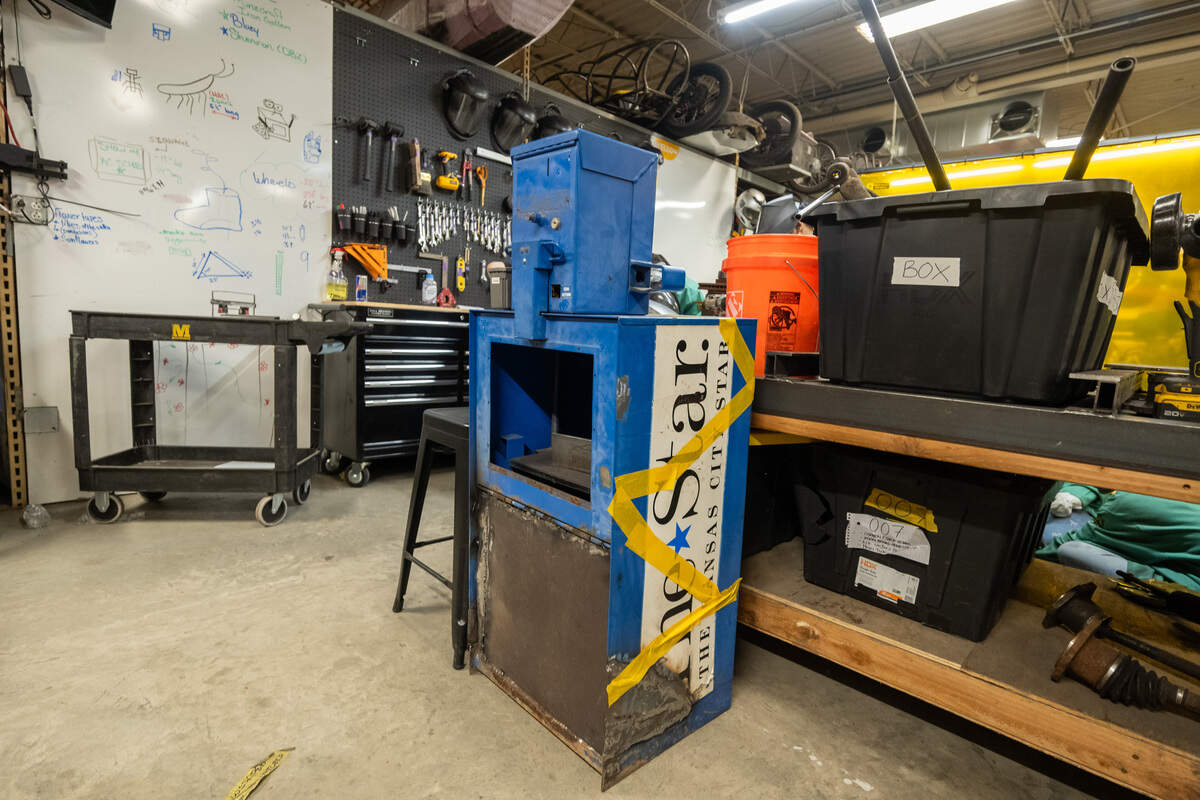
Like the one my buddy has, a few of these boxes were given away to collectors and to folks who just wanted one for nostalgia’s sake. And others, like the three I saw recently, were up for grabs, given away and stored, maybe in an old warehouse or garage somewhere, until someone came along with a bright idea of how they might be repurposed.
That’s exactly what has happened with the three retired newspaper boxes gifted by The Star to Show Me KC Schools, a Kansas City nonprofit that helps parents and families navigate and understand local educational options.
“Rather than letting them sit unused, we gathered them and partnered with MINDDRIVE” — an experiential, project-based STEM and arts nonprofit offering engineering and digital design training to high school students — “to give the boxes a completely new purpose,” said Leslie Kohlmeyer, executive director for Show Me KC Schools.
STEM program for KC kids
She explained that the bright idea was for MINDDRIVE students to use the creative welding skills they learned in the independent STEM program and transform the boxes into functional works of art that will serve as distribution points for annual school guides and other school materials that help Kansas City families access information about public schools in the city.
I wanted to see the transformations in progress. Where was all of this taking place? And, I thought to myself, “How elaborate could the process possibly be if the metamorphosis of each box was being executed by high school students?
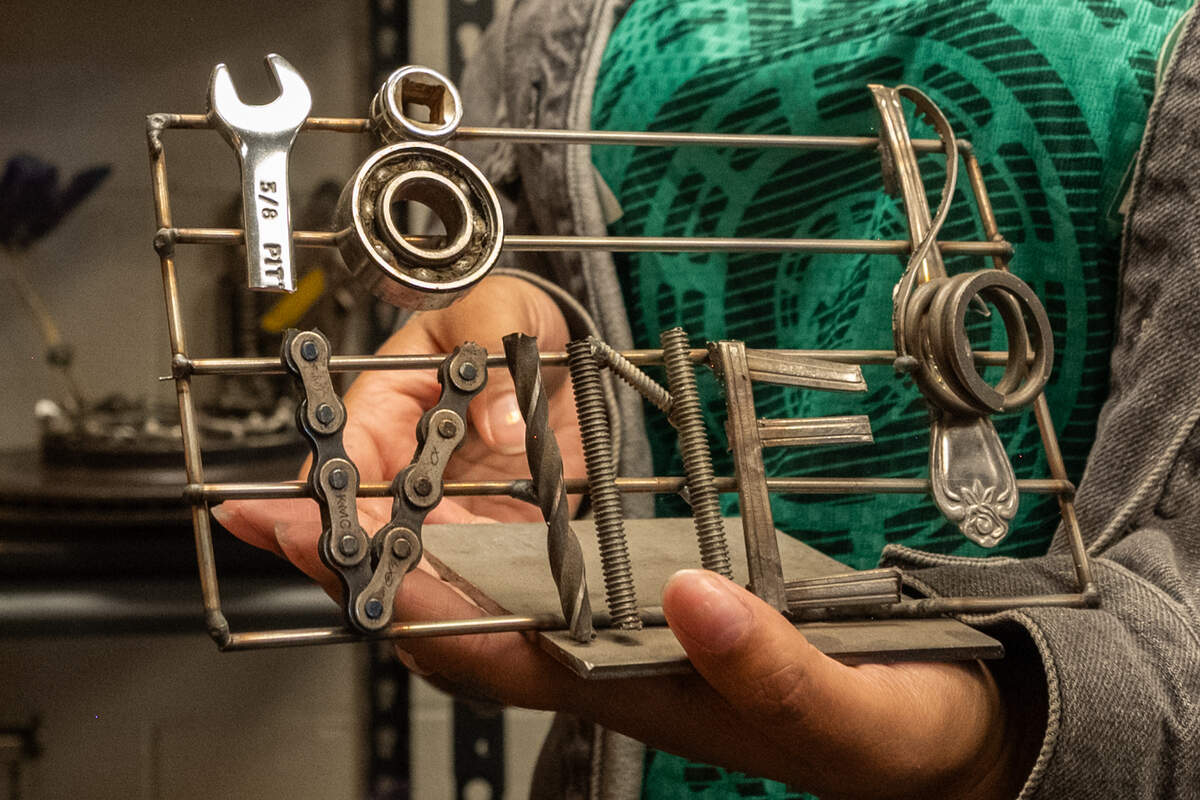
MINDDRIVE is an inconspicuous red brick building at 26th and Holmes, between the Crossroads and Hospital Hill. What I saw inside blew me away. In the lobby, shelves filled with metal sculptures designed by students lined the walls. Intricate pieces of scrap metal welded together.
In another room, students pulled up to rows of electronic equipment and large computer screens, working on a variety of design projects.
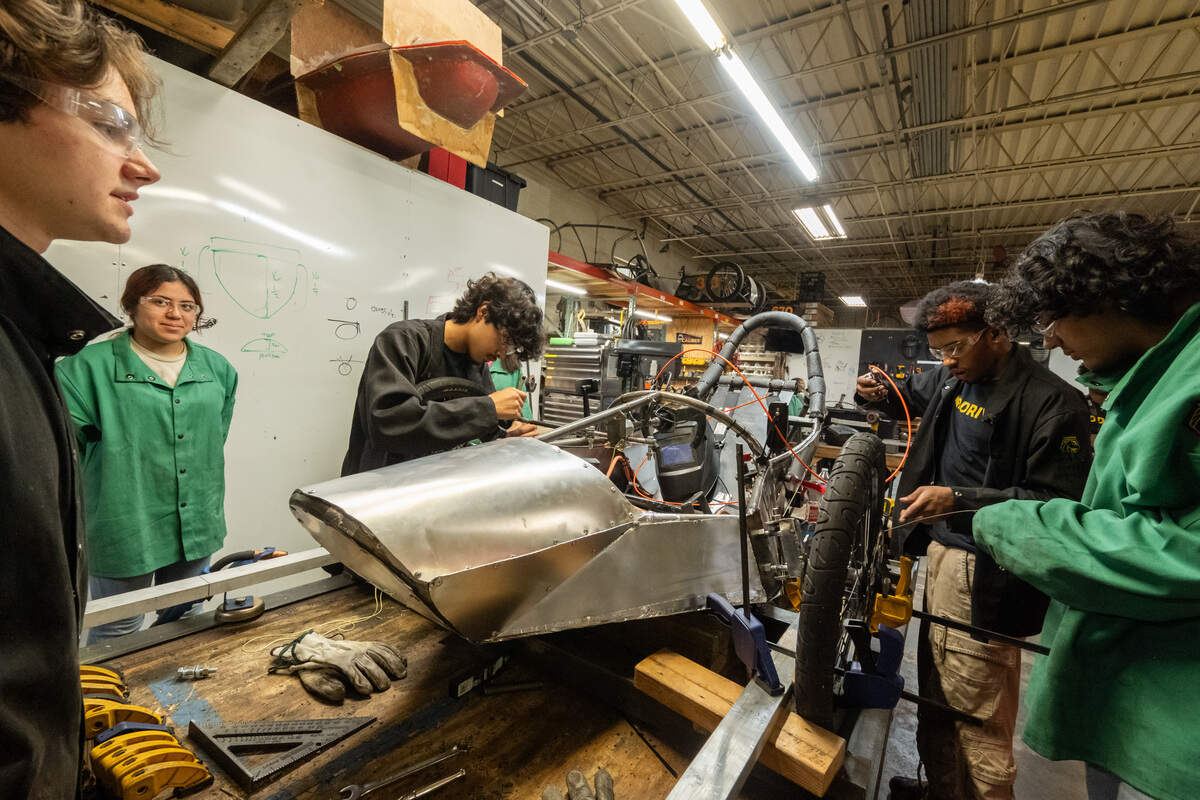
Another set of doors led into what looked to me like a big warehouse filled with students surrounding several service bays. Students wearing goggles, gloves and protective clothing were either working on — as in repairing or building — automobiles. If not for the fresh young faces of the workers in the room, one might think they had walked in to a professional auto repair factory.
MINDDRIVE has partnered with Operation Breakthrough and its Ignition Lab, and on several occasions students have rebuilt old cars and given them to working moms who can’t afford transportation for their family. On the day I visited, students were in the parking lot repairing a mom’s car. Inside, another group had a wrecked car on a bay, giving it a new front end after a mom from Operation Breakthrough had been involved in a minor wreck and needed a repair she couldn’t pay for.
Seems like a fair deal. The students, under supervision, get the practice they need to transfer the skills learned to careers or college readiness, and the mom gets her car back in tip-top shape.
These students know what they’re doing. Why else would Jason Kelce — yes Travis’ brother — have the kids at MINDDRIVE convert his 1986 Chevy K10 pickup truck into an electric vehicle powered by a drive unit and battery packs taken from a Tesla. In fact, a group was converting another vehicle the day I visited. And at yet another bay, students clamored around a group building a small race car from scratch.
Minecraft at work
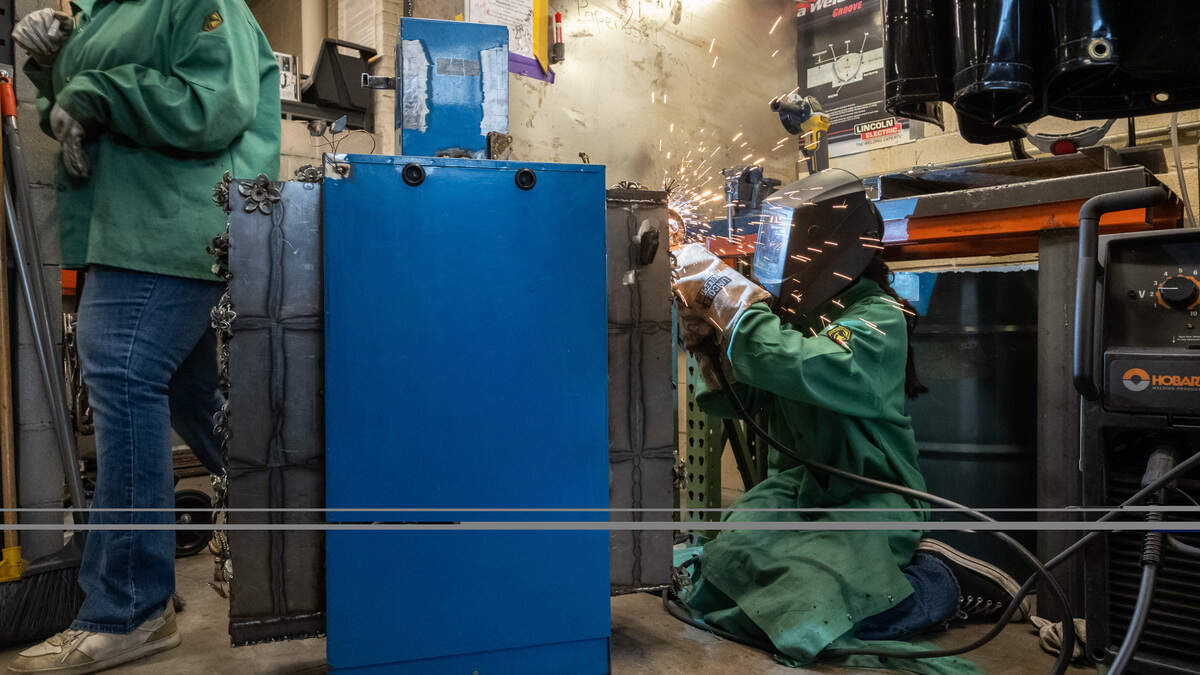
And then I saw them, or at least the first of them: the newspaper boxes. Towards the rear of the giant workspace, a teenager pulled on a welding mask and began attaching metal flowers that she and her team had crafted onto what now looked like a blue and gray robot covered in metal vines and blooms. Incredible!
“The first time I saw this box, I immediately thought of a Minecraft character, because it had the face of a Minecraft character,” said the 17-year-old Cristo Rey high school student whose name I’m not using here at her instructor’s request. Besides, it’s her skills, not her name, that matter for this story. She and her team chose to turn their box into an iron golem. In case you are not familiar with the Minecraft video game, iron golems are powerful utilities created by villagers to patrol and protect their villages.
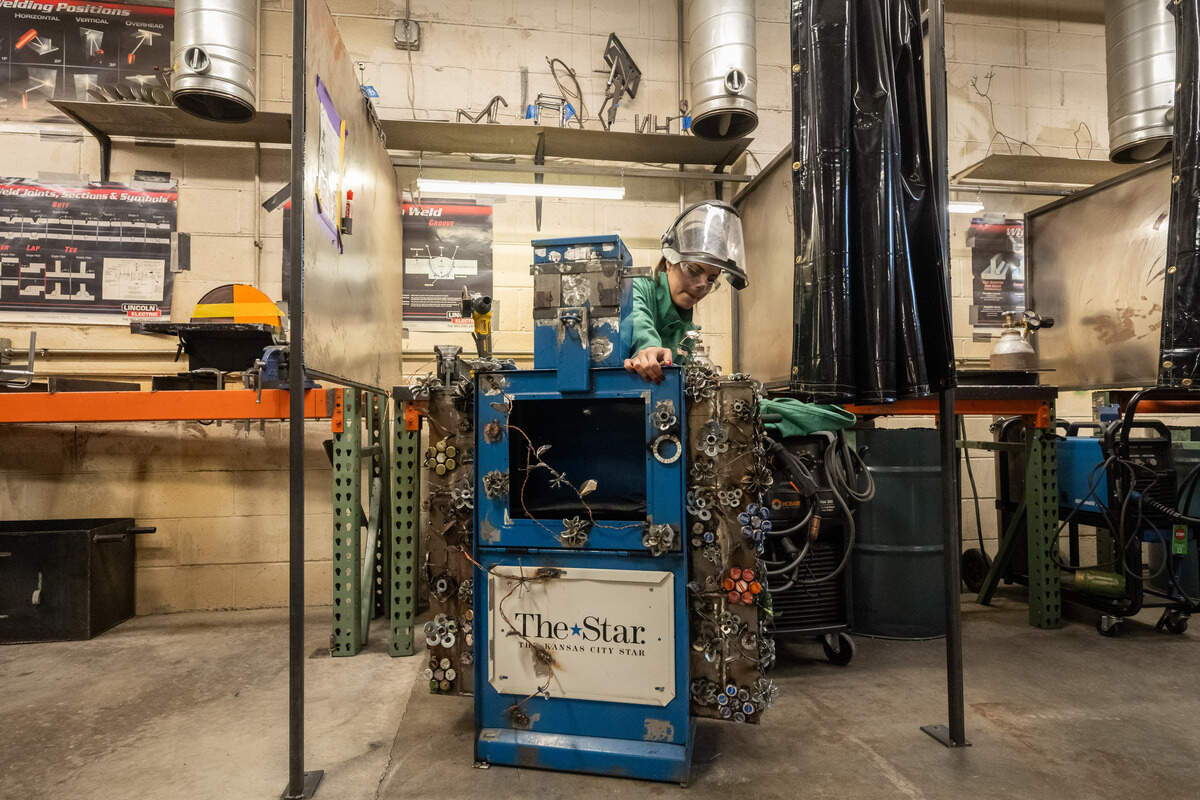
Iron golem are usually covered in vines and leaves. And here’s where creativity came into play. This team decided lots of flowers were in order, so they molded every petal of every flower out of metal scraps and welded bunches of them to giant arms, which they also built and attached to the newspaper box in transition.
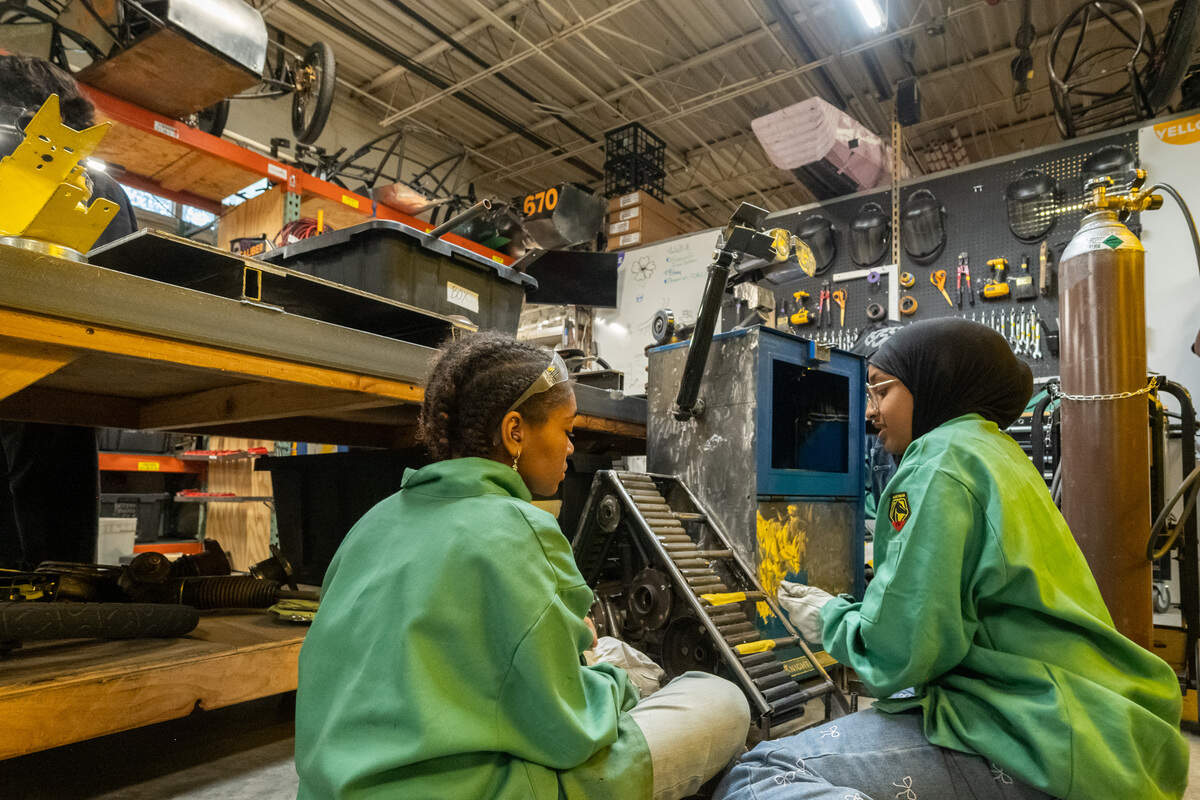
A few feet away, a group worked on a second box. This one I recognized immediately: Wall-E, the beloved little titular robot from the 2008 Pixar animated sci-fi film. The young ladies working on this transformation nailed it. The toughest part, they told me, was getting the caterpillar tracks or tank treads that helped the little robot move just right. They looked perfect to me.
I couldn’t help thinking, as MINDDRIVE alum Nina Rojo Moren — now a creative tech assistant at MINDDRIVE —showed me around the place, that I’ll bet very few people know that our Kansas City kids are getting this kind of hands-on training in a place like this.
From my perspective, this is a perfect example of how a city nurtures its young people so that they want to stay and work and give back in the city that raised them. I’m not a betting woman, but if I were, I’d be willing to bet that most of the students who go through MINDDRIVE go on to become good contributing members of theircommunities. We need more programs like this one.
MINDDRIVE and the students it serves survive on the generosity of Kansas Citians. From what I could see, investing in the future of these young people appears to be a worthy one. Oz Qureshi, director at MINDDRIVE, said the 15-year-old program is still growing and finding new and innovative ways for its students to engage with and to help their KC neighbors.
Qureshi is teaching students more than engineering and fabrication skills. Students are learning the power of community, too.
But they also need community help. Besides financial donations, “We always need recycled metal, or any metal scraps,” Qureshi said. MINDDRIVE will take pretty much any scrap metal. “Spoons, cutlery, bolts, screws and all that stuff in the garage that no one is ever going to use, we could use,” Qureshi said.
Donations can be dropped off at 2615 Holmes St. Message the program on social media or send to an email to oz@minddrive.org