Will new Missouri antisemitism law stop all talk of Israel in schools? | Opinion
I suppose I may be accused of being something I am not because of what I have to say here, regarding a new Missouri law requiring schools to protect Jewish students specifically from antisemitic language.
The law is meant to halt discriminatory and hateful speech in classrooms and lecture halls, and it puts the onus on schools. I agree offensive hate speech that disrupts the education process in our schools or on college campuses should be prohibited.
While free speech, even hate speech, is protected in the United States, the 1969 Supreme Court case Tinker v. Des Moines established that students have the right to free expression, except when it causes a substantial disruption to the learning environment of others. Some time ago, schools adopted policies to address racist, bigoted and antisemitic hate speech when it fit into the categories laid out in that case.
That should be enough. But apparently it’s not enough for Missouri lawmakers who — at a time when, according to the American Jewish Committee, there’s been a rise in antisemitism around the nation — felt the need to interject another layer of restriction to protect Jewish students. I tend to believe that it’s more about legislators, especially the Republican supermajority in Jefferson City+, wanting to align with President Donald Trump.
Last year, Trump signed executive orders to address the rise in campus antisemitism by directing federal resources to investigate and punish antisemitic incidents and anti-Zionist protests.
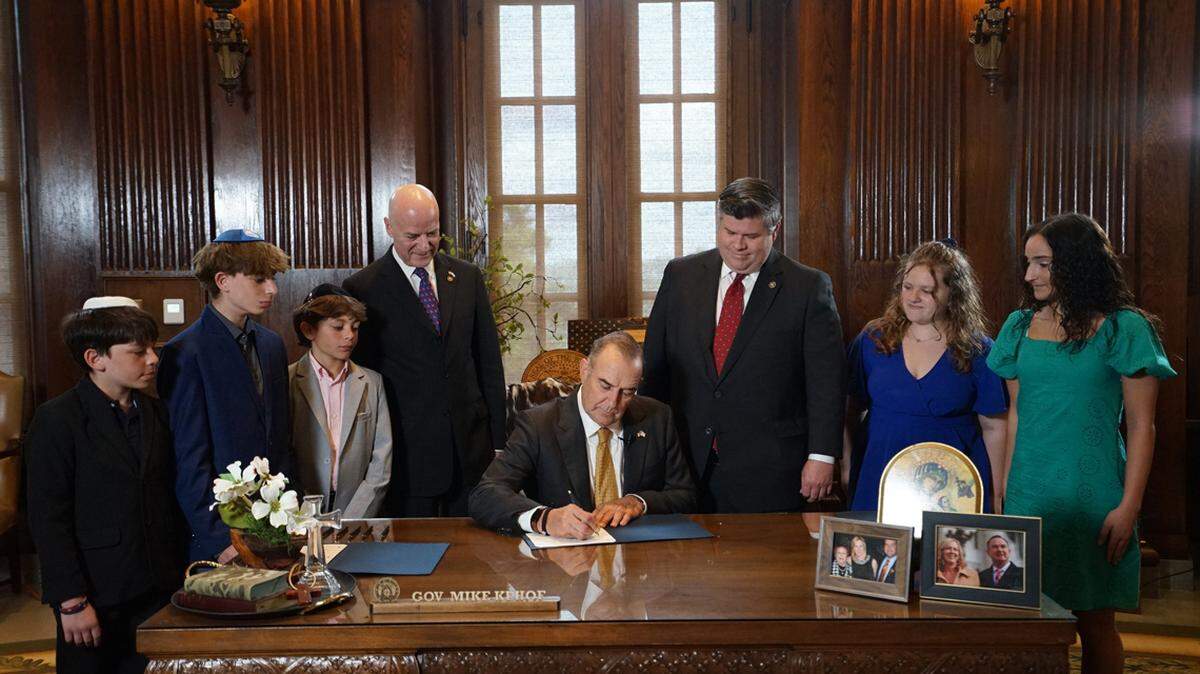
Last month, Missouri Gov. Mike Kehoe signed into law House Bill 2061, landmark legislation designed to combat antisemitism in public K-12 schools, charter schools, colleges and universities.
The new law mandates that the International Holocaust Remembrance Alliance’s definition of antisemitism be adopted into the code of conduct for schools and public institutions of higher education. The IHRA definition is fast becoming a standard in the U.S. for identifying hate speech as it relates to Jewish people. The U.S. State Department has used a working version of the definition since 2010.
All discussion shut down?
Missouri’s law requires that instances of antisemitic language or behavior be documented and reported to a state education governing body for investigation, except when the critical speech on college and university campuses is religious or political in nature, and therefore protected under the U.S. Constitution as free speech. That is, unless conduct relating to the speech also creates an atmosphere of fear or intimidation.
Here’s my concern: I worry, for good reasons that I’ll get to in a moment, that Missouri’s new law could lead schools, especially colleges and universities, into trouble in how they interpret the IHRA definition of antisemitism — specifically, the section that mentions speech criticizing Israel — or that they won’t bother to interpret it at all, and just shut down all discussion.
State Sen. Curtis Trent, a Springfield Republican who presented the bill to the Missouri Senate, said, “The goal here is not to prevent the political criticism of any country, any state, any particular practices politically.” He said the goal is “to ensure that students and others have the ability to engage in rigorous discourse and have access to educational institutions.” But isn’t that already the case?
The bill says schools must consider whether possible antisemitic speech relating to the criticism of Israel is related to public policy or if that speech condemns differently — and I guess by this it means the speech reveals hate towards the people of that nation — than condemnations made by folks unhappy with politics in any other nation comparable to Israel.
Misunderstood ‘critical race theory’
Colleges in Missouri, and across the country for that matter, don’t have a good track record for interpreting nuance, especially once lawmakers get involved in mandating what can and cannot be discussed at the risk of some penalty.
Consider the term “critical race theory,” which became a major political flashpoint in this country in 2020 and 2021. Mere mention of it could turn an otherwise calm school board meeting into a vicious battleground.
Most people, especially lawmakers, seemed to have little understanding of what critical race theory really is, yet they legislated against it, forbidding its teachings in our schools and on our campuses all around the country.
What happened is that many colleges and schools simply labeled everything related to Black history as CRT, and canceled or diluted those lessons.
I’m afraid that academic discussions about the geopolitics around the Israeli-Palestinian conflict may suffer the same fate.
What I mean is that rather than trying to deeply understand that opposing the policies of the Israeli government or even advocating for the rights of Palestinians is not inherently antisemitic, schools may toss all and any conversations on the subject into the antisemitic bucket. That would not only be wrong, but would also infringe on free speech.
After talking with friends who are Jewish and a local rabbi, I feel confident in saying there is separation between the political decisions made by the state of Israel and what it means to be Jewish. Plenty of Jewish people, in Israel and around the world, disagree with the current Israeli government’s leadership, and have no problem saying so. Are they antisemitic, too? Of course not.
‘Then I, a Jew, am antisemitic’
I reached out to a retired Kansas City Star journalist who is Jewish and whose father was a prominent area rabbi.
“I’ll tell you this much,” said Dan Margolies, “the idea that criticizing Israel is inherently antisemitic is outrageous and ridiculous. If so, then I, a Jew, am antisemitic.”
Rabbi Mark H. Levin, founding rabbi at Congregation Beth Torah in Overland Park, agrees that criticism of Israel is not antisemitism. “Israel is a political state like every other national state in the world,” Levin said. “It is the right of free people to criticize actions of the state. Israel must be subject to criticism like any other nation in the world.”
He also said he believes college campuses are the right space for healthy, free academic inquiry at the highest level, that the inquiry should not be limited, and that speech should not be allowed to stray into bigoted language.
But are college campuses willing to sort through the nuance of that difference? I’m not so sure that they are. I see them just tossing an it’s-all-antisemitic blanket over everything and out of fear saying, “Let’s just leave Israel out of it all together.”
That would be a mistake, stifling knowledge and intellectual growth. And it is the opposite of what schools and colleges are supposed to provide.