This KC lynching marker has been damaged three times. Now it’s gone | Opinion
Not long after protests against police brutality erupted around the country following the 2020 public killing of George Floyd, an unarmed Black man, by a white Minneapolis police officer, there was an incident deemed by some as a symbolic lynching in a public park near Kansas City’s West Bottoms.
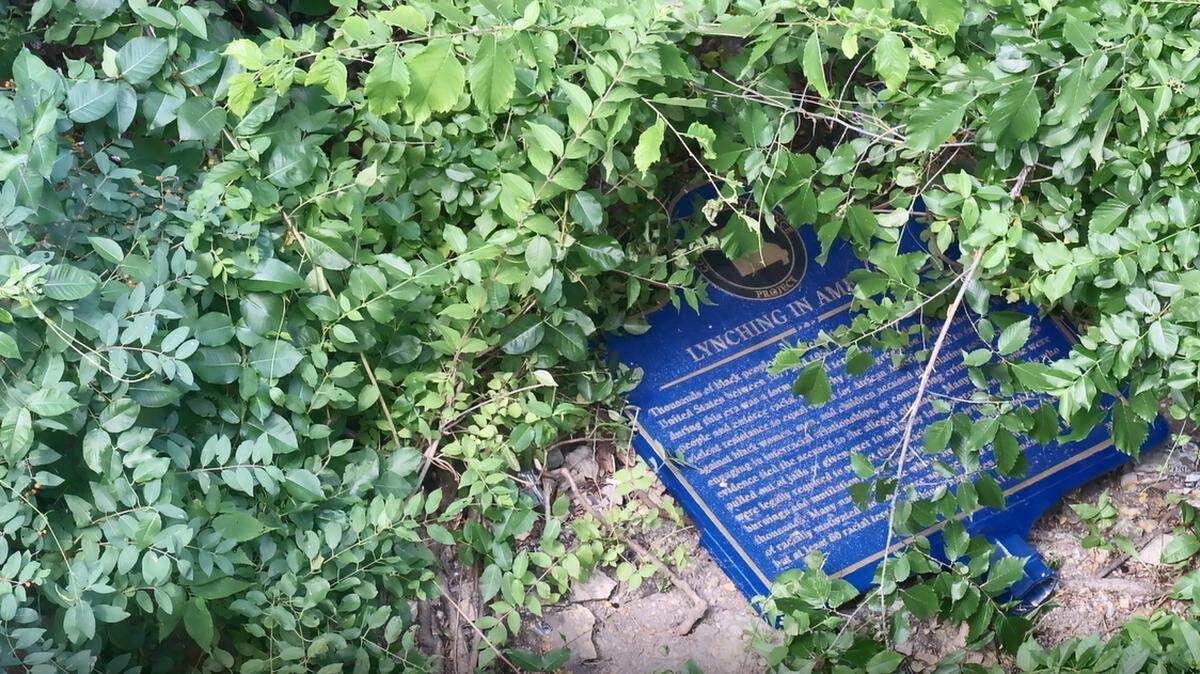
A 200-pound, 42-by-38-inch metal marker, which was erected by the Community Remembrance Project of Missouri in 2018 at West Terrace Park near 10th and Summit streets in Kansas City, stood as a memorial to the lynching of Levi Harrington — until somebody cut it down.
Recently, somebody stole its replacement.
This latest incident of vandalism was the third for this marker. Shortly after it first went up with a ceremony and a call for racial reconciliation from the Missouri Catholic Conference, it was defaced with graffiti and then quietly replaced.
Maybe you’re thinking, “It’s a sign, for goodness sake, so what’s the big deal?” Well, goodness matters. Here’s why I care about the marker, and why you should care, too.
Damage to that history marker may indeed be considered a hate crime. Somebody, somewhere, knows who is responsible, and someone needs to be held accountable. Not to pursue finding the perpetrators of this vandalism and theft is like mocking Harrington, or at least the memory of him and the brutal way he died. That should not be tolerated.
Harrington was an innocent 23-year-old Black man who was lynched in 1882 by an angry white mob that accused him of killing a police officer.
According to information at the Black Archives of Mid-America, the mob dragged Harrington from police custody, wrapped a rope around his neck and hanged him from a steel beam on the Bluff Street Bridge, near the city’s West Bottoms. Kansas City historian Glenn North, director of inclusive learning and creative impact at The Museum of Kansas City, said hundreds of people gathered on the bluff to witness the lynching.
Harrington’s lifeless body, riddled with bullets, still hung from the bridge that night when a man who later confessed to the police officer’s killing was apprehended.
The symbolic lynching
Sometime in June 2020, the country was in the midst of a racial reckoning after nearly everyone had viewed video of George Floyd being killed by a police officer pressing his knee, all his weight behind it, on Floyd’s neck until he stopped breathing. Someone went up to West Terrace Park and decapitated the Harrington memorial marker — sawed the metal sign off its base — and pushed the head of the sign over the cliff of the bluff where it had been standing.
That sign, part of The Equal Justice Initiative’s Community Remembrance Project of Missouri, was so badly damaged that it had to be replaced again. It was replaced in 2021 by the Kansas City Parks Department, North said.
A couple of weeks ago, I learned that the sign, estimated to cost about $3,000, was again missing from its post at the park.
What happened to that marker is a criminal mystery, and for now, police are not looking for the thief because no one has even filed a report about it. North said he thinks that’s because they believe, “Nothing will come of it, so why bother?.
The whole thing is disturbing, reflects poorly on Kansas City and reminds me of the 2024 theft of the bronze Jackie Robinson statue that was cut off at the ankles and found days later smoldering in a trash can in a city park in Wichita.
The man responsible for that crime — Ricky Alderete — was eventually caught and sentenced to 18 months in prison for the theft and destruction, and ordered to pay $41,500 in restitution. The statue has since been replaced.
Kansas City Parks and Recreation said a police report was filed the first time the Harrington memorial marker was cut from its base. It was later found lying in shrubbery down a hill and is now on exhibit at the Black Archives.
Kansas City Police Department Captain Jacob Becchina, a spokesman for the department, said detectives investigated the vandalized marker for days between the middle of June and the end of July 2020. They “conducted an area canvass looking for any surveillance cameras in the area and to see if there were any witnesses,” Becchina said. “All leads have been exhausted at this time.” It is still an open case.
I don’t believe the second or the third incidents were pranks done by kids with poor judgment. It’s more than that.
.jpg "image001 (3).jpg")
“The message I’m getting is that they still don’t like Black folks,” said Keslie Spottsville, a founding member of the Community Remembrance Project of Missouri and a former member of the board of directors at The Black Archives of Mid-America. “To me, this says we hate you, and we are going to terrorize you.”
North sees it this way: “We know what this is,” he said. “It’s racism. It’s an attempt at erasure. And I don’t think that it is a stretch to think that a person who would do something like that, violence against a sign, might commit violence against a person. It was intentional. They had to come with the right tools. It took some time. It was not random. It was premeditated.”
Vandalized markers not unusual
Historical markers memorializing Black lynching victims in the U.S. are vandalized, stolen or destroyed, sometimes in attempts to obscure this country’s history of racial violence. “Sadly, this is not an isolated issue,” said Gianluca De Fazio, associate professor in the Department of Justice Studies at George Mason University. De Fazio’s research found 12 cases of lynching markers stolen or vandalized, out of 213 such markers around the country.
In 2024, a marker in Lithonia, Georgia, was stolen. Last year, a Dallas marker was damaged. The marker for Emmett Till in Mississippi has repeatedly been riddled with bullets since it went up in 2007. At one point, more than 300 bullet holes were counted. The Till marker has been replaced four times. No one has been arrested or charged.
The Remembrance Project of Missouri is an extension of the Equal Justice Initiative, based in Montgomery, Alabama. Volunteers collect the soil from places in states where people were lynched. That soil is stored in marked jars housed as part of an exhibit at the Black Archives of Mid-America here in Kansas City. In Missouri, 60 racial terror lynchings of Black people have been documented, more than any other state outside the South. So far, three memorial markers have been erected.
The Remembrance Project of Missouri seeks to mark every location where a lynching took place with a sign like the one stolen from the Kansas City park. Each sign details the murder. It’s ugly history, but it is American history and should never be forgotten. Defacing the sign, cutting it down or stealing it won’t change the truth. It won’t stop historians from telling the stories of the Black men, women and children who were tortured and lynched across this country because of the color of their skin.
Someone knows who keeps vandalizing the Harrington marker. Someone knows where that marker is and who took it. That thief needs to face consequences for the crime. People need to know that this behavior is not OK and perpetrators will be prosecuted.
This marker must be replaced. But when a new one goes up, Kansas City Parks and Recreation should also install protections — fencing and cameras — to keep vandals from destroying this meaningful reminder that as a city, as a state and as a nation, we have come a long way from a time when brutal racial violence permeated much of our society.