Other Black Kansas Citians may not agree, but Kwanzaa’s principles are universal to me
As this year ends with the world still battling a devastating pandemic and nationally tussling with polarizing politics and racial and economic disparities, I can’t stop thinking that the principles of Kwanzaa should be everyday ones and embraced by everyone.
I see Kwanzaa as a celebration of connectivity, unity and advancement. But it is much more than a week in a year. The seven principles — unity, self determination, collective work and responsibility, cooperative economics, purpose, creativity and faith — encompass and amplify the individual, the family and the community.
Yes, as a secular observance it was established in 1966 by California State University Professor Maulana Karenga (born Ron Karenga) for Black Americans to promote self-affirmation, working together and to recall Black history in and beyond the Americas.
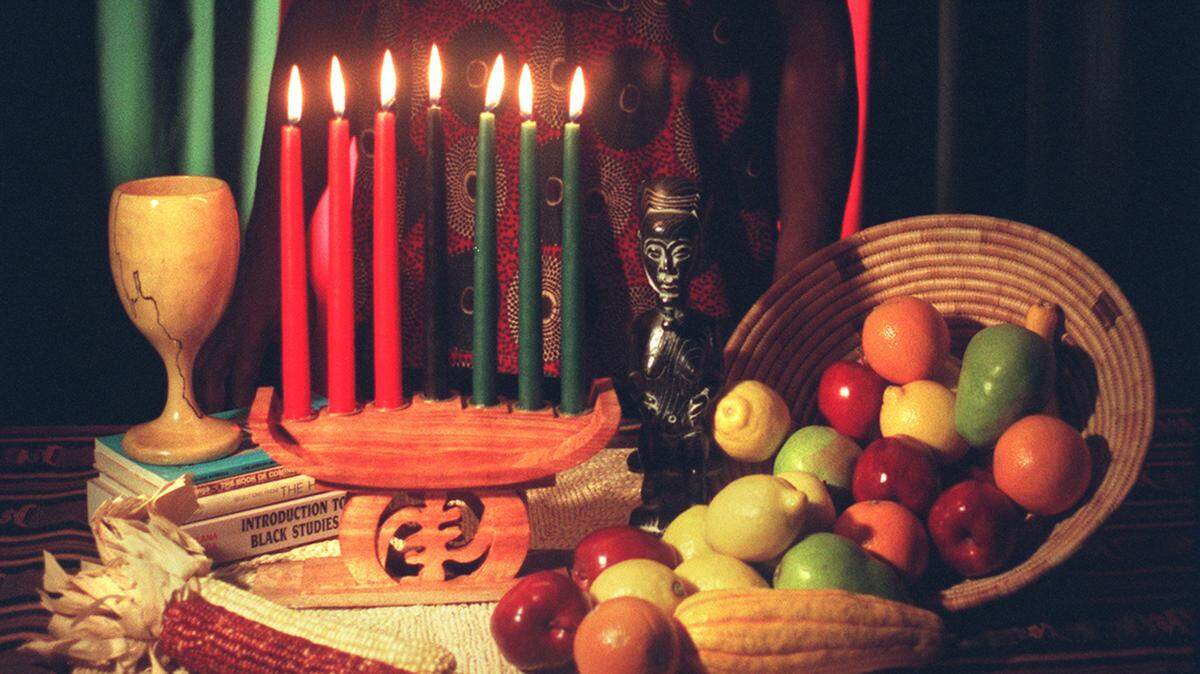
And yes, traditionally, with the lighting of the seven candles of the kinara, it is celebrated primarily by Black Americans. But it is not a Black-only observance. Nor is it Swahili for “Merry Christmas.” The word means first, as in first harvest. Its principles, although pulled from different segments of African harvest celebrations, are — or ought to be — universally embraced and nurtured.
The late Archbishop Desmond Tutu said we are more connected than we realize. “When we harm others, we harm ourselves,” he said, “But it is just as true that when we help others, we also help ourselves.” You know, like wearing a mask and getting vaccinated.
“Moreover, Kwanzaa destroys stereotypes and biases,” said the Rev. Darron Edwards, pastor of Kansas City’s United Believers Community Church. “When you study the principles of Kwanzaa, you discover we all want the same things.”
When I discussed with Black friends, family and some community leaders my thoughts that the principles of Kwanzaa are ones that could and should serve the whole of society, I was warned that some Black Americans may resent that idea. For them it is indeed a by-us, for-us deal.
Others said my eternally optimistic view is worthy of conversation.
“If somehow the broader community desires to understand, celebrate and practice Kwanzaa principles, it is important to know that the celebration grows out of the rich heritage of Black nationalist philosophy, which has as its aim the liberation of Black people in this country,” said the Rev. Vernon Howard, president of the Southern Christian Leadership Conference of Greater Kansas City and senior pastor of St. Mark’s Church. That liberation, he said, is “inseparable from reparations for Black people … with expediency.” OK, sure. But definitely deeper than where I intended to go with this column.
Collective work, responsibility are cross-cultural values
While a week from Dec. 26 through Jan. 1 is set aside as a time of reflection on past accomplishments and thoughts about how we move forward as a community, the principles of Kwanzaa should not be static or polarized, but rather cross-cultural and daily.
Such elements as collective work and responsibility should be encouraged in school, work and at home. We need people to live with purpose and to share and express creativity to make our country and the world a better place for everyone.
If there is one thing COVID-19 has taught us, it is that building, supporting and maintaining local business — cooperative economics — is key to prosperity on varying levels in every ZIP code and neighborhood. And yes, Rev. Howard, broad economic health cannot come without economic justice first for those who have been denied economic growth.
So much of this also translates to community safety because when all are doing better, working together, uplifting one another, there is less room for violence, intolerance and destruction. I do doubt anyone could successfully argue that Kansas City doesn’t need more of that.
On another note, while for some of us Kwanzaa is a time to celebrate the feel and look of our heritage, it is not about the clothes, and I’m not talking about everybody going out draped in Afrocentric attire. That would be cultural appropriation that I am not down with.
And I’m also not talking about commercializing Kwanzaa into a shopping event where those who have, profit off of those who don’t have much. We don’t need more of that. That is actually the opposite of Kwanzaa.
I’m talking about all of us, regardless of skin pigmentation and cultural background, recognizing that as a community, city, state and nation, we could benefit from embracing and living the way of Kwanzaa’s principles — seven days a week, 365.