Just what should we make of a Kansas City bus riders’ union? | Opinion
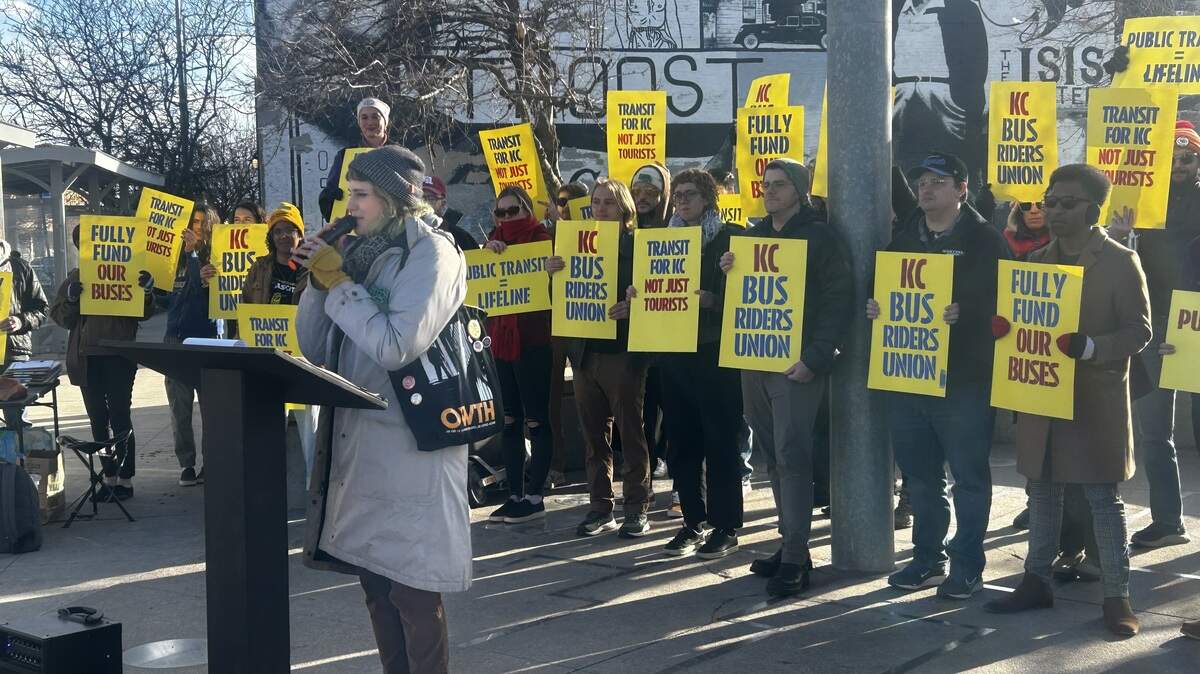
I spent part of Friday afternoon at the park-and-ride at 31st and Troost, where a group of transit advocates had gathered to launch what they’re calling a Kansas City bus riders union. There were handmade signs, some speakers and a steady stream of drivers honking as they passed. Some of the horns seemed to signal solidarity. Some of it was just Troost Avenue.
The effort is being organized by activists tied to the Sunrise Movement’s local transit campaign, which has been pushing for more bus funding the past few years. The idea, organizers said, is to bring riders together as a unified voice to demand change.
Where I started to get a little lost was the word union.
The definition has expanded in recent years beyond the traditional model of dues-paying workers bargaining with an employer. Around here, you might have first noticed that shift in 2022 when KC Tenants launched a citywide tenant union. It has the bones of a union, in the sense that it carries leverage. Renters can band together, withhold rent and force negotiations with a landlord. The strategy has produced occasional results, most recently in Raytown, where a rent strike ended with concessions from the property owner.
But a bus riders’ union stretches the definition almost to the snapping point.
The Montgomery bus boycott would be a historical touchstone here, I suppose. But that was a boycott aimed at a fare-dependent private system. Kansas City buses are publicly funded and currently free. If riders refuse to board, the buses still run. The drivers still get paid. If you rely on the bus to get to work or the grocery store, a boycott would seem only to hurt yourself.
So where’s the leverage?
I put that question to a few of the organizers on Friday. I regret to report that I was no more clear on the answer when I left than when I arrived.
Dee Iyer, a lead organizer who spoke at the rally, told me I should talk to another organizer, Cody Sanders. He spoke of “people power” and “putting pressure on local officials” and “strength in numbers,” but didn’t have much in the way of specifics for me. Eventually, he sent me back across 31st Street to Iyer.
How is this a union? I asked. And what would success look like?
Iyer mentioned a similar group she was a part of when she lived in Pittsburgh, and another organizer cited a long-running bus union in Los Angeles. But those both sounded more like advocacy groups than unions. Another group, Bus Riders United St. Louis, formed in 2021 but has been quiet since 2022 — perhaps a case of pandemic-era organizing energy that burned hot and cooled off.
“Right now, as we approach this budget season, we are trying to maintain our current levels of (bus) service,” Iyer said. “And from there, after we gather more support, we’ll have to meet and decide what our priorities are going forward.”
Specifics weren’t forthcoming, and it didn’t seem productive to litigate the terminology. I nodded and moved along.
Buses and budgets
However it’s branded, there’s plenty of room for transportation-related activism in Kansas City.
The financial math has been getting worse for years. When the city went fare-free in 2020, it boosted ridership but surrendered roughly $9 million in annual revenue. Federal COVID-19 relief funds papered that over for a while. But that money is gone now.
Meanwhile, our suburban neighbors have been backing out of their contracts with the Kansas City Area Transportation Authority. Grandview, Raytown, Independence, Blue Springs, Gladstone, Liberty, Parkville and Riverside have all cut their KCATA funding in recent years, leaving Kansas City to shoulder the bulk of the costs.
The situation came to a head last spring. Facing a roughly $32 million gap between what the city offered and what it cost to keep buses running, KCATA drew up plans to eliminate 13 of its 29 routes, end late-night service, gut weekend schedules and lay off 171 workers.
It didn’t happen, but only barely. After months of negotiations, the city in August cobbled together a one-year fix. It coughed up millions for KCATA and, most notably, ended its six-year experiment in free fares. Riders can expect to pay $2 per trip starting this summer.
But even if fare revenue creeps back toward the $9 million the system collected before the pandemic, that won’t solve the bigger funding problem. Kansas City is putting about $77.8 million into KCATA this year, with similar funding planned next year. But running the system now costs north of $110 million. The rest gets patched together through federal aid, diminished suburban buy-in and, hopefully, fares. It’s a thin way to run a regional transit system.
Iyer said her group plans to attend upcoming City Hall budget hearings around the city to push for more bus funding. One of those listening sessions is Monday at Ruskin High School, where one expects there will be no shortage of riders with stories about late buses and routes they can’t afford to lose.
But City Hall isn’t the only table where these negotiations should be happening. If this is really a bus riders’ union, its grievances ought to lie with KCATA and the greater metro, too. Kansas City can only bargain with its own taxpayers for so long before the math stops penciling out.