Self-named ‘police wife’ collides with strange politics of Missouri-run KCPD | Opinion

Heather Hall is in a bind.
The former Kansas City councilwoman, who represented the Northland from 2015 to 2023, took to social media last week to ask friends and strangers alike for help getting confirmed to the Kansas City Board of Police Commissioners.
Hall is a Republican. She’s married to a retired Kansas City cop — a “police wife,” as she reminds us in her recent video. She was nominated by a Republican governor in a state where Republicans control every branch of government. She’s seeking a seat on a police board that, thanks to one of Missouri’s most anti-democratic arrangements, is controlled by the state rather than the city it polices.
On paper, Hall’s appointment should have been a layup. So why is she on Facebook crowdsourcing Kansas Citians to intervene on her behalf?
The answer lies in Missouri’s unusual system of state control over Kansas City policing — and in the fact that Senate Democrats, after a year of having their power steamrolled, have located one of the few levers they can still pull.
Gov. Mike Kehoe nominated Hall in July, and she has been serving in an acting capacity since then. But under Missouri law, appointments to the police board don’t become permanent unless the state Senate signs off. By long-standing tradition, that process begins with the senator who represents the appointee’s home district.
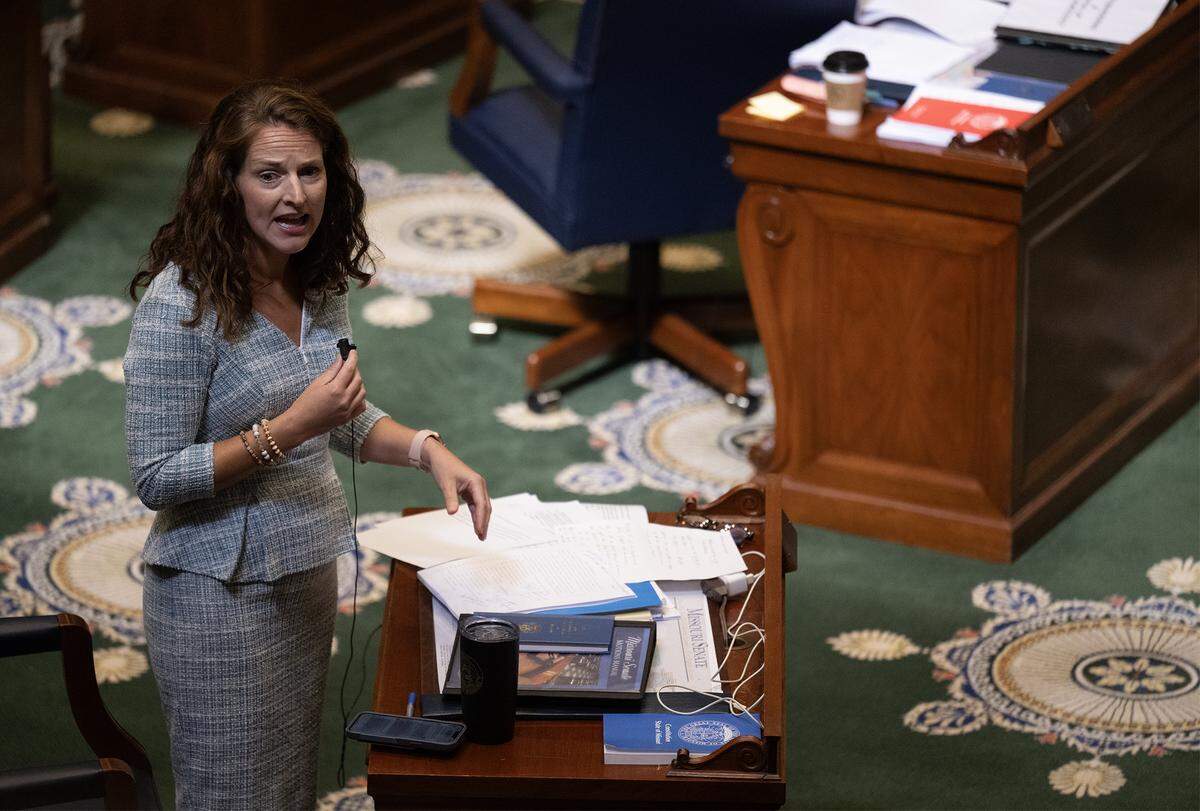
In Hall’s case, that’s Northland Democrat Maggie Nurrenbern. And Nurrenbern isn’t inclined to approve the pick.
“I have a lot of concerns about her record as a member of the City Council,” Nurrenbern told me Monday.
That resistance makes more sense when viewed against how Senate Republicans have governed over the past year. They have repeatedly deployed procedural maneuvers once considered nuclear options, blowing past Democratic filibusters to override the will of Missouri voters.
Paid sick leave was approved, then repealed. Abortion restrictions were rejected, then resurrected. And in the fall, Republicans rushed through early redistricting in a special session, answering a demand from President Donald Trump to give Republicans a better chance of winning House seats in 2026.
Given all that, it’s hard to blame if Nurrenbern and the Senate Democrats wanted to use some leverage now that the Senate is back in session.
Question of independent oversight
A more interesting question is whether Hall, who didn’t get back to me for this column, deserves to be denied her appointment.
Nurrenbern says that someone so closely tied to the Kansas City Police Department cannot credibly provide independent oversight. She’s raised concerns about Hall’s marriage to a retired officer and the overlap between the police board and the police retirement system.
“The decisions she makes on the commission would impact her family’s income,” Nurrenbern said.
That argument seems a bit shaky. The Board of Police Commissioners does not vote on decisions that directly affect the pension benefits of already-retired officers, said KCPD spokesman Phil DiMartino.
“The Board of Police Commissioners does not have the authority to change pension benefit levels, cost-of-living adjustments (COLAs), contribution rates, or payout formulas for Kansas City Police Employees’ Retirement System (KCPERS),” DiMartino wrote in an email to me Tuesday. “Those elements are established in Missouri statute and, where applicable, administered by the KCPERS Retirement Board in accordance with statutory and actuarial requirements. Any material changes to benefit structures would require action by the Missouri General Assembly, not through action by the Police Commissioners.”
More concerning is Hall’s judgment in other matters that would affect Kansas City.
As a councilwoman, Hall voiced opposition to returning local control of the police department to Kansas City. I understand why a Republican from rural Missouri might be comfortable with the state running Kansas City’s police force. I don’t understand how someone who lives here and sat on the City Council for eight years could defend such a backward arrangement.
Nurrenbern said she met with Hall to discuss the position and asked Hall about “her continued stance against local control.”
“I said, you know, ‘What’s the path to getting Kansas City out of state control?’” Nurrenbern said. “And she wasn’t able to give me an answer to that.”
Hall has also previously aligned herself with Republican efforts to destabilize the city’s finances by targeting the 1% earnings tax.
The earnings tax is the backbone of Kansas City’s budget. Kill it and you don’t just blow a hole in City Hall — you blow up funding for the police department itself.
“And to me, that’s just asinine,” Nurrenbern said. “How does she think we will be able to fund public safety without the earnings tax?”
East Side leaders concerned
On Monday afternoon, I stopped by a press conference at the Urban League, where some East Side leaders explained why they support Nurrenbern’s decision.
For decades, they’ve watched the police board function less as a check on power than as a shield for it, all while the communities most affected by policing remain unrepresented.
Urban League CEO Gwen Grant put it plainly. “We who reside east of Troost represent 70 to 80% of the population that has to deal with law enforcement in this community,” she said. “Yet we have no seat on the Board of Police Commissioners. That is shameful.”
I asked the Rev. Dr. Vernon Howard of the Southern Christian Leadership Conference of Greater Kansas City who he’d like to see appointed instead. He didn’t have a specific answer for me, opting for a more rhetorical response.
“That’s the problem,” Howard said. “Nobody is asking us that question. How about some roundtables? Some public meetings? We feel like our voices are not heard.”
But that’s the quiet truth underneath all of this. The system was never designed to listen to Kansas City residents.
Blocking Hall is probably the right call. But it won’t change much. Republicans will nominate someone else — another loyalist, another safe pick — and Kansas City will remain what it has been for generations: a city policed by a department it does not control, overseen by a board it does not choose.
Still, it must be said: After a year in which Missouri Republicans casually bulldozed long-standing Senate norms, there’s a certain civic satisfaction in watching one of them sweat like this.
This story was originally published February 4, 2026 at 5:08 AM with the headline "Self-named ‘police wife’ collides with strange politics of Missouri-run KCPD | Opinion."