
Remember, Josh Hawley voted for that Jan. 6 provision in the reopening bill | Opinion
Chump change
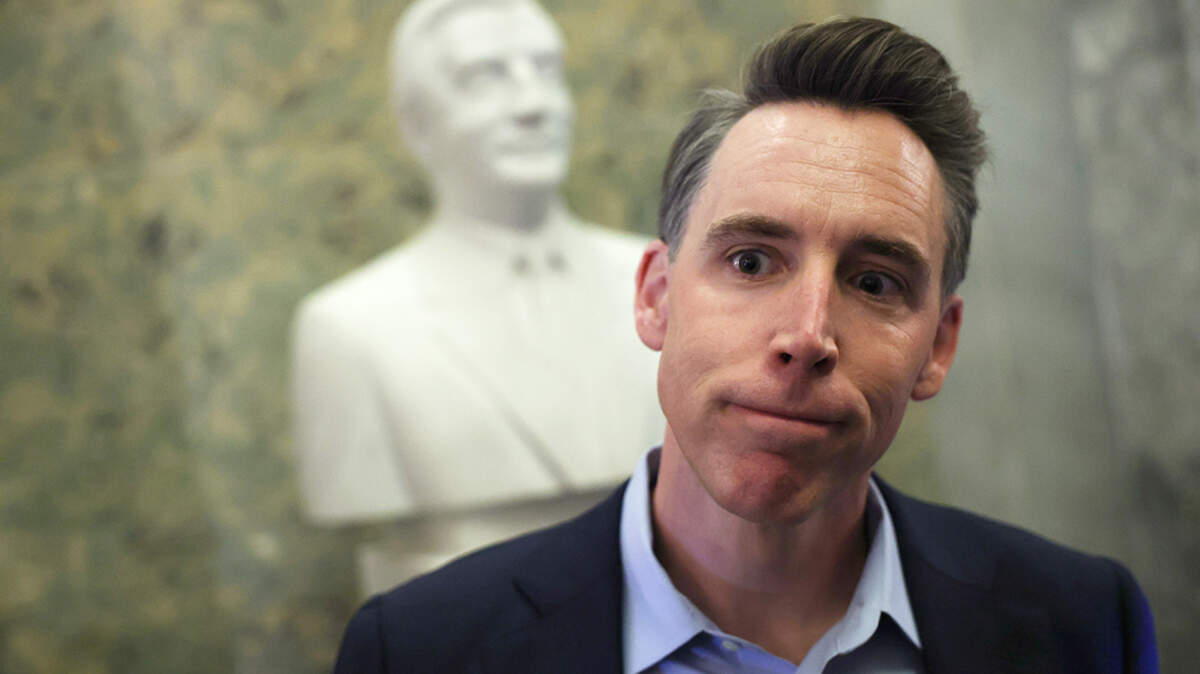
I recently saw that Missouri Sen. Josh Hawley could benefit from a provision to the bill reopening the government. It could give him a minimum $500,000 personal payday for damages because his and seven other GOP senators’ phone records might have been sought in the Department of Justice’s probe of their potential involvement with the Jan. 6, 2021 Capitol insurrection. That could be more money than many of his constituents receive for a lifetime of labor.
Some people may accuse Hawley of stealing, but I’m confident he has the legal skills to draft wording allowing him to pocket the money legally. And while his office told regular Star opinion correspondent Joel Mathis that the senator thought the provision was “a bad idea,” he still voted for the bill, and posted in social media that anyone who sought his phone data “needs to be PROSECUTED.” He has the power to enrich himself. In the words of George Washington Plunkitt of the Tammany Hall political machine, “I seen my opportunities, and I took ‘em.”
The thing that baffles me is why Hawley settled for the short-end money. It would have taken only one or two more keystrokes to make the amount $10 million, even $100 million. But a measly $500,000 per inspection? That seems like chump change.
I’ve seen speculation that Hawley and other senators who made themselves eligible under this retroactive provision actually might not cash in on the opportunity. The absurd theory is that turning down this self-dealing windfall would somehow prove their honesty. After all, they could have taken more.
- Robert Settich, Gladstone
Veterans left out
Kansas likes to say it honors veterans. Its laws even promise it. On paper, Kansas’ veterans preference statute says qualified veterans should get a real hiring edge for public jobs — a fair shot at an interview and a written explanation if we’re passed over.
As an educator, historian, former Kansan and veteran, I’m concerned that promise has been quietly hollowed out.
After a 2007 audit found serious problems, the Legislature supposedly fixed veterans preference in 2008 and created narrow exemptions for a few special positions. A 2011 audit reviewed how that system worked. That was the last time anyone looked statewide.
In 2015, Kansas changed its civil service system so that many jobs could be shifted from the protected “classified” bucket into the more flexible “unclassified” bucket. The veterans preference exemptions were never updated, but many positions can now be labeled “unclassified” by internal decision. On paper, the statute still exists. In practice, the number of jobs where preference truly applies may be shrinking every year.
If Kansas is serious about veterans, the Legislative Post Audit Committee should order a new audit to determine how much damage has been done and what it will take to fix it.
- Andrew E. McGuire, Kansas City
High costs
So Immigration and Customs Enforcement deports Julio Rojas of Olathe. (Nov. 17, 1A, “Deported to El Salvador, KC immigrant describes the violent ordeal: ‘I lost everything’”) He paid taxes, and his job enabled him to support a wife and son by sending money back to El Salvador.
The American taxpayers paid for the officers to arrest him as well as the costs of transportation to four facilities in four states, board and food at those facilities and the flight to San Salvador. What is the cost to his wife and child? He’s back in his home village because he had no criminal charges or history to justify jailing him in El Salvador.
I see no common sense in deporting people who pay taxes and have no criminal charges. How about spending all that money hiring immigration attorneys and judges and give law-abiding taxpayers a path to citizenship?
- Emilee Rose, Kansas City
Magic wand
So a new stadium will fix everything that’s wrong with the Chiefs? Right!
- Dan Norburg, Overland Park
Not just cars
Is Kansas City prioritizing bike lanes over efficient vehicle travel? The simple answer is no. (Letters, Nov. 16, 18A)
I would like to remind readers that bikes are an efficient form of travel that allows Kansas City to better serve the needs of people for whom driving may not be an option. That includes people like me who live with vision issues. It also includes children who are too young to drive, people who have aged out of driving, people who can’t afford to drive and many more.
One-third of Americans do not drive. It might seem we have a robust bike network, but it’s important to put it in context: While Kansas City has more than 6,000 lane miles for drivers, there are about 62 miles for people who bike, scoot or use assistive mobility devices such as wheelchairs. Many of our streets lack sidewalks.
Efficient travel should also mean safer travel, which Kansas City has made a priority in the last few years. Crashes, serious injuries and fatalities cost our city millions of dollars and far too many lives. An efficient system for me offers transportation safety and transportation choice — something that roads, bike lanes, sidewalks and transit come together to provide.
- Shawn Tolivar, Kansas City
Bigger picture
I wonder whether David Mastio’s white male status has color-blinded him to life before discrimination was legally leveled. (Nov. 20, 12A, “In KCK, Trump deserves credit for busting affirmative action as he promised”) To be so dismissive of the importance of affirmative action is naive.
The fact that minority groups have better chances today with jobs, education and business than in the past does not reduce the importance of affirmative action being enacted in the first place. Time and history alone would not have brought us this far without intervention. Lauding Donald Trump for ending it is the epitome of white male racism, gender discrimination and bias.
- Marilyn Schaeffer, Kansas City