
Kansas City doesn’t really own the Plaza — but we do in one important way | Opinion
It’s difficult to overstate the importance of the Country Club Plaza to Kansas City’s identity. From the hours we spend at the shopping district’s annual Christmas lighting ceremonies and late-summer art fairs, many of us count its streets and sidewalks as integral threads of our civic fabric.
We also tend to forget it is, and always has been, a money-making operation. “I think there’s this idea that the Plaza isn’t just property,” Mayor Quinton Lucas told Kansas City PBS, “that it belongs to everyone, that it belongs to this community.”
Only it doesn’t. J.C. Nichols — inarguably the most influential local real estate developer of the 20th century — began “planning for permanence” in the area in the early 1900s with his eye fixed firmly on commerce. By 1923, the first Plaza shops opened for business. Today, it’s generally considered the first specifically-planned outdoor shopping center in the country, with its Spanish-inspired architecture and discreet hidden parking making it more aesthetically pleasing than the hodgepodge that springs up without a careful and specific plan.
“People love the Plaza because of the way it looks and feels,” Kansas City architecture enthusiast Greg Jenkins said in an email to the editorial board. “Seville, Spain, anyone?”
Nichols was a bit ahead of his time with his Plaza vision, strategically creating all that parking to lure shoppers traveling by car — in its early days, it boasted eight service stations, previewing our reality today when most of us are accustomed to driving ourselves everywhere.
In June 2024, the Plaza was purchased for a reported $175.6 million by HP Village Partners, now known as Gillon Property Group. That Dallas-based developer’s owners trace their roots back to Chiefs owner Lamar Hunt’s father. But that family connection doesn’t convince some Kansas Citians, who hated to see ownership move out of town.
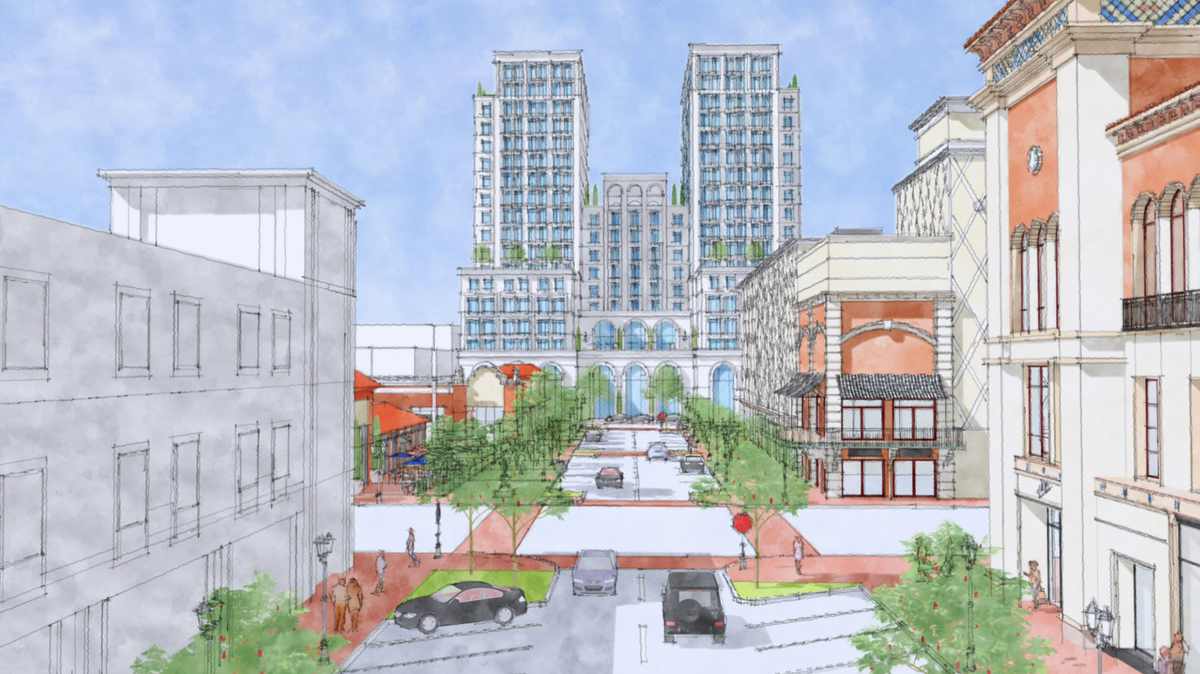
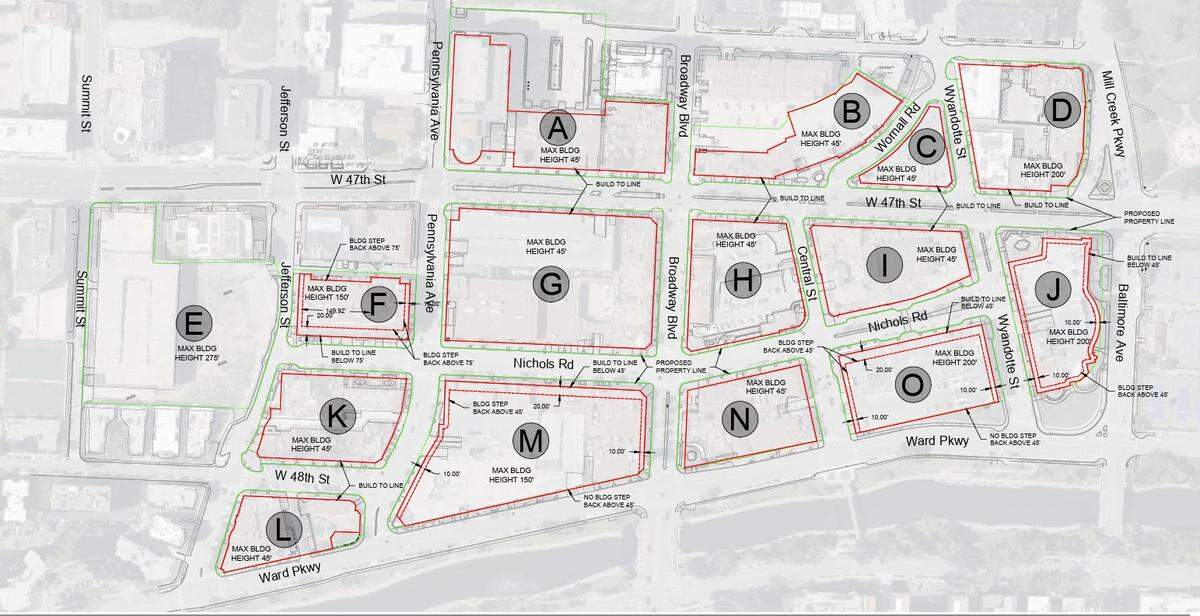
Now Gillon is looking to make some major changes — and looking up. A master development plan the owner filed with the city last month seeks permission to construct new buildings up to 200 feet tall in five areas. That’s in addition to the approval the City Council already gave for a 275-foot structure where the abandoned Nordstrom department store project was meant to be.
The renderings of Gillon’s proposal we’ve seen so far are artful and appealing — but they don’t particularly scream “Plaza” to us.
‘Lots of skepticism’
“As an organization, we certainly want any development to be smart,” said Matt Fuoco, secretary and treasurer of the Plaza Westport Neighborhood Association, a 501(c)(4) nonprofit neighborhood group. “And by that, we mean that it takes into account the historic nature of the Plaza — what it was, what it’s developed into and what it can potentially become. But the caveat to that is that there has to be a solid vision and a plan that’s put before the key stakeholders, and right now, we just have snippets.”
Gillon officials met with residents at a public engagement forum last Monday evening, where they stressed that the plan would require any new buildings to use materials and finishes in keeping with the Plaza’s character.
But attendees expressed “lots of skepticism that they would do anything other than building big towers first,” Fuoco said.
We understand, and encourage, that skepticism, a keystone of our Midwestern sensibilities. In this new gilded age of haves and have-nots, everyone should lean heavily on the second half of that old Russian proverb, “Trust but verify.”
“I know that in general and historically, the Plaza has been considered a luxury shopping district,” said Jonathan Duncan, who represents District 6 on the City Council. “Although in more recent years, I wouldn’t consider an Untuckit or a Bath & Body Works to be luxury shopping. … So my critique and my challenge to all those involved is to be thinking about, how do we ensure that we are providing housing at all levels of the socioeconomic spectrum … to ensure we have affordable housing for the people who are going to be making the Plaza run?”
‘Want to see the Plaza evolve’
We asked Duncan what he’s hearing from his constituents about the Plaza’s future. “It’s a healthy mix,” he said. “I think it’s pretty well divided by generation. Those who remember the Plaza from the ‘80s and before want to keep the Plaza as they remember it. Those who are younger want to see the Plaza evolve.”
Nostalgia can be a heck of a drug. Because while our collective memory might be of when the district was home to upscale stores such as Harzfeld’s and Gucci, we also sometimes overlook that it has boasted a Sears and a bowling alley in its history, in addition to all those gas stations.
That’s a trap many of us fall into, an idealized version of the past that never really was. The Plaza wasn’t a surefire hit from the get-go. Critics called it “Nichols’ Folly,” also the title of a terrific program on Kansas City PBS (streaming for free on kansascitypbs.org — don’t miss it). Internet shopping has so radically changed the face of retail that the days of mom-and-pop shops being able to afford prime storefront rents are increasingly in the rearview. And some critics even dismiss the Plaza’s Spanish architectural filigrees as out-of-place, romantic theatricality.
But even if they’re play-acting, those red roof tiles and ornamental facades are still inextricable parts of our self-image. And if the district’s new owners change its architectural identity too much — too dense, too high, too expensive — they risk turning it into something nobody recognizes anymore. That’s their right. But they might create a new Country Club Plaza that loses Kansas City’s heart, and that would be wrong.