
Josh Hawley and Eric Schmitt are right we’re divided. More fighting won’t fix that | Opinion
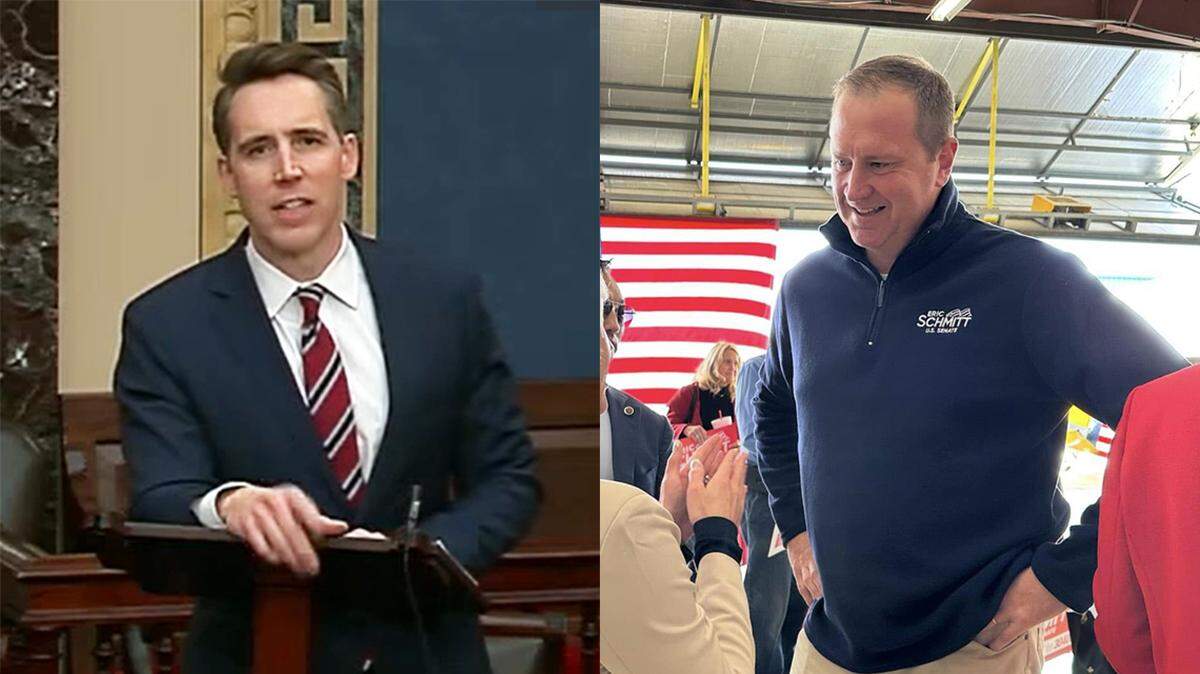
Are America’s foundational values crumbling? Missouri’s U.S. senators both think so.
Josh Hawley and Eric Schmitt, both Republicans, were among the many American conservatives who raised alarms last week about a new Wall Street Journal poll. The survey revealed that since the late 1990s, there has been a steep decline in the percentage of Americans who say that ideals such as religion, patriotism, child-rearing and community involvement are “very important” to them.
“THIS is the greatest challenge our nation faces — the loss of our common culture & the principles & beliefs that bind us together,” Hawley wrote on Twitter.
Schmitt offered a more acerbic take. “The Left embraces Cultural Marxism and despises patriotism, religion, community and merit,” he wrote. “We must reject the Left’s divisive ideology and rally around the American Idea and a renewal.”
Well, wait a second.
While the survey was presented with a headline saying that Americans are “pulling back” from ideals that have defined the American character, we’re not so sure that’s the case. A closer look at the poll reveals some of those old values are still pretty popular.
Ninety-four percent of respondents said hard work is “very” or “somewhat” important. Ninety percent expressed support for the value of tolerance. Seventy percent value marriage, and 65% say that having children is ideal. Seventy-three percent say patriotism is important to them. Two-thirds still value a belief in God.
Getting a majority of Americans to agree on any proposition is pretty tough these days — which makes these numbers extraordinary, even if they’re softer than they once were. We have a lot more in common than we think.
Still, we take the senators’ underlying point: Building a healthy, thriving country does require some element of common purpose and commitment to the future. On any given day, the news headlines are filled with signs that both elements are in short supply across America. There is definitely work to be done.
But a question arises: Are Hawley and Schmitt really up to that task?
We’re skeptical, at least as far as the two culture warriors currently comport themselves.
Why? Because creating that common purpose — and using that foundation for the good of all Americans — is something that must be done together. This country is too big and diverse for one small faction to simply impose its vision on everybody else.
Missouri’s senators aren’t exactly bridge builders. We don’t need to rehash Schmitt’s tired social media tirades about “cultural Marxism” and the “climate cult,” and Hawley’s fist-saluting insurrectionary sympathies have been analyzed to death. Suffice it to say, the pair have done precious little to bring us all together in the service of some bigger “American idea.” Instead, they’ve repeatedly thrown down the gauntlet: You’re with us, or you’re against us.
America too diverse for a single culture
That’s the first problem. The second? The ideal offered by Hawley, Schmitt and many of their fellow Republicans is simply too narrow to fit America’s reality. In Missouri and across the nation, the GOP this year is passing bill after bill attempting to enshrine a conservative notion of the good life — a nostalgic 1950s television version of society that never was reality — by using government to squelch competing visions.
They have passed legislation forcing libraries to take down so-called “explicit” LGBT-themed books, pushed the state’s universities to curtail their diversity initiatives, and are threatening to outlaw medical care for some of Missouri’s most vulnerable young people. The plain intent of all these initiatives is to erase the cultural shifts of the last few decades — to stuff it all back in the closet.
That won’t work. Missouri won’t become whiter or straighter or more religious because a GOP-led government tries to require it. Neither will America. A “common culture” cannot be the same thing as a monoculture.
We should note here that Democrats haven’t always done a great job of building bridges, either. Barack Obama’s 2008 assessment that rural conservatives “cling to guns or religion” was a misguided expression of contempt that still carries a sting. So was Hillary Clinton’s derision of Donald Trump’s supporters as a “basket of deplorables.” Liberals and progressives have helped make the problems we face today.
How then to build that elusive common purpose among Americans?
It is notable that the “decline” observed in the Wall Street Journal poll coincides roughly with the rise of the internet and hundreds of niche-interest cable TV channels as our dominant conduits for media consumption and public discourse — and the corresponding polarization of our politics. We are becoming a nation of lonely people, using our computers and smartphones to yell at each other in all caps while listening mostly to folks who tell us exactly what we already want to hear.
And what many of us want to hear is that we are the good guys. That the other guys are bad. Sometimes that is true. Not nearly as often or as much as we’d like to think, though. For the most part, America’s reality is far more complex.
Would you understand that complexity from the public pronouncements of Sens. Hawley and Schmitt? Do their Twitter feeds make you want to reach out and understand your neighbors a little bit better, or to be kinder or more generous to them?
Maybe not.
An American ideal worthy of the name won’t be constructed on a foundation of relentless divisiveness. Missouri’s senators are exhorting us to a future of shared ideals. They can start by first reexamining how they publicly express their own values.