
Athletes like Patrick Mahomes have a huge voice. They’re right to use it against gun violence
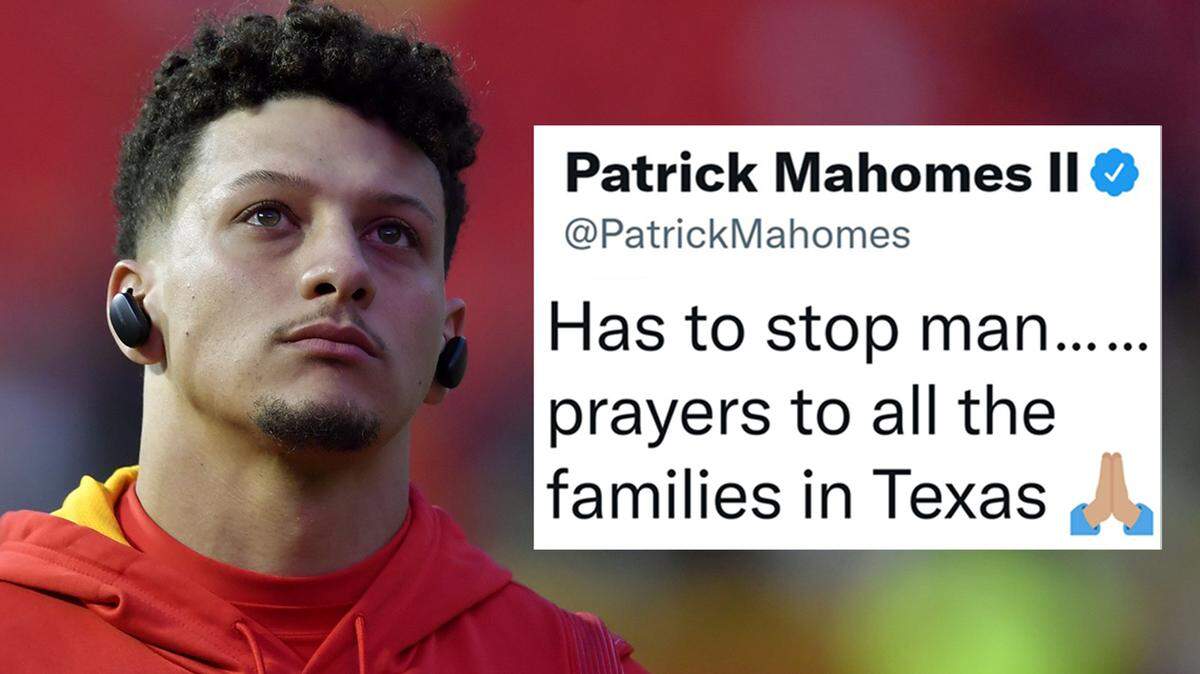
On May 24, as the horrific reports came in from Robb Elementary in Uvalde, Texas, Kansas City Chiefs quarterback Patrick Mahomes posted a comment on Twitter.
“Has to stop man,” he wrote. “Prayers to all the families in Texas.”
In substance, Mahomes’ tweet resembled tens of thousands of others posted that day. In reach, however, it was quite different: More than 73,000 people liked the post, and nearly 5,000 people retweeted it to their followers. Hundreds of thousands of fans saw the quarterback’s reaction.
Mahomes and his colleagues — and athletes in Major League Baseball, pro basketball, soccer and other sports — may sometimes chafe at their presence in the public’s eye. The best known athletes, Mahomes included, can rarely step outside their homes in peace. Fame has a price.
But it has value, too. Athletes can be enormously influential in focusing public attention on issues far beyond the diamond, or the court or the field. And in this hour, in the wake of the massacre that took the lives of 21 people, 19 of them children, that influence, and those voices, are beyond essential.
We must not close our eyes to mindless slaughter. It cannot be business as usual — at school, church, or the ballpark.
Steve Kerr, coach of the NBA’s Golden State Warriors, reacted to the shooting with anguish. “I want every person listening to this to think about your own child or grandchild or mother or father, sister, brother,” he said in a news conference after the shooting. “How would you feel if this happened to you today?”
One million people liked the video, which the team posted.
The New York Yankees and the Tampa Bay Rays used their Twitter feeds to denounce gun violence, and to promise support for groups pushing for reasonable gun rules. San Francisco Giants manager Gabe Kapler said he would not stand for the national anthem “until I feel better about the direction of our country.”
Game announcers discussed the Uvalde calamity. Other athletes tweeted, issued statements, posted videos. “The week when sports would not let America look away,” said a headline in The New York Times.
Some sports fans find all of this objectionable. They booed Colin Kaepernick for kneeling during the anthem. They protested when Black athletes urged reform after the murder of George Floyd in Minneapolis. Shut up and dribble, they said.
They’re wrong.
No one can require any player, or team, to say anything he or she or it does not want to say. The First Amendment protects silence, as well as speech. And, to be clear, athletes typically don’t have any special insight into policy concerns.
But every athlete has free speech rights, just like all Americans. And because of their outsize audience, those rights can often accomplish more than a private citizen can.
“You don’t want to just be able to (say) ‘oh, condolences,’” Mahomes said. “You want to make sure that we’re holding people accountable, that we do whatever the steps are. I don’t know the steps.”
Many players use their positions to raise money for charities, or operate their own charitable foundations. They make the community better. Players for the Chiefs and Royals, and the teams themselves, have good records in this regard. Sporting KC and KC Current, the men’s and women’s professional soccer teams, also promote community involvement. We applaud those efforts.
At this moment, though, more is needed. We support players and coaches and owners who use their platforms to keep the public’s attention locked on the bloodshed in Texas, and the violence that plagues our community, even now. We urge more of them to speak out.
No athlete, alone, can solve the problem of murdered students — no one person can do that. But we simply can’t return to normal. If that means a shortstop, or a linebacker, or a quarterback must keep all of us focused on the crisis, so be it.
This story was originally published June 2, 2022 at 5:00 AM.