
Thanks to U.S. Supreme Court, same-sex marriages are closer in Kansas
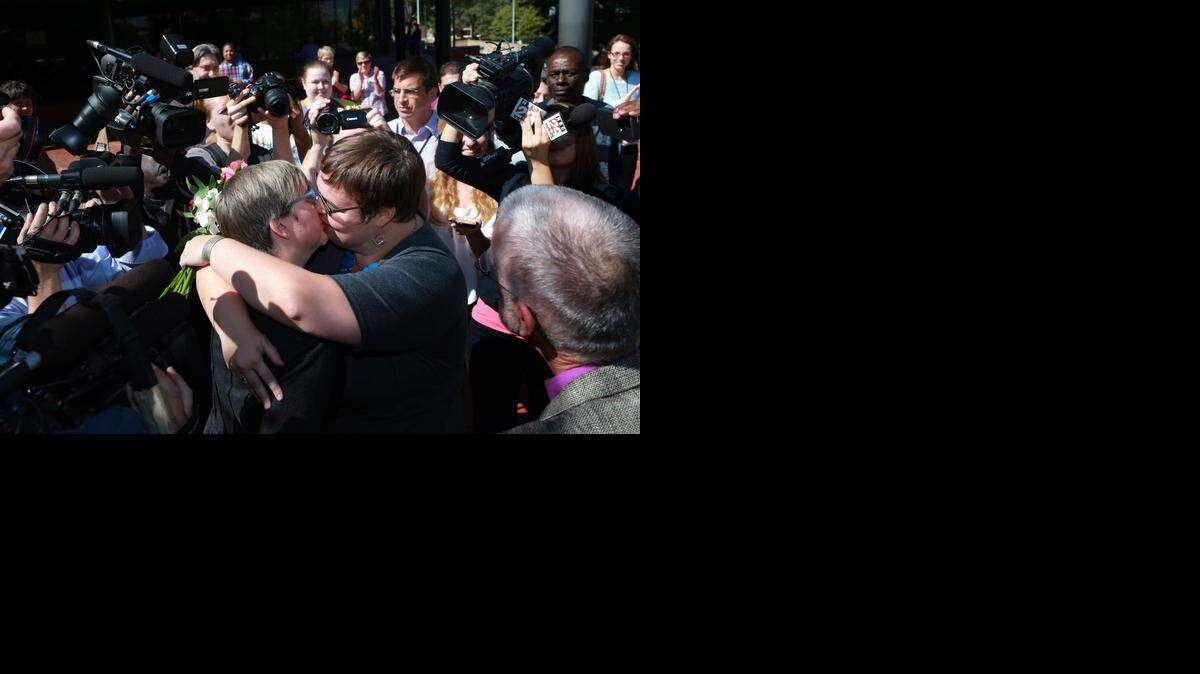
With a deceptively low-key move on Monday, the U.S. Supreme Court opened up an expressway for same-sex marriages, and Kansas becomes one of the potential early stops.
Justices said they would not hear appeals from five states whose same-sex marriage bans had been overturned by courts. The refusal appears to leave Indiana, Oklahoma, Utah, Virginia and Wisconsin with no choice but to allow gay and lesbian couples to marry and enjoy the full privileges of legal unions.
The 10th Circuit Court of Appeals, which overturned gay marriage bans in Oklahoma and Utah, also encompasses Kansas. It is expected that appeals judges will strike down prohibitions in Kansas, as well as Colorado and Wyoming. The American Civil Liberties Union on Monday said it plans to file a lawsuit asking a federal judge to rule the Kansas law unconstitutional.
Missouri’s ban of gay marriages is also being challenged. Jackson County Judge J. Dale Youngs last week delivered an emphatic ruling telling the state it must recognize same-sex marriages made in other states. Laws that purport to do otherwise “are wholly irrational, do not rest upon any reasonable basis, and are purely arbitrary,” Youngs wrote. “If plaintiffs were treated the same as their opposite-sex counterparts with legal out-of-state marriages, their marriages would be recognized in Missouri. They are not.”
Yielding to Youngs’ logic, Missouri Attorney General Chris Koster will not challenge his ruling.
Missouri’s ban is being tested more directly in St. Louis. Mayor Francis Slay and Recorder of Deeds Sharon Carpenter offered City Hall as the location for four same-sex weddings in June as a way to get the issue into court. Koster gave them what they wanted by seeking an injunction to cease further marriages. That should ultimately lead to a definitive ruling on the constitutionality of Missouri’s marriage prohibition.
The U.S. Supreme Court’s non-action Monday is expected to quickly increase the number of states where same-sex marriage is legal from 19 to 24. Once that takes place, the majority of Americans will live in states where gay and lesbian couples can marry legally.
Ultimately, a civil rights issue of this magnitude must be validated by a definitive Supreme Court ruling. So far, the justices have been reluctant to take that on. But while they wait, the nation is swiftly approaching the point where there will be no turning back.