
Royals’ George Brett and a Johnson County ally ramp up Kansas City’s war on ALS
Kansas City Royals legend George Brett looks at the furious development of a COVID-19 vaccine as a possible new battle plan for the war he’s been rallying the troops to for 40 years — against the dreaded disease ALS.
“We’ve all seen what our country can do if we put our mind to it,” Brett told The Star Editorial Board. “I would love to see another Warp Speed event on something like this.”
So would the Kansas City region’s latest enlistee in the struggle — Scott Smith — who’s been unwillingly and tragically drafted into the ALS fight with his diagnosis of amyotrophic lateral sclerosis, also known as Lou Gehrig’s disease. The Lawrence native and Johnson County resident’s terminal illness is made all the more shocking by his relatively young age of 39. And it’s made ironic by the fact that he’s a health nut, a former Truman State football and wrestling athlete and now a personal trainer. His brother calls it a sick karmic joke.
ALS, after all, is a progressive muscle-wasting disease with no cure. Half of those diagnosed die within three to five years.
“I work on the human body. It’s my specialty,” said Smith, owner of BodySmith Personal Training in Kansas City. “Exercise and playing sports is just such a part of me. It’s what makes me happy. So, it is kind of my worst nightmare come to life.”
It’s all the more nightmarish because of Smith’s status as a husband of just three years and father to both an 18-month-old girl and another due in April. And the thing is, it could happen to anyone: While some ALS is inherited, 90% of the time no one else in the family has it.
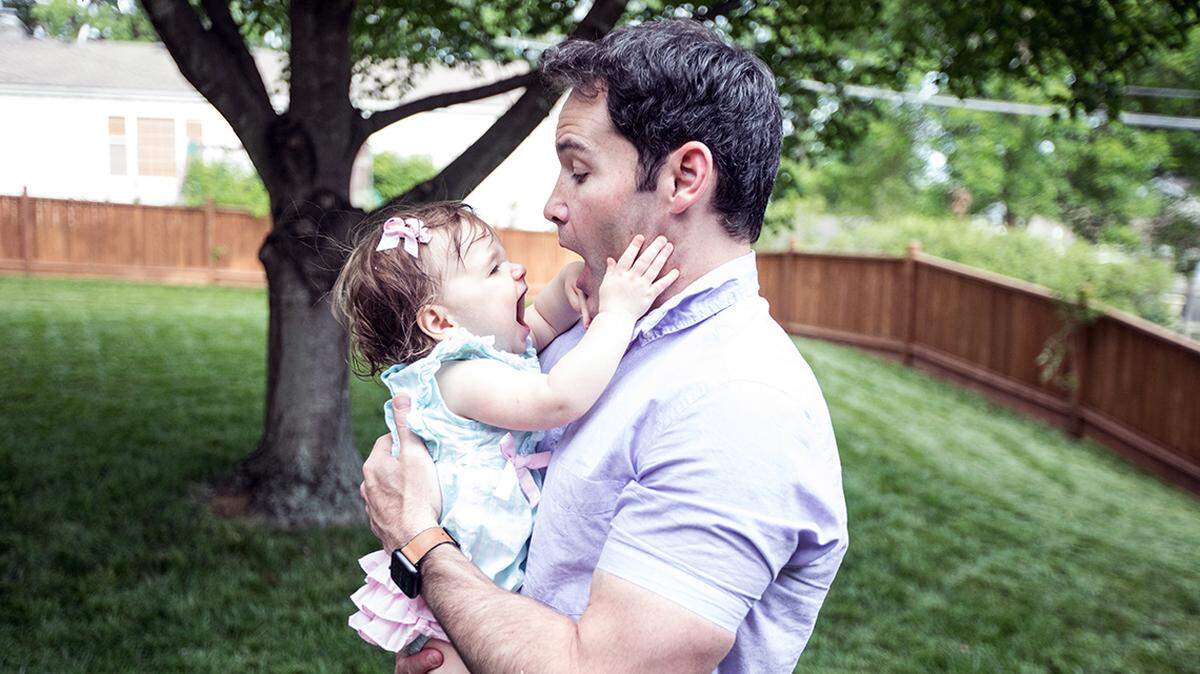
Smith first noticed unusual stuttering and slurring while training clients this summer — an oddity he chalked up to speaking through a coronavirus mask. But then he lost his ability to sing to his daughter, another curiosity for someone who’d recorded and toured with a band in St. Louis out of college. He thought maybe he’d simply overtaxed his vocal cords.
But then came the upper-body muscle twitching, trouble swallowing and finally, in one medical consultation, the signature hyper-reflexivity on one side of his body.
“I went out to the parking lot and got on my phone and Googled what that meant,” Smith said. “And it pretty much said that was a sure-fire sign that you have motor-neuron disease.” The University of Kansas Health System, which is on the front lines of the ALS fight, confirmed the finding, as did the Mayo Clinic.
Of course, no serious illness is ever contained to the patient alone, and the implications of Smith’s dire prognosis spread instantly.
“When he was diagnosed, I knew I had to be strong for Scott,” said his wife Jamie, a respiratory therapist in the emergency department at Children’s Mercy Hospital Kansas in Overland Park. “But at the same time, my world was falling apart, you know?” For a few days, she said, Iris had to stay with her grandparents. “We couldn’t even be around our daughter. We would just look at her and cry. This was not the life that we wanted for her.
“No family deserves to go through this. No one deserves to go through this. I wouldn’t wish this on my worst enemy. It’s just a horrible feeling of hopelessness.”
It’s a feeling exacerbated by seemingly small things, such as seeing a smoker in the next car and realizing he or she will outlive you, even after your assiduously healthy lifestyle and your many sacrifices for a better future.
Guided by Keith Worthington’s example
And yet, Smith’s peril lends this season of hope and redemption special resonance.
“Life is just such a gift,” he said. “When you’re diagnosed with a terminal illness, you gain perspective, I just think people should know that nothing in life is guaranteed. Don’t take anything for granted. And just know that somewhere out there, there’s a guy that would give anything — anything, all his money, all his possessions — to not have this dark cloud hanging over his head threatening to take away everything he loves. Be grateful for everything you have.”
Their unavoidable despair, while ever running in the background, has been overshadowed by the Smiths’ quick pivot to fighting the disease — not just for Scott’s sake, but for those who follow. It’s the same spirit exhibited by Keith Worthington, the Kansas City clothier who befriended a young George Brett in the 1970s and who later succumbed to ALS, but not before conscripting Brett into carrying on the battle.
Brett understands the misery and melancholy of the disease well, having involved himself in innumerable affected lives during four decades of golf fundraisers to fight ALS — joined in the effort by Kansas City golfing great Tom Watson. But Brett also knows how tenacious patients can be, and he was quite taken with Smith’s upbeat nature after the two met over a beer and joined forces last week.
“He was living a great life, the perfect life,” Brett said, noting the weight of this disease. “Everybody’s just heartbroken at what it does. Now you’ve got to man up. And he’s manned up. And I’m proud of him. The guy’s just a stud. People that have ALS don’t give up.”
Helped along by friends such as Katie Keys who are providing the Smith family meals and a GoFundMe campaign that has already raised more than $75,000 — and only weeks after absorbing his own devastating news — Smith said, “We’re kind of transitioning into advocates.”
“If we can prevent another person from having to go through this hell, then we’ll do it,” Jamie added.
Next: Congress, a new ‘Ice Bucket Challenge’
So, what’s the plan?
First, legislation. Congress only recently passed a bill to eliminate the insane five-month waiting period for ALS patients to begin drawing Social Security disability benefits. And with just two FDA-approved drugs to slow the disease’s progression only slightly, two other freshly introduced bills would expand access to, and insurance coverage for, investigational drugs. Kansas Rep. Sharice Davids is already on board, as every member of Congress should be. It’s indefensible to deny terminally ill Americans the right to try anything legitimate that might help.
In addition, Brett is also working to devise the next “Ice Bucket Challenge” concept that goes viral and raises millions for ALS. His idea: Change for ALS, in which folks are challenged to save their loose change during the year and convert it to ALS research and patient aid. Look for it next year in Kansas City stores and Major League Baseball clubhouses near you.
“I really believe when and if they find a cure for ALS that Kansas City should be really, really proud of itself for the support that they’ve made over the years,” Brett said. “Kansas City’s been at the forefront of this. It would be another Super Bowl champion, or a World Series championship for this city. It really would be.
“I have a lot of free time. I don’t have to go out and face Nolan Ryan every fifth day. I want to help find a cure for this disease.”
So should the nation. At warp speed.