
Let cameras into the U.S. Supreme Court for the gay marriage case
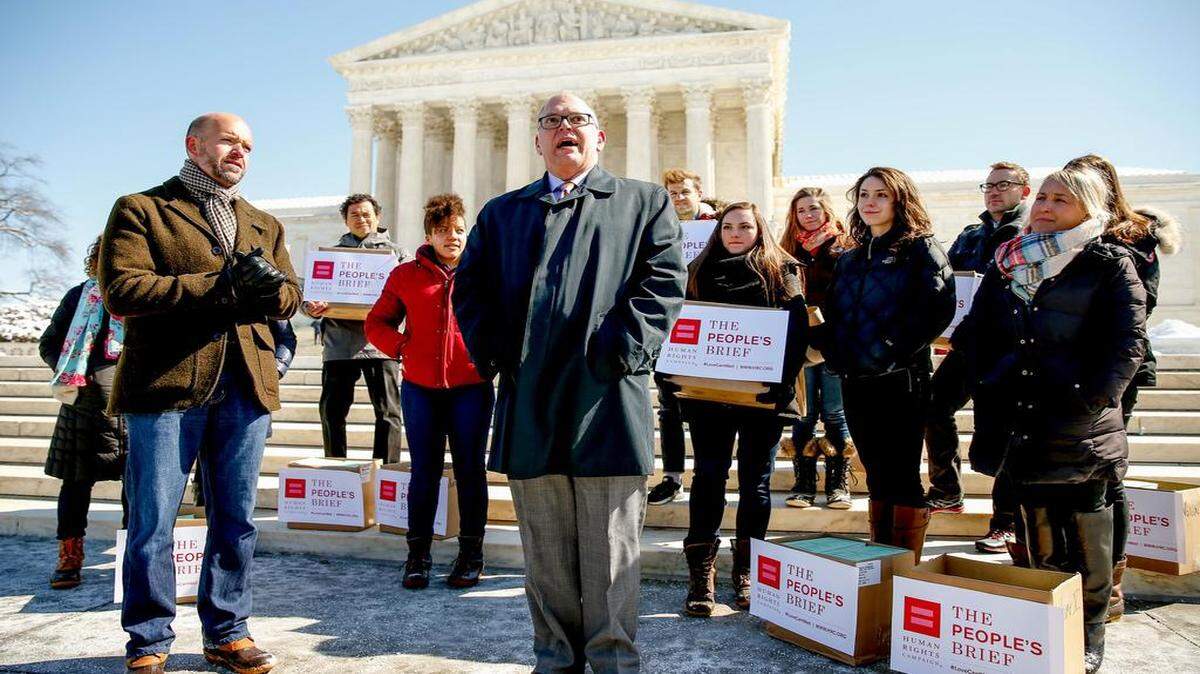
On Tuesday, the U.S. Supreme Court will hear oral arguments in the much anticipated case to decide if the Constitution grants same-sex couples the right to marry. Many Americans, wherever they fall on the issue, might have more than a passing interest in watching the hearing.
Well, they’re out of luck. The Supreme Court clings to an outdated ban on cameras. So much for transparency and open democracy.
Technically, transparency exists at the court; anyone may attend a hearing. In practice, only a few lucky or wealthy people get to watch. The court reserves most of the few hundred seats for staff, guests of the justices, lawyers and the media. The remaining ones go to people who stand in line for days or who pay someone hundreds or thousands of dollars to stand in line for them. (In Washington, there’s a closet industry of line-standers.)
The rest of us have to settle for a transcript, an audio recording and second-hand accounts. At least the court will release audio of the same-sex marriage case later the same day. Usually the public has to wait until the end of the week.
But audio isn’t as good as video. Nonverbal communication matters. When justices roll their eyes, it means something. When a lawyer sweats profusely at a particular line of questioning, that means something, too. Those visual cues are lost without video.
Anyone who doubts the value of video need look no further than recent police shootings. In Ferguson, Mo., without a video recording, what really happened remains disputed. In South Carolina, footage of an officer shooting a suspect left little room for debate.
Filming the court need not become a media circus with cameras in everyone’s face and color commentators. Two fixed cameras broadcasting the justices and the attorneys would be a minimum, but enough. Think C-SPAN, not ESPN.
The justices cite tradition. However, good government should triumph over arbitrary, antiquated inertia.
They also worry that lawyers would grandstand. Cameras sometimes do encourage strange behavior, but in the tightly controlled setting of the Supreme Court, a lawyer likely wouldn’t risk losing a case just to show off.
Indeed, all 50 state supreme courts allow some cameras, and the Ninth Circuit Court of Appeals permits them. None has reported significant problems.
Some opponents rightly note that court arguments often are arcane, but they reach the wrong conclusion. Difficult is not an excuse for exclusion. Instead, it’s an opportunity for education. Video recordings also would provide a precious historical record.
Yet the nine justices of the court have not budged. During their confirmation hearings, Justices Elena Kagan and Sonya Sotomayor said they were open to allowing cameras. They changed their tune after they donned their robes.
Congress could intervene, but it has refused to do so.
The legal arguments on Tuesday in Obergefell v. Hodges will set the framework for what could be a landmark civil rights decision. Scholars might someday might set the court’s ruling on par with Brown v. Board of Education or the Dred Scott decision.
Americans deserve a chance to see that history unfold.
This story was originally published April 26, 2015 at 10:00 AM.