
A great welcome back for the Nichols memorial, Kansas City’s most famous of fountains
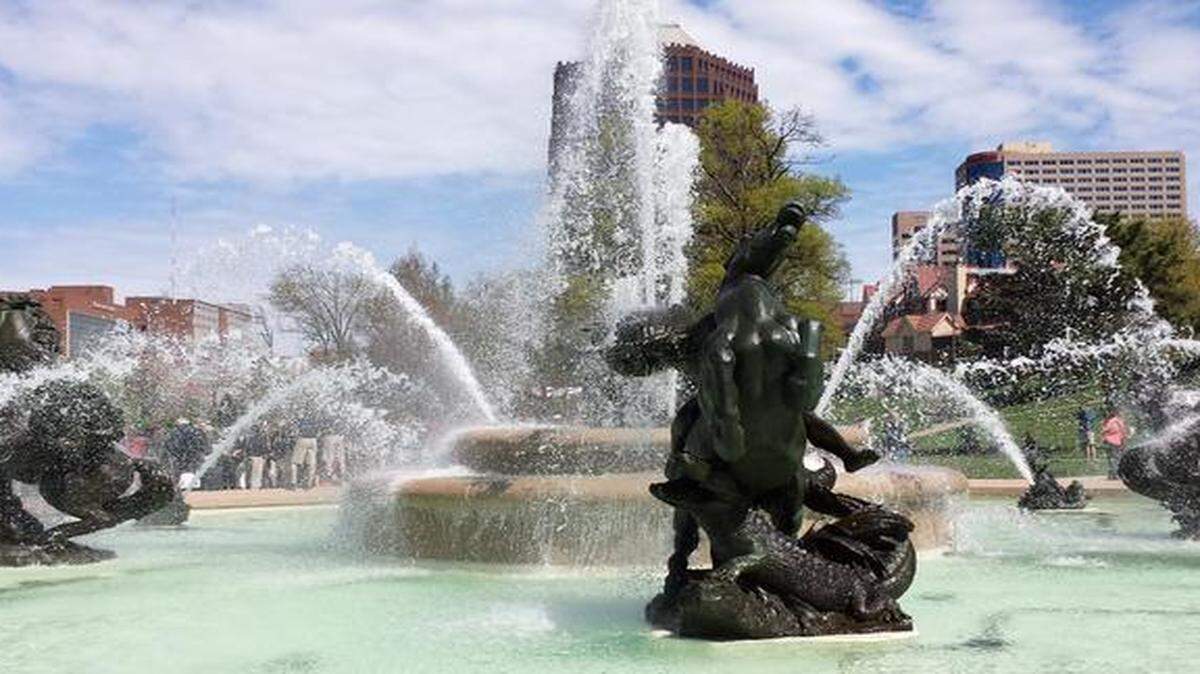
Sunshine, civic leaders and school musical groups Tuesday greeted the return of the J.C. Nichols Memorial Fountain, Kansas City’s most iconic public place of water-spouted art.
The beautifully restored bronze grouping of heroic figures on horseback and dolphin-riding children had spent recent months with conservators, and the city’s Parks and Recreation Department chose the annual Fountain Day to celebrate the preservation and turn the water back on. The east entrance of the Country Club Plaza, at J.C. Nichols Parkway and Emanuel Cleaver II Boulevard, also now boasts the newly refurbished Seville Light Fountain.
None of this restoration work is cheap, and speakers at Tuesday’s ceremony heaped well-deserved praise on the private donors and businesses that made this and future restoration work possible. The nonprofit City of Fountains Foundation is in the midst of raising $3.5 million to restore and maintain nine of 48 city-owned fountains deemed to be in most need of attention. The city’s budget contribution so far for major maintenance has been minimal, despite Kansas City’s long-cherished identity as a fountain capital.
In the case of the Nichols Fountain, Nichols family foundations put up most of the $350,000 tab. Grundfos, Taggart Objects Conservation, Water’s Edge and the J.E. Dunn Co. were among those who contributed materials, labor and services.
“It couldn’t be nicer,” said Jeannette Nichols as she sat in the sun, looking at the gleaming bronzes before the ceremony. Her late husband, Miller Nichols, succeeded his father, J.C. Nichols, as the head of the family real estate company. The Nichols Fountain was installed in 1960 to honor the memory of the pioneering real estate developer. The original fountain was made by a French sculptor in 1910 for a wealthy New York family, who later lost everything after the stock market crash of 1929.
The fountain has a new feature, or rather an old one brought back to the fold. The long-lost “fourth dolphin” came to the city when a descendant of a later owner of the piece discovered its connection to the Nichols fountain. That was in 2008. The dolphin group is now back in the pool, and the Italian-made replica, installed in 1960, stands on a nearby plinth with a placard that tells the story.
The event Tuesday also brought the welcome news that a contract had been signed to fix and revive the long dormant Volker Fountain, at the south end of Theis Park. The work will include installation of a new clean-water circulation system, meant to avoid the clogs and breakdowns that accompanied the previous use of water from Brush Creek.
Fountains justifiably contribute to Kansas City’s collective self-esteem. As visual entertainment, as backdrop for meditation and wedding photos, as gathering places for urban conversation and daily serendipity our fountain assets are civic necessities. Caretakers such as the City of Fountains Foundation, established more than 40 years ago, and their public and private partners should be thanked profusely for these efforts.
As the mesmerizing anchor of Mill Creek Park, the refreshed Nichols Fountain will stand for many more years, attracting locals and visitors and their never-ending cameras.
Kay Callison, of the Nichols family, underlined the special place this fountain occupies in the city’s image: “There’s only one of these in the world.”
It’s easy to dismiss the overused promotion of the city as one with “more fountains than Rome.” But on a gloriously balmy morning when the streams of water are spraying and the inherent energy and magic of the Nichols Fountain sculptures are dancing in your head, it might as well be true.
This story was originally published April 14, 2015 at 4:29 PM.