
Kansas, Missouri senators help Trump remake US courts even during shutdown | Opinion
Now that the longest federal government shutdown in America’s nearly 250-year existence has concluded, there will be ample time to dissect precisely why the shuttering commenced, was allowed to persist for an extensive period and why it halted. Essential to identifying exactly what occurred will be designating the specific constituents that actually comprised the shutdown. An instructive example is the U.S. Senate Republican majority’s decision to continue systematically appointing numerous conservative federal judges, because this effort affords valuable insights about the recent shuttering.
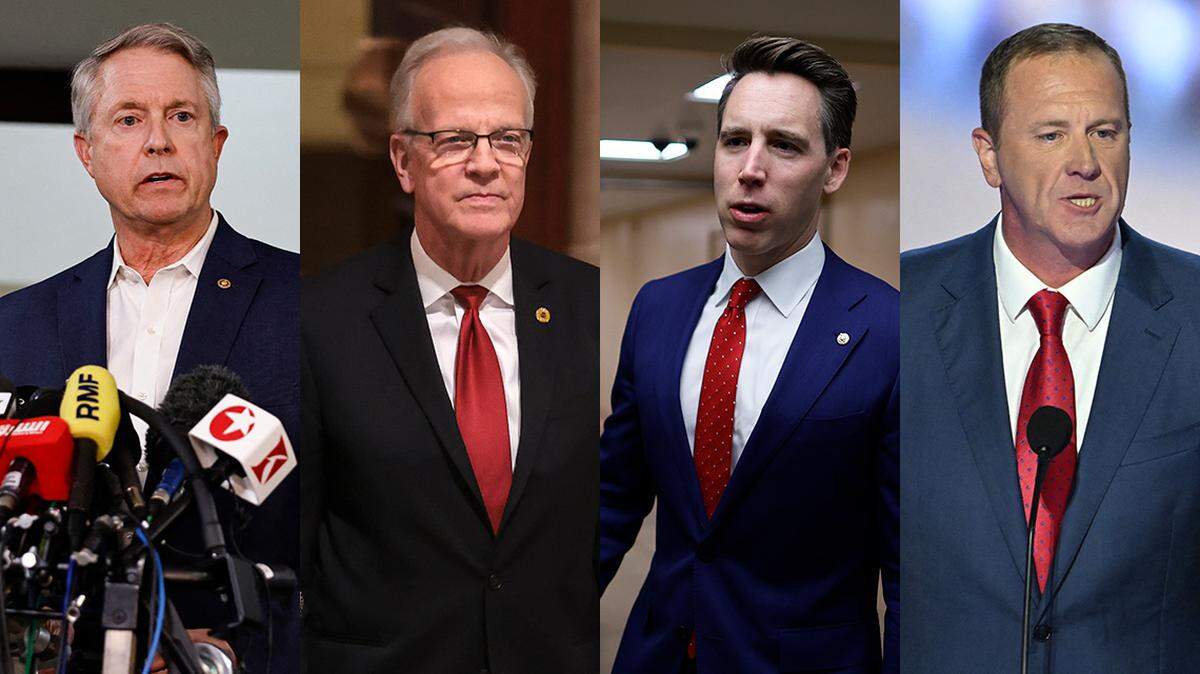
Kansas GOP Sens. Jerry Moran and Roger Marshall seemingly assumed relatively different approaches from Missouri’s Republican Sens. Roy Blunt, Josh Hawley and Eric Schmitt when addressing federal judicial selection during the administration of President Joe Biden. The Missouri senators appeared to minimally engage with the White House, partly because Blunt was retiring in 2022, while Hawley and Schmitt were seemingly hoping to fill the four district vacancies that arose with nominees whom a Republican president could nominate and confirm in cooperation with the senators.
The Missouri senators’ approach proved successful when Donald Trump regained the presidency in 2024, and Hawley and Schmitt worked closely with Trump to recommend four well-qualified, extremely conservative candidates — Josh Divine, Cristian Stevens, Zack Bluestone, and Maria Lanahan — who rather smoothly won confirmation on party-line votes.
In comparison, the Kansas senators seemed to communicate minimally with Biden about filling their state’s three district openings, which remain empty, although Moran and Marshall did appear to coordinate with Biden in filling a Kansas 10th Circuit vacancy with highly qualified, mainstream nominee Richard Frederico, who had served as a military lawyer and federal public defender.
Josh Hawley’s wife a potential nominee
The Missouri senators should continue cooperating with Trump to fill a Missouri 8th Circuit opening, which recently materialized when long-serving Judge Duane Benton announced his intention to assume senior status, and to fill a Western District vacancy when Judge Douglas Harpool recently announced that he too would assume senior status. Legal press outlets have reported that several well-qualified people are included on a list of candidates whom the White House is interviewing for the 8th Circuit opening, which could be filled soon. They include Erin Hawley, who is the wife of Sen. Hawley; Eastern District Judge Sarah Pitlyk, whom Trump appointed in December 2019; Jesus Osete, who is the principal deputy assistant attorney general for the U.S. Department of Justice Civil Rights Division; and District Judge Cristian Stevens, whom the Senate confirmed in July.
On Dec. 1, Trump nominated Megan Benton for the Harpool district vacancy. The Kansas senators should also coordinate with Trump to nominate and confirm excellent, moderate candidates for the state’s three district empty posts.
On Oct. 1, the federal government started what became its most protracted shutdown. Despite widespread public misperceptions that the entire government was completely shuttered, particular sectors of that government have in fact remained open, and some actively conducted America’s business as usual. The Senate provides a trenchant illustration. The world’s greatest deliberative body systematically discharged numerous important upper chamber responsibilities during the shutdown. These duties include supplying advice and consent respecting individuals whom Trump nominates to fill the many empty seats that materialize when the 856 active circuit and district court judges choose to assume senior status, fully retire or die.
When the government eclipsed the significant milestone of the most prolonged shutdown, precisely what the Senate accomplished by filling the circuit and district court vacancies merits analysis. From Oct. 1 to Nov. 12, the Senate confirmed four judges to the appellate courts across the country, which are effectively the courts of last resort for the states that comprise them in 99% of appeals, because the Supreme Court Justices comprehensively review fewer than 100 requests to overturn lower courts’ decisions annually. The Senate also confirmed seven district court judges, who find the facts and compile the record for appellate courts in a substantial percentage of cases, while they are the only jurists most federal court litigants encounter.
Many appointees lack diverse experience, independence
Numerous Trump appointees possess extremely conservative ideological views, evince more loyalty to the president than the Constitution and lack diverse experience, independence, ethnicity, gender and sexual orientation. When the Senate confirms nominees, they serve for life and resolve myriad cases that involve life, liberty, property and other vaunted constitutional and civil rights. Illustrative are the perspectives in which 1st Circuit nominee Joshua Dunlap and 9th Circuit nominee Eric Tung — whom the Senate confirmed in November — expressed opinions about critical questions, including abortion, executive power and same-sex marriage.
The Senate Judiciary Committee was also busy processing nominees over the 43-day period when much of the federal government remained closed. The panel convened one hearing in which two district nominees testified and four sessions in which members deliberated on and voted to approve Dunlap and Tung, as well as six district nominees the Senate then confirmed.
In sum, Americans should remember that Trump and the GOP Senate majority assiduously nominated, evaluated and confirmed many appellate and district court jurists who lack valuable diversity attributes during the shutdown. However, the Senate confirmed the four Missouri district nominees before the shutdown began. Republicans assertively engaged in the selection process and confirmed very conservative, life-tenured judges, even while millions of Americans were literally and figuratively starving, because Trump and Congress deprived these individuals of government benefits — namely employment and food assistance, to which they are entitled.
Kansas and Missouri’s senators must work with Trump and their colleagues to fill the vacancies that remain with highly qualified, mainstream judges.
Carl Tobias is the Williams Chair in Law at the University of Richmond in Richmond, Virginia.
This story was originally published December 9, 2025 at 5:02 AM.