
As a conservative watchdog, I’ve never seen such abuse of power in Missouri | Opinion
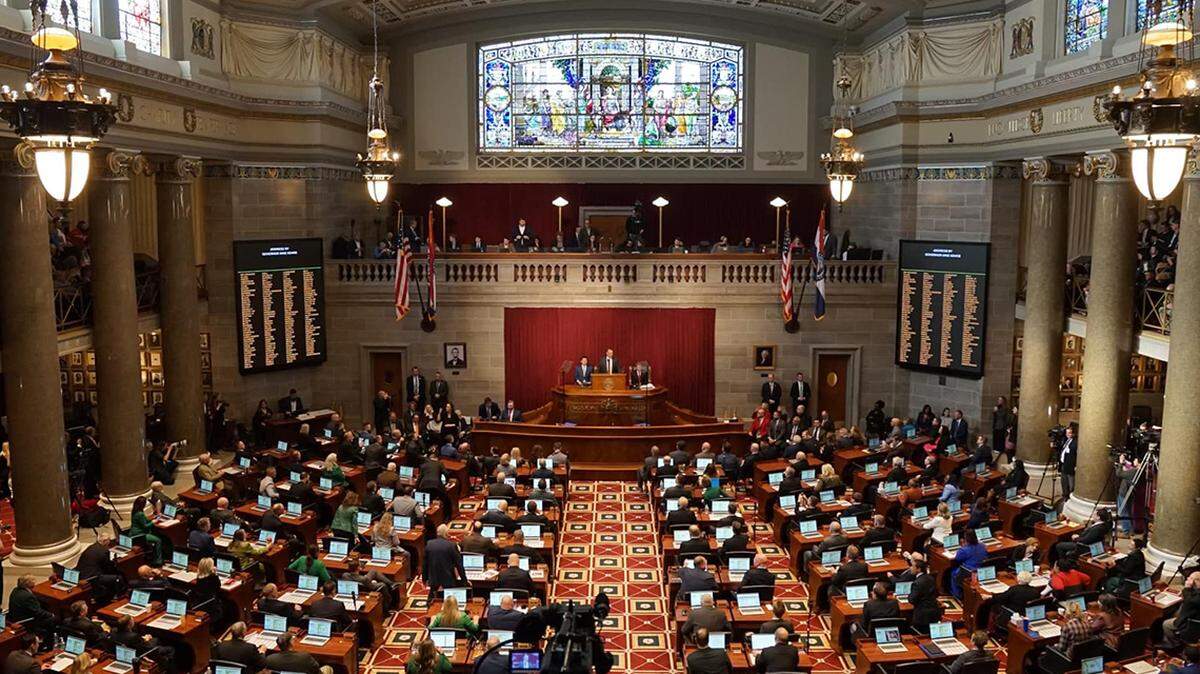
For nearly three decades, I have been a volunteer constitutional conservative, small government, free market watchdog at the Missouri State Capitol — and in all that time, I have never seen the level of abuse of power I witnessed during the two special sessions the governor called this summer.
This month, the Missouri Senate rammed two monumental and controversial bills through without allowing an opportunity for any real deliberation. No amendments were allowed from either party in committee or in the chamber, and for changes to the initiative petition process, not a single minute of discussion or debate was allowed on the Senate floor.
Normal rules were suspended, and it was made clear by Republican leadership that party members had better toe the line. One of only two state senators to buck the party line was punished immediately after he voted no.
That all happened in the Second Extraordinary Session of 2025.
Before that, Gov. Mike Kehoe called the legislature together in June to pass legislation that would provide public subsidies to build privately owned facilities (such as headquarters and training facilities) for the Kansas City Chiefs and Royals, in spite of constitutional prohibitions of a “grant of public money” to “any private person, association or corporation.”
State Sen. Mike Moon, state Rep. Bryant Wolfin and I are suing to get that bill struck down by the courts. (See: Moon v. State, case number 25AC-CC05910)
That subsidy bill may cost Missouri taxpayers more than $1 billion if the courts let it stand.
That’s a lot of money, but it pales in comparison to what the politicians are attempting to do with the second session the governor called in September. The second session is an attempt to grow government and party power like never before in Missouri history.
The two pieces of legislation would concentrate power in the hands of a ruling class, in total contradiction to our nation’s and our state’s founding principles.
Founders fought consolidation of power
Understand this: Men like Thomas Jefferson, James Madison, George Washington, Patrick Henry and Thomas Paine disdained oligarchy. The war they fought was against the oligarchical rule of King George and a parliament that was unconstrained by a written constitution. Through policies of mercantilism (we call it crony capitalism or corporatism today), the favorites of the king were granted largess at the expense of the peoples’ lives and liberty.
Yes, much like subsidies for private sports franchises.
The founders’ solution to oligarchy was a constitutional republic in which “all political power is vested in and derived from the people,” in the words of the Missouri Constitution, and government that exists at the “consent of the governed.”
The hallmark of the Founding Fathers’ vision is a system that prevents the concentration of political power. Separate jurisdictions for federal and state government, three distinct branches of government and a bicameral legislature, distributed power and constitutionally proscribed checks on power were designed to prevent oligarchy.
The people, themselves, also had a check: They could vote the bums out if they saw public officials abusing power.
By the turn of the 20th century, the people in about half the states decided that voting was not an adequate check on government power. Like today, the party machines and big money interests could buy elections. So the people of those states amended their constitutions to allow themselves, independent of the government, to repeal laws they thought were oppressive by referendum, or to build taller fences around the power of government with constitutional amendments proposed by initiative petition.
Politicians weakening the initiative petition process effectively takes that check away from the people of Missouri. It virtually guts the initiative petition check on government power.
It makes it virtually impossible for citizen proposed amendments to be approved, but allows the General Assembly — which is unduly influenced by contract lobbyists and deep pocket special interests — to propose amendments that can be approved with support from just the urban centers of the state, leaving most of rural Missouri with little voice.
In the same extraordinary session, our esteemed so-called “representatives” in Jefferson City passed a gerrymandered congressional district map that I believe was without constitutional authority. The new map effectively disenfranchises both urban and rural voters by lumping together Kansas City and a swath of rural counties as far east as Maries County, north of Rolla.
That map does not result in districts that are “as compact … as may be,” as required by Article III, Section 45 of the Missouri Constitution.
Like the gutting of the initiative petition process, the gerrymandered map is designed to be oligarchical concentration of power in the hands of the current ruling class. That happens to be Republicans now — but rest assured, Democrats are taking notes and will do the same once they are in power again.
Missouri politicians have once again proven Lord Acton’s maxim: “Power tends to corrupt and absolute power corrupts absolutely.”
Ron Calzone is an entrepreneur and one of the founding directors of Missouri First Inc., a think tank devoted to public policy that promotes individual liberty, limited constitutional government and free market principles. He is also president of the Article 3 Institute, Inc., a 501(c)(4) nonprofit dedicated to educating the public and public officials about the limits the Missouri Constitution imposes on the power of the Missouri General Assembly and enforcing those limits through litigation. This commentary originally appeared in the nonprofit Missouri Independent.